
Nobody warns you about this when you buy a kitchen chimney. You set it up, it works beautifully for the first month, and then slowly, without you really noticing, it starts struggling. The smoke lingers a little longer. The kitchen feels a bit stuffier. And one day you look up at the filter and realise it’s coated in a thick, amber-brown layer of grease that could probably double as cooking oil.
That happened to me. I went nearly two months without cleaning the baffle filter because nobody told me I needed to do it that often. By the time I finally took it out, the grease had hardened into something I needed a screwdriver and a bucket of patience to deal with.
Here’s the reality: kitchen chimney cleaning is not optional. If you’re still choosing a chimney, start with our Complete Kitchen Chimney Buying Guide for Indian homes first. It’s not a once-a-year thing either. For Indian households cooking daily meals with frying, tadka, and pressure cooking, the chimney filter needs attention every 15 to 20 days. Skip it, and your chimney suction power drops fast: sometimes by 30 to 50% within two months.
The good news is that chimney maintenance at home is genuinely easy once you know the steps. No special tools. No service call needed for most of it. Just warm water, dish soap, and about 30 minutes of your time.
This guide covers everything: how to clean each kitchen chimney filter type, how to handle the oil tray, when to replace a carbon filter, how to wipe down the body without damaging the finish, and a realistic maintenance schedule for Indian cooking households. By the end, you’ll know exactly what to do and how often to do it.
Why Regular Kitchen Chimney Cleaning Matters More Than You Think
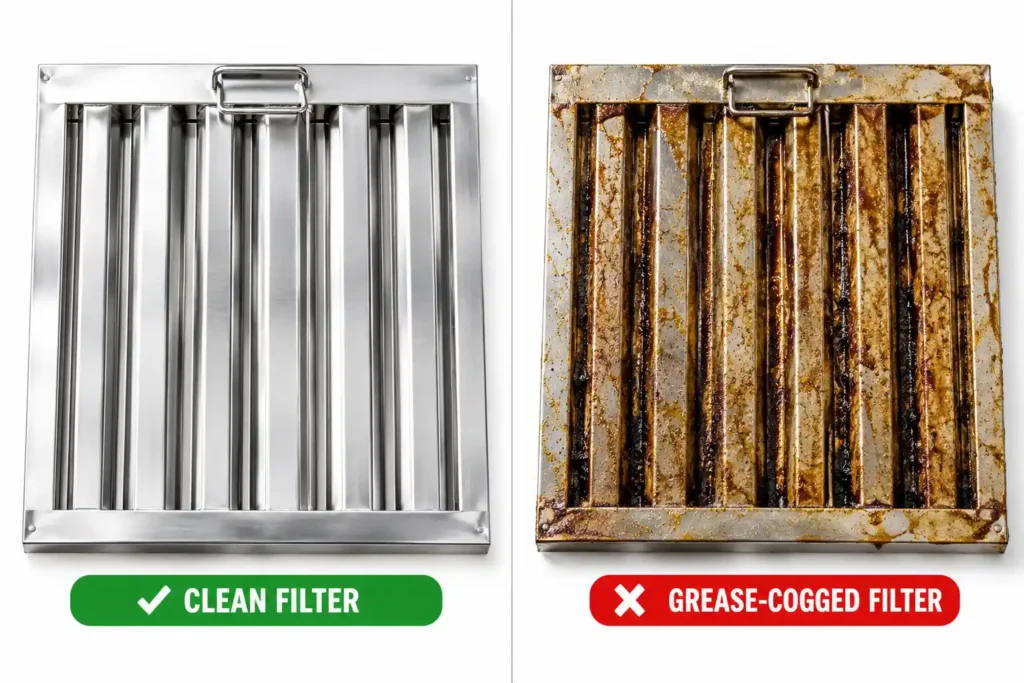
Most people clean their kitchen chimney when it stops working well. By that point, they’ve already lost weeks of proper suction and let grease harden to a point where cleaning takes twice as long.
Getting ahead of it is far easier.
What Happens When You Don’t Clean the Chimney Filter
Suction drops fast. A baffle filter loaded with grease creates resistance that the motor has to fight. Within 3 to 4 weeks of heavy Indian cooking without cleaning, suction can drop by 20 to 30%. Within 2 months, up to 50%. Our Suction Power Guide explains the full numbers.
Grease becomes a fire risk. Accumulated grease inside a kitchen chimney is flammable. It doesn’t burst into flame under normal conditions, but if oil ever ignites on the hob and flame travels upward, a grease-loaded chimney is genuinely dangerous. This is not an exaggeration. Grease-related fires are a leading cause of home cooking fires, according to FEMA’s Cooking Fire Safety guidance, which is part of why regular filter cleaning is not optional.
Odours return. When filters are saturated, they stop absorbing cooking smells and start releasing the old ones back into the kitchen. Your kitchen starts smelling like a week’s worth of cooking all at once. This is more than a comfort issue too, unfiltered cooking smoke is a documented contributor to indoor air pollution, according to the World Health Organization’s research on household air pollution.
Motor strain shortens lifespan. A motor working against clogged filters runs hotter and harder than it should. Over years, this shortens the chimney’s operational life.
How Often Should You Clean a Kitchen Chimney?
This depends entirely on how much and what you cook.
| Cooking Pattern | Baffle Filter Cleaning | Oil Tray Cleaning | Carbon Filter (Ductless Only) | Professional Service |
| Daily full Indian meals with frying | Every 15 days | Every 3 to 4 weeks | Every 3 months | Once a year |
| Regular Indian cooking, occasional frying | Every 20 to 25 days | Every 4 to 6 weeks | Every 4 to 5 months | Once a year |
| Light cooking, mostly boiling and steaming | Every 30 to 45 days | Every 6 to 8 weeks | Every 6 months | Once a year |
The baffle filter schedule is the one most people get wrong. They treat it like a monthly task when it needs to be closer to fortnightly for standard Indian cooking.
What You Need Before You Start Cleaning
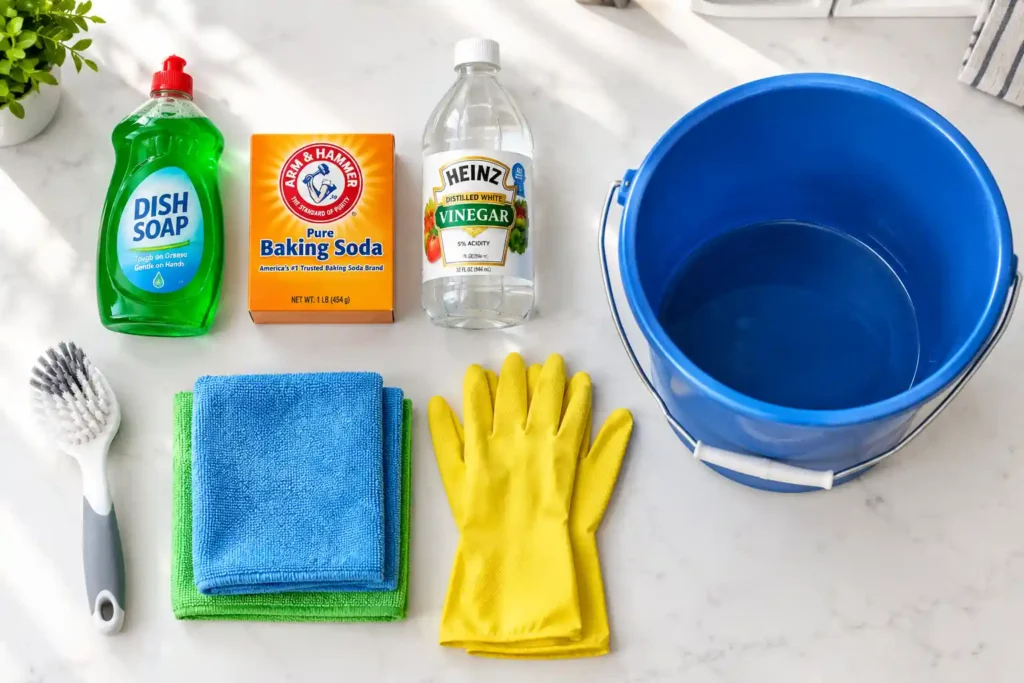
You don’t need anything special. Most of this is already in your kitchen.
Basic Supplies for Kitchen Chimney Cleaning
- Rubber gloves: chimney grease is sticky and difficult to wash off skin
- Large bucket or kitchen sink: big enough to fully submerge the baffle filter
- Dish soap / dishwashing liquid: a good degreaser is the core tool here
- Baking soda: for stubborn hardened grease
- White vinegar: cuts through grease residue and helps with odours
- Soft scrub brush or old toothbrush: for getting into the curved sections of baffle filters
- Microfibre cloths: for wiping the chimney body without scratching the finish
- Newspaper or old cloth: to lay on the counter or floor under the chimney during cleaning
What Not to Use
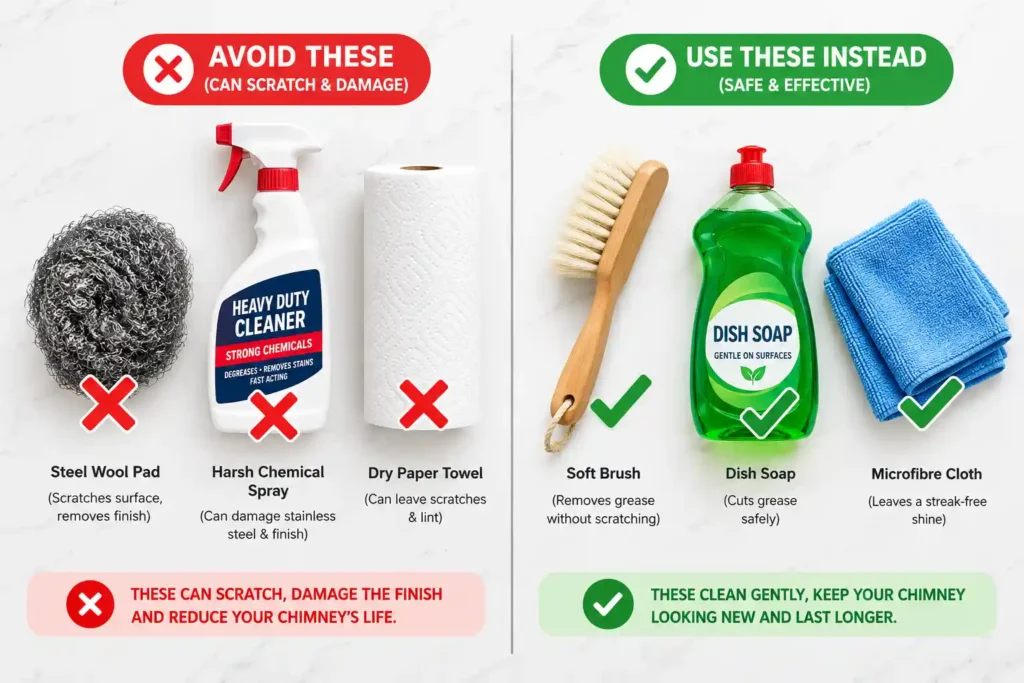
- Steel wool or abrasive scrubbers on stainless steel surfaces: they leave scratches that trap grease and look terrible over time
- Harsh chemical solvents directly on plastic components or control panels
- High-pressure water jets: water can get into the motor housing and cause damage
Quick Clean Method When You’re Short on Time
The full soak-and-scrub method below gives the best result, but it needs 30 to 60 minutes of mostly hands-off time. If you genuinely don’t have that right now, a foam degreaser spray gets you most of the way there in about 10 minutes.
When This Method Works
This is a reasonable stopgap between full cleans, not a replacement for the fortnightly soak. It works well on light to moderate grease buildup. For a filter that hasn’t been touched in over a month and has hardened, visibly amber grease, skip straight to the full soak method, a spray alone won’t cut through that.
Quick Clean Steps
- Remove the filter and lay it flat over a sink or on newspaper
- Spray a kitchen-safe foam degreaser generously over both sides
- Leave it to sit for 5 minutes, this gives the degreaser time to break down surface grease
- Wipe with a microfibre cloth or rinse under hot water
- While the filter sits, spray and wipe the hood interior and exterior panels with the same cleaner
- Dry the filter fully before reinstalling, the same drying rule applies regardless of which method you use
Choosing a Safe Degreaser Spray
Look for a foam-based kitchen degreaser specifically labelled safe for stainless steel and kitchen appliances. Avoid oven cleaners or heavy-duty industrial degreasers, these are formulated for much tougher, baked-on residue and can be too harsh for chimney filter coatings and plastic trim over repeated use.
How to Clean a Baffle Filter: Step-by-Step
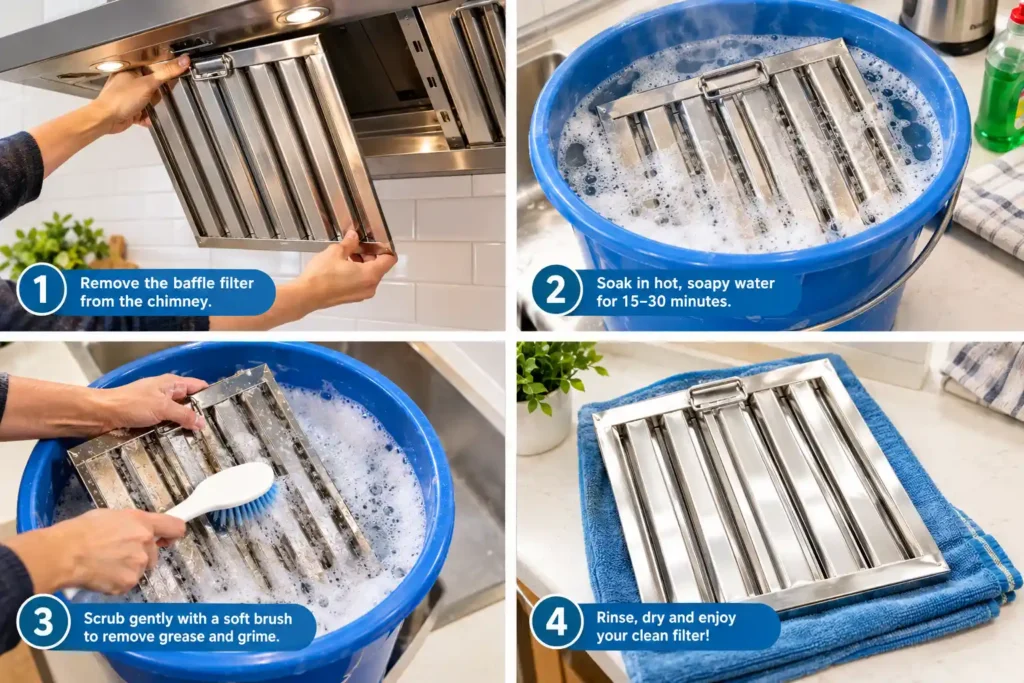
The baffle filter is the workhorse of your kitchen chimney. It takes the most grease and needs the most frequent cleaning. Learn which Chimney Filter Type Suits Your Kitchen before buying. Here is the full process.
Step 1: Turn Off and Cool Down
Turn the chimney off and let it sit for at least 15 to 20 minutes before touching anything. The motor housing and filters get warm during operation. Working on a hot chimney is uncomfortable and slightly risky if there’s any residual grease near heat.
Step 2: Remove the Baffle Filter
Most baffle filters slide out or unclip from the bottom of the chimney with a simple pull or twist. Consult your manual the first time if you’re unsure. The mechanism varies slightly by brand.
Hold the filter over a sink or spread newspaper below before fully removing it. Grease drips are guaranteed.
Step 3: Soak in Hot Soapy Water
Fill a large bucket or your kitchen sink with the hottest tap water you can manage. Add 3 to 4 tablespoons of dishwashing liquid.
Submerge the baffle filter completely and let it soak for 20 to 30 minutes for regular cleaning. For a heavily clogged filter that hasn’t been cleaned in more than a month, extend the soak to 45 to 60 minutes.
Hot water loosens the grease. The soaking does most of the work for you.
For stubborn hardened grease: Add 2 to 3 tablespoons of baking soda to the hot soapy water along with the dish soap. Baking soda is mildly abrasive and alkaline, which breaks down baked-on grease much faster than soap alone.
Step 4: Scrub and Rinse
After soaking, use a soft scrub brush or old toothbrush to work through the curved baffles. Grease collects most in the tight angles and folds.
Run the brush along each baffle section in one direction. You’ll see the grease lifting off as a brownish foam in the water. That’s exactly what should happen.
Rinse thoroughly under hot running water. Hold the filter up to a light source to check. You should see clean, shiny metal with no amber-toned grease residue left in the creases.
If residue remains, soak for another 15 minutes and scrub again.
Step 5: Dry Completely Before Reinstalling
This step matters more than people realise. A wet filter reinstalled into the chimney carries water up toward the motor during the first use. Over time, moisture in the motor housing causes corrosion.
Shake off excess water, then either: – Leave the filter to air dry for 30 to 60 minutes standing upright – Pat dry with a clean cloth, paying attention to the interior fold sections – Some baffle filters can go in the dishwasher on a high-temperature cycle. Check your manual.
Reinstall only when fully dry.
Baffle Filter Cleaning: Quick Reference
| Step | Action | Duration |
| Cool down | Turn off chimney, wait | 15 to 20 minutes |
| Remove filter | Slide or unclip, hold over sink | 2 minutes |
| Soak | Hot water plus dish soap plus baking soda if needed | 20 to 60 minutes |
| Scrub | Soft brush along baffles | 5 to 10 minutes |
| Rinse | Hot running water, check under light | 3 to 5 minutes |
| Dry | Air dry or pat dry | 30 to 60 minutes |
How to Clean a Cassette or Mesh Filter
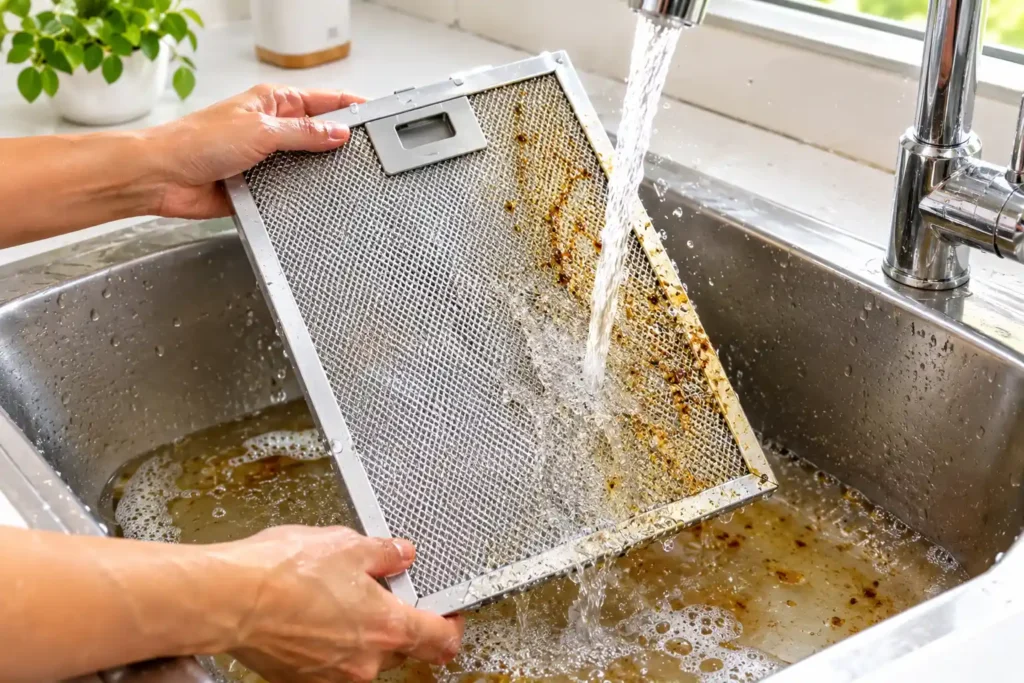
Cassette filters (also called mesh or aluminium filters) are common in older or budget kitchen chimney models. The cleaning process is similar to baffle filters but needs to happen more often because mesh filters clog faster.
Cleaning Steps for Cassette Filters
The soak-and-scrub method works here too, but with a few adjustments:
- Use warm to hot water: very high heat can warp aluminium mesh frames
- Soak for 15 to 20 minutes maximum
- Use a soft brush only: mesh is more delicate than baffle steel and can distort under pressure
- After rinsing, shake gently to clear water from the mesh cells
- Air dry fully before reinstalling
Cleaning frequency for Indian cooking: Every 10 to 15 days. Mesh filters trap grease in tighter spaces than baffles and clog noticeably faster under heavy Indian cooking conditions.
Advantages and Disadvantages of Cassette Filters vs Baffle Filters
| Cassette / Mesh Filter | Baffle Filter | |
| Grease trapping | Moderate | High |
| Cleaning frequency (Indian cooking) | Every 10 to 15 days | Every 15 to 20 days |
| Ease of cleaning | Moderate (delicate mesh) | Easy (solid stainless steel) |
| Durability | Lower (mesh can distort) | High (solid steel baffles) |
| Best for | Light cooking, budget chimneys | Heavy Indian cooking |
How to Replace a Carbon Filter (Ductless Chimneys Only)
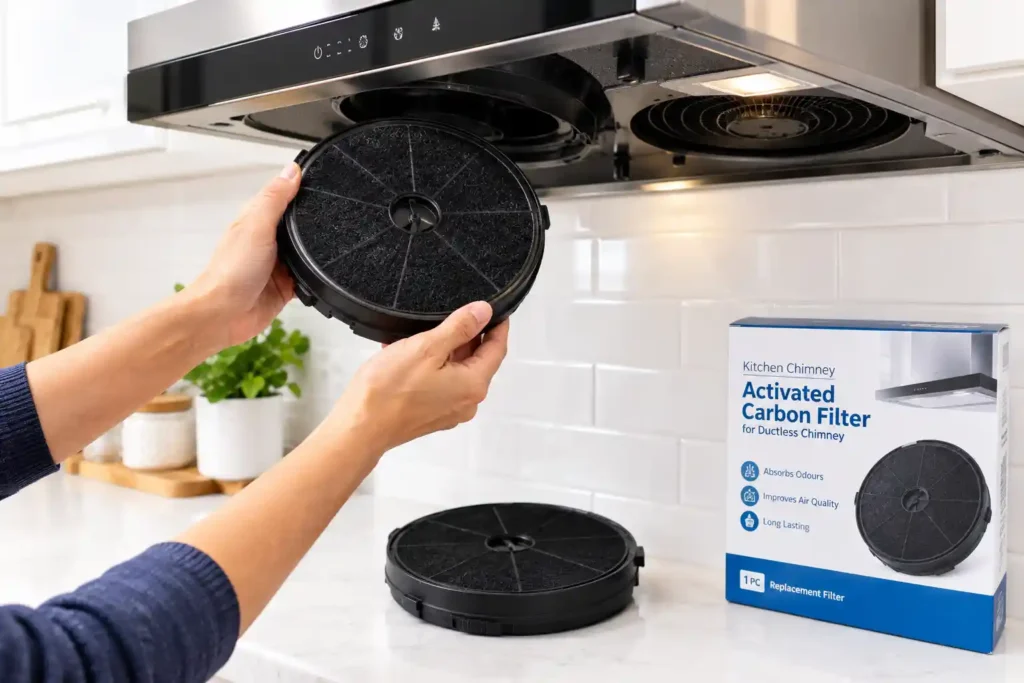
If you have a Ductless Recirculating Chimney, you have a carbon filter behind the baffle or mesh filter. Carbon filters cannot be washed. They must be replaced entirely.
Why Carbon Filters Cannot Be Cleaned
Activated carbon works by trapping odour molecules in microscopic pores. Once those pores are full, the carbon is spent. Washing it with water collapses the pore structure without removing the trapped molecules, making the filter useless.
Trying to “clean” a carbon filter is one of the most common chimney maintenance mistakes. It looks clean afterward but does nothing for odour control.
When to Replace the Carbon Filter
Replace every 3 to 6 months, depending on cooking intensity:
- Daily heavy Indian cooking: every 3 months
- Regular cooking, occasional frying: every 4 to 5 months
- Light cooking: every 6 months
Signs your carbon filter needs replacing before the scheduled date: – Cooking odours linger in the kitchen after the chimney has been running – Kitchen smells like previous meals when you’re not cooking – The chimney runs but doesn’t seem to be removing smells
How to Replace a Carbon Filter
- Turn off and unplug the chimney
- Remove the baffle or mesh filter first
- The carbon filter sits directly above. It usually slides out or unclips
- Check the model number on your existing filter (printed on the frame) and buy a matching replacement
- Slot the new filter in, reinstall the mesh or baffle filter above it
- Run the chimney for a few minutes to confirm normal operation
Where to buy replacement carbon filters: Most major kitchen chimney brands in India (Elica, Faber, Hindware, Glen, Kaff) sell model-specific replacement carbon filters on their websites and on Amazon India. Always match the model number exactly.
How to Clean the Oil Collector Tray
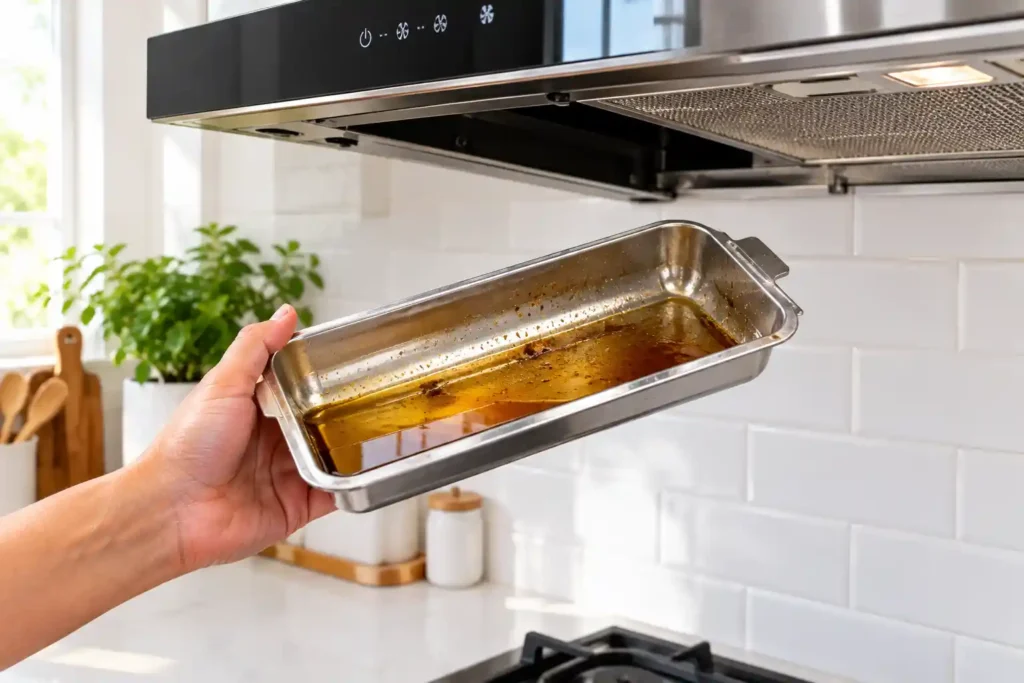
The oil collector tray sits at the bottom of the chimney’s filter housing and collects the grease that drips off the baffle filter during operation. It’s small, easy to forget about, and genuinely important to keep clean.
Why the Oil Tray Matters
An overflowing oil collector tray drips onto your hob. Hot oil dripping near a lit burner is a fire hazard. A simple one to prevent, but a real one.
It also becomes harder to clean the longer you leave it. Fresh liquid oil wipes out in seconds. Oil that’s been sitting in a tray for two months and has partially solidified takes considerably more effort.
Oil Tray Cleaning Steps
- Slide or pull the oil tray out from the filter housing
- Pour the collected oil into a disposable container (an old jar or plastic bag works fine. Don’t pour cooking grease down the sink)
- Rinse the tray with hot water and a small amount of dish soap
- Wipe dry with a cloth or paper towel
- Slide back in
Takes about 5 minutes. Do it monthly, or whenever you notice the tray is more than half full.
How to Clean the Chimney Body and Exterior Panels

The exterior of your kitchen chimney collects a fine grease mist over time, especially around the bottom edges nearest the hob. Left uncleaned, it builds into a sticky layer that attracts dust and becomes harder to remove.
Cleaning Stainless Steel Chimney Panels
Weekly wipe: Use a damp microfibre cloth to wipe the exterior surfaces. This takes 2 minutes and prevents grease from hardening.
For built-up grease on stainless steel: – Apply a small amount of dish soap to a damp cloth – Wipe in the direction of the steel grain (look closely: stainless steel has a brushed grain direction, usually horizontal) – Rinse with a clean damp cloth – Dry immediately to prevent water spots
For fingerprint marks and smudges: A few drops of baby oil or mineral oil on a soft cloth, wiped in the grain direction, removes fingerprints and leaves a light protective coating on the steel surface.
Cleaning Glass Chimney Panels
Many modern kitchen chimney models have curved or straight glass panels. Use a standard glass cleaner and a lint-free cloth. Avoid abrasive sponges. They scratch glass permanently.
Cleaning the Control Panel
Wipe the touch control panel with a barely damp cloth. No spray cleaners directly on the panel. Moisture can seep into the electronics. A dry microfibre cloth handles most smudges on touch panels without risk.
How to Clean an Auto-Clean Kitchen Chimney
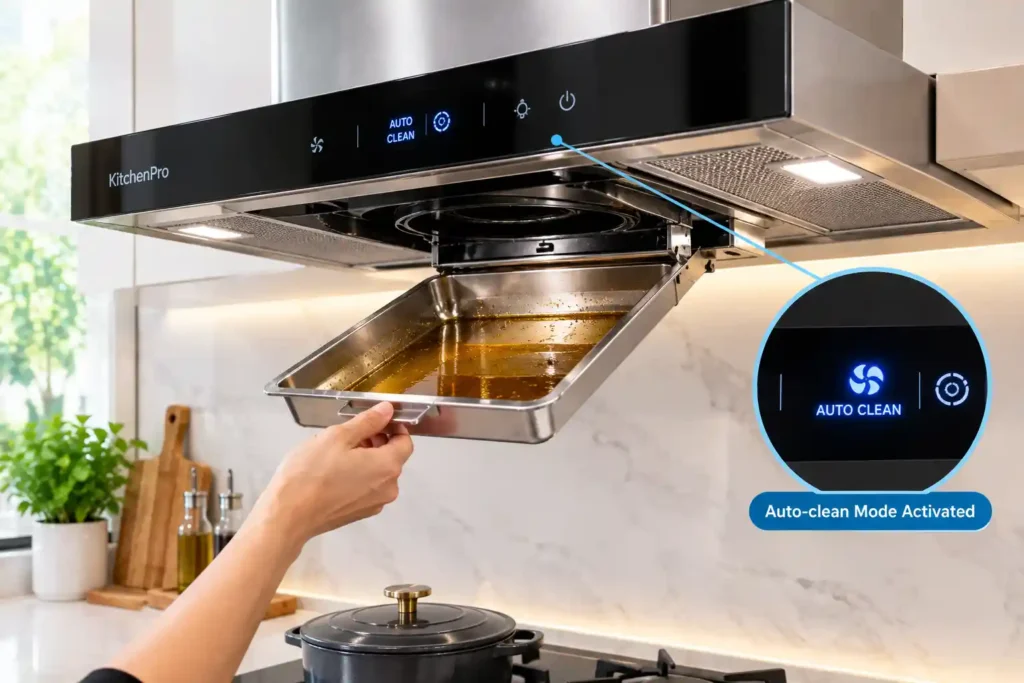
Auto-Clean Chimneys use a heating element to loosen grease from the filters and motor blades, channelling it into the oil collector. The auto-clean cycle does the heavy lifting so you don’t have to manually scrub filters.
How Often to Run the Auto-Clean Cycle
For heavy Indian cooking: every 15 days For moderate cooking: every 20 to 25 days
Running it less often lets grease harden between cycles, which reduces how effectively the heating element can dislodge it.
Step-by-Step: Running the Auto-Clean Cycle
- Make sure the oil collector tray is empty before starting. A full tray overflows during the cycle
- Press and hold the auto-clean button (usually 3 to 5 seconds) until the cycle indicator light appears
- The cycle runs for 15 to 30 minutes depending on the model. Keep the kitchen ventilated during this time as some smoke can be produced from the heating element burning off grease
- After the cycle completes, remove and empty the oil collector tray
- Wipe the tray clean and reinstall
What Auto-Clean Doesn’t Replace
The auto-clean cycle handles the internal filter and motor area. It doesn’t clean:
- The exterior body panels
- The glass or stainless steel chimney surfaces
- The oil collector tray (you still need to empty and wash this manually)
- The duct or exterior vent grille (check this every 6 months. See our Ducted vs Ductless Installation Guide for duct maintenance tips)
Advantages and Disadvantages of Auto-Clean Chimneys for Maintenance
| Advantages | Disadvantages |
| No manual scrubbing of baffle filters | Higher purchase cost than manual models |
| Maintains consistent suction between service cycles | Auto-clean cycle takes 15 to 30 minutes and produces some smoke and smell |
| Ideal for households that cook daily | Oil tray still needs manual emptying after every cycle |
| Reduces time spent on chimney maintenance | Heating element needs professional check every 2 years |
DIY vs Professional: When Should You Call for Help
Everything covered so far in this guide is genuinely a DIY job. But a few situations are worth recognising as your cue to stop and call a technician instead of pushing further yourself.
Signs You Need Professional Help, Not DIY
- Suction stays low after a full filter clean. If you’ve properly soaked, scrubbed, dried, and reinstalled the filter and suction still feels weak, the issue is likely in the motor, duct, or blower wheel, none of which are safe or practical to open up yourself.
- Unusual noise, burning smell, or visible sparking. Stop using the chimney and call a technician immediately. These are electrical warning signs, not cleaning problems.
- The duct is blocked and you can’t clear it from either end. Ducted systems sometimes need the pipe itself opened or detached, which is a job for someone familiar with your specific installation.
- The auto-clean heating element isn’t heating. This is an electrical component, not something to test or repair yourself.
- It’s been more than a year since any professional service. Even with diligent DIY cleaning, the motor blower wheel and internal components accumulate grease that only a technician can properly access.
Everything else, filter washing, oil tray emptying, exterior wiping, carbon filter swaps, you can confidently handle yourself with the steps in this guide.
Annual Professional Service: What It Covers and Why It Matters
Most people skip the annual service. Most people also end up calling a technician in year 3 or 4 for a problem that a year-2 service would have caught early.
What a Professional Chimney Service Includes
A standard kitchen chimney service from the brand’s authorised technician covers:
- Deep cleaning of the motor blower wheel (not accessible in home cleaning)
- Checking motor rpm and current draw against spec
- Inspecting and clearing the duct (ducted models)
- Checking the exterior vent flap for blockage
- Testing all speed settings and auto-clean function
- Tightening any loose mounts or connections
- Replacing worn seals if needed
How Much Does a Kitchen Chimney Service Cost in India?
Typical chimney service charges in India in 2026:
| Service Type | Approximate Cost |
| Basic cleaning and inspection | Rs. 300 to Rs. 600 |
| Deep motor cleaning + filter service | Rs. 600 to Rs. 1,200 |
| Duct cleaning (ducted models) | Rs. 500 to Rs. 1,000 additional |
| Carbon filter replacement (parts included) | Rs. 400 to Rs. 800 |
Most brands include one or two free service visits within the warranty period. Use them before the warranty expires. See how service costs factor into our Kitchen Chimney Brand and Price Guide. After that, booking through the brand’s authorised service centre is safer than using local repair shops for anything involving the motor.
Common Kitchen Chimney Cleaning Mistakes to Avoid
Mistake 1: Skipping the Soak
Trying to scrub a dry or barely-wet greasy filter is hard work that produces poor results. The soak is not optional. Hot water with dish soap or baking soda breaks down the grease so the brush can clear it easily. Without soaking first, you’re pushing grease around rather than removing it.
Mistake 2: Reinstalling a Wet Filter
Water in the filter housing gets pulled toward the motor during the chimney’s first run after cleaning. Over repeated cycles, this causes corrosion inside the motor housing. Always dry filters completely before reinstalling.
Mistake 3: Washing the Carbon Filter
A carbon filter cannot be cleaned. Washing it damages its structure and removes none of the trapped odour molecules. Replace it on schedule instead.
Mistake 4: Ignoring the Oil Collector Tray
The oil tray is small and out of sight, which is why people forget it. An overflowing tray is a fire hazard. Check it monthly at minimum.
Mistake 5: Using Abrasive Scrubbers on Steel Surfaces
Steel wool or rough scouring pads leave permanent scratches on stainless steel exterior panels. Those scratches trap grease and make future cleaning harder. Use soft brushes for filters and microfibre cloths for exterior surfaces.
Mistake 6: Running Auto-Clean With a Full Oil Tray
If the oil tray is full when you start the auto-clean cycle, it overflows during the cycle. Grease ends up dripping onto your hob. Always empty the tray before running auto-clean.
Complete Kitchen Chimney Maintenance Schedule

Weekly Tasks (5 minutes)
- Wipe the exterior body panels with a damp microfibre cloth
- Wipe the glass panels if your chimney has them
- Check the oil collector tray level
Fortnightly Tasks (30 to 45 minutes)
- Full baffle filter wash: soak, scrub, rinse, dry, reinstall
- Empty and clean the oil collector tray
- Run auto-clean cycle if your chimney has that feature
Monthly Tasks (15 minutes)
- Deep wipe of exterior panels with dish soap solution
- Check the chimney’s bottom edges for grease build-up near the filter housing
- Inspect the exterior vent grille (ducted models) for blockage
Every 3 to 6 Months
- Replace carbon filter (ductless chimneys only)
- Check the duct for any visible blockage at the exterior vent end
- Look inside the filter housing with a torch to check for any grease build-up on the motor housing exterior
Annual
- Book professional service through brand’s authorised centre
- Have motor rpm and duct condition checked
- Ask technician to inspect the auto-clean heating element if applicable
Full Maintenance Schedule at a Glance
| Task | Frequency | Time Needed |
| Exterior wipe | Weekly | 5 minutes |
| Oil tray check | Weekly | 2 minutes |
| Baffle filter full wash | Every 15 to 20 days | 30 to 45 minutes |
| Oil tray clean | Monthly | 5 minutes |
| Auto-clean cycle | Every 15 to 25 days | 15 to 30 minutes (hands-off) |
| Carbon filter replacement | Every 3 to 6 months | 10 minutes |
| Duct and vent check | Every 6 months | 5 minutes |
| Professional service | Annually | 1 to 2 hours (technician) |
People Also Ask: Kitchen Chimney Cleaning FAQs
1. How do I clean a kitchen chimney at home?
Remove the baffle filter, soak it in hot water with dish soap and baking soda for 20 to 30 minutes, scrub with a soft brush, rinse thoroughly, dry completely, and reinstall. Wipe the exterior with a damp microfibre cloth. Empty and rinse the oil collector tray monthly. For ductless chimneys, replace the carbon filter every 3 to 6 months.
2. How often should I clean my kitchen chimney filter?
For daily Indian cooking with regular frying and tadka, clean the baffle filter every 15 to 20 days. For moderate cooking, every 25 to 30 days. Cassette or mesh filters need cleaning every 10 to 15 days under Indian cooking conditions because they clog faster.
3. Can I put chimney filters in the dishwasher?
Baffle filters made from stainless steel are generally dishwasher-safe. Check your chimney’s manual to confirm. Use a high-temperature cycle. Aluminium cassette filters should not go in the dishwasher. Heat can warp the frame. Carbon filters must never be washed at all.
4. How do I clean a greasy chimney filter at home?
Soak the filter in the hottest water you can manage, with 3 to 4 tablespoons of dish soap and 2 to 3 tablespoons of baking soda. Leave for 30 to 60 minutes for heavy grease build-up. The baking soda breaks down hardened grease far faster than soap alone. Scrub with a soft brush, rinse well, and dry before reinstalling.
5. Can I wash a carbon filter?
No. A carbon filter cannot be washed or reused. It must be replaced entirely. Washing damages the activated carbon structure without removing trapped odour molecules. Replace it every 3 to 6 months depending on how often you cook.
6. How do I use baking soda to clean a chimney filter?
Add 2 to 3 tablespoons of baking soda to a bucket of hot water along with dish soap. Submerge the filter and soak for 30 to 60 minutes. Baking soda is alkaline and mildly abrasive, which makes it effective on baked-on grease that dish soap alone struggles with. Follow with a scrub and thorough rinse.
7. How do I clean an auto-clean kitchen chimney?
Empty the oil collector tray, then press and hold the auto-clean button for 3 to 5 seconds. The cycle runs for 15 to 30 minutes. Keep the kitchen ventilated during the cycle. After it finishes, remove and rinse the oil tray. The auto-clean cycle handles the internal components; you still need to wipe the exterior panels manually.
8. How do I know when my carbon filter needs replacing?
When your kitchen starts retaining cooking smells even while the chimney is running, or when old food odours linger between cooking sessions, the carbon filter is saturated and needs replacement. Don’t wait for a complete failure. Replace on a schedule of every 3 to 6 months for Indian cooking households.
9. Can I use vinegar to clean a chimney filter?
White vinegar is useful as a rinse agent after scrubbing because it cuts through any remaining grease residue and helps neutralise odours. It works best as a follow-up to dish soap and baking soda rather than as a standalone cleaner for heavy grease. Rinse with clean water after the vinegar rinse.
10. How much does a kitchen chimney service cost in India?
A basic chimney cleaning and inspection from an authorised service centre typically costs Rs. 300 to Rs. 600. A deep service including motor cleaning costs Rs. 600 to Rs. 1,200. Carbon filter replacement with parts runs Rs. 400 to Rs. 800. Most brands include one or two free services during the warranty period.
11. Is it safe to use caustic soda or acetone to clean chimney filters?
It’s best avoided. Caustic soda is corrosive, can damage stainless steel finishes and skin on contact, and acetone or paint thinner are flammable solvents, not something you want near a kitchen appliance or an open flame. Dish soap, baking soda, and vinegar handle standard chimney grease effectively and safely. Save stronger measures for a professional, not a DIY attempt.
12. How do I dispose of the grease collected from chimney cleaning?
Never pour collected oil or grease down the sink, it solidifies inside pipes and causes blockages over time. Pour it into a sealed container, an old jar or a sturdy plastic bag works fine, let it cool and solidify if it’s liquid, then dispose of it with regular household waste. Some Indian cities also have used-cooking-oil collection points through local recycling initiatives, worth checking if you fry often.
Conclusion
Kitchen chimney cleaning is one of those tasks that feels like a chore until you skip it long enough to understand why it matters. A clean chimney runs at full suction, keeps kitchen air fresh, protects your walls from grease build-up, and lasts years longer than a neglected one.
The schedule isn’t complicated:
- Baffle filter: every 15 to 20 days for Indian cooking households
- Oil collector tray: monthly
- Exterior wipe: weekly
- Carbon filter replacement: every 3 to 6 months (ductless chimneys only)
- Auto-clean cycle: every 15 to 25 days
- Professional service: once a year
The whole routine (filter wash, oil tray, exterior wipe) takes about 45 minutes when done on schedule. Leave it for 2 months and you’re looking at double the time and triple the effort to get the same result.
For anything involving the motor, duct, or internal components, book a service through the brand’s authorised centre. It’s worth it once a year.
If you want to understand how a clean filter affects your kitchen chimney suction power, our Chimney Suction Power Guide explains exactly what happens to airflow as filters clog, and how to calculate the right capacity for your kitchen. Drop your questions in the comments below. If you have a specific model or a filter type that’s giving you trouble, mention it and I’ll point you in the right direction.