Written by Mohammed Saqib, researcher and writer at Kitchen Chimney. Last updated: October 29, 2026
Thinking of buying a kitchen chimney but worried about the light bill? Whether a kitchen chimney increases your electricity bill depends on the model’s rated wattage, how long you run it, and your electricity tariff. This guide uses simple watts-to-units calculations and examples to help you estimate the running cost for your own kitchen instead of relying on a blanket promise that the extra cost is always negligible.
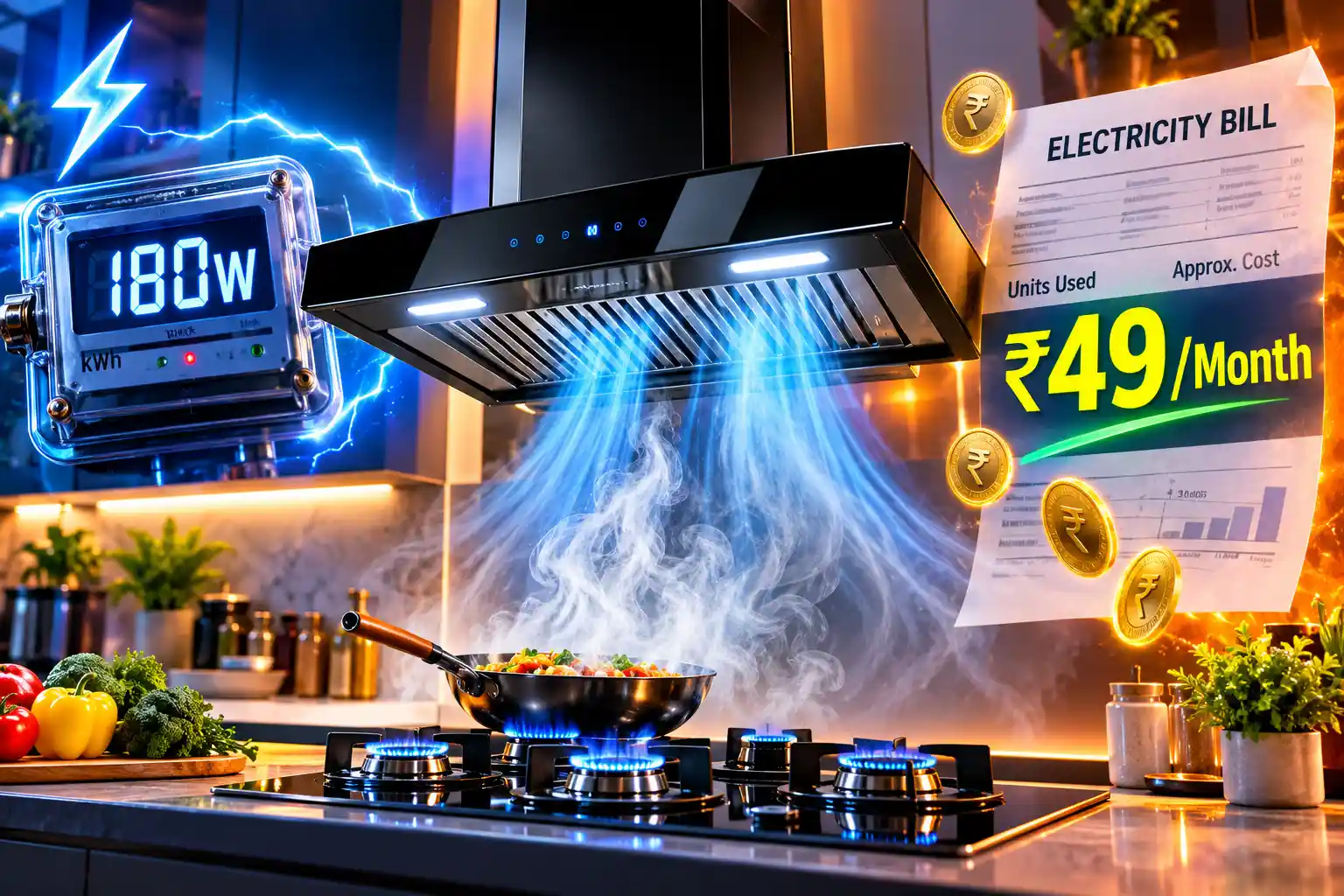
Short answer: yes, a kitchen chimney uses electricity, but the monthly cost depends on its actual power input, how many hours you run it, any lights or cleaning cycle used, and the rate on your electricity bill. For example, a 180W appliance running for 1 hour each day uses 5.4 units in a 30-day month. At an illustrative rate of Rs.9 per unit, that is Rs.48.60 before any applicable fixed charges, slab effects or time-of-day rates.
Use the formula and examples below with your own model’s rated wattage and the applicable rate from your latest electricity bill. The wattages and Rs.9 rate shown in examples are assumptions for calculation, not a claim that every chimney or household has the same figures.
Does Kitchen Chimney Increase Electricity Bill? Quick Answer
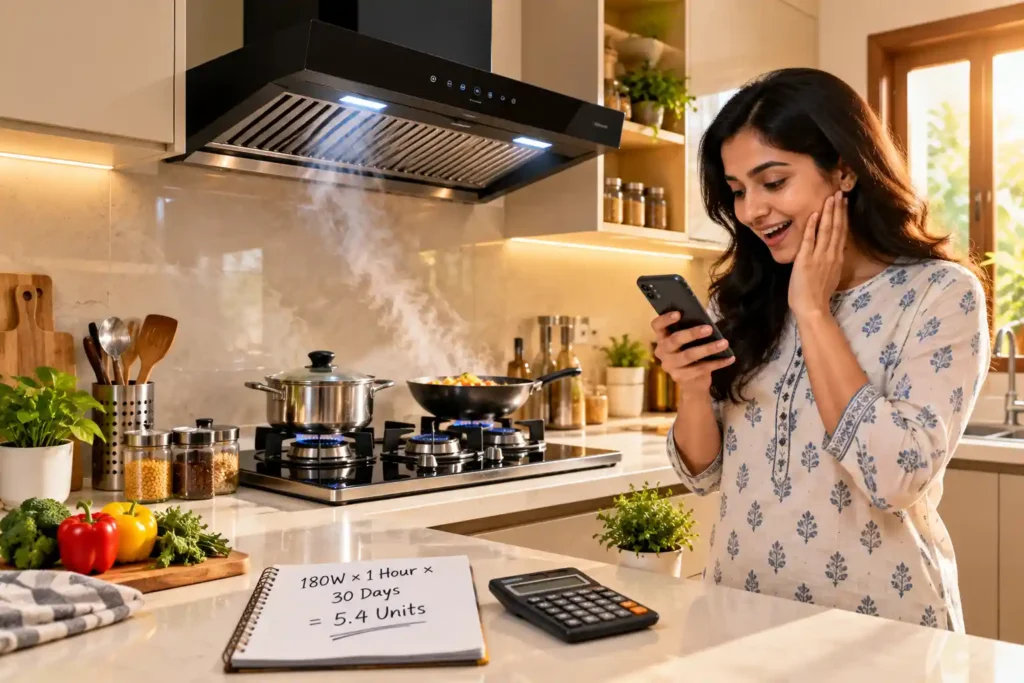
- Illustration: 180W for 1 hour daily equals 5.4 units per 30-day month, or Rs.48.60 at Rs.9 per unit.
- Illustration: 250W for 1 hour daily equals 7.5 units per 30-day month, or Rs.67.50 at Rs.9 per unit.
- An auto-clean cycle adds a model-specific amount. Calculate it from the cycle’s rated input and actual duration.
- BLDC motors can use less power in some models, but compare each appliance’s rated input rather than assuming a universal monthly cost.
- Formula: (Wattage in W ÷ 1000) × hours per day × days used × rate per unit.
How Much Electricity Does a Kitchen Chimney Consume?
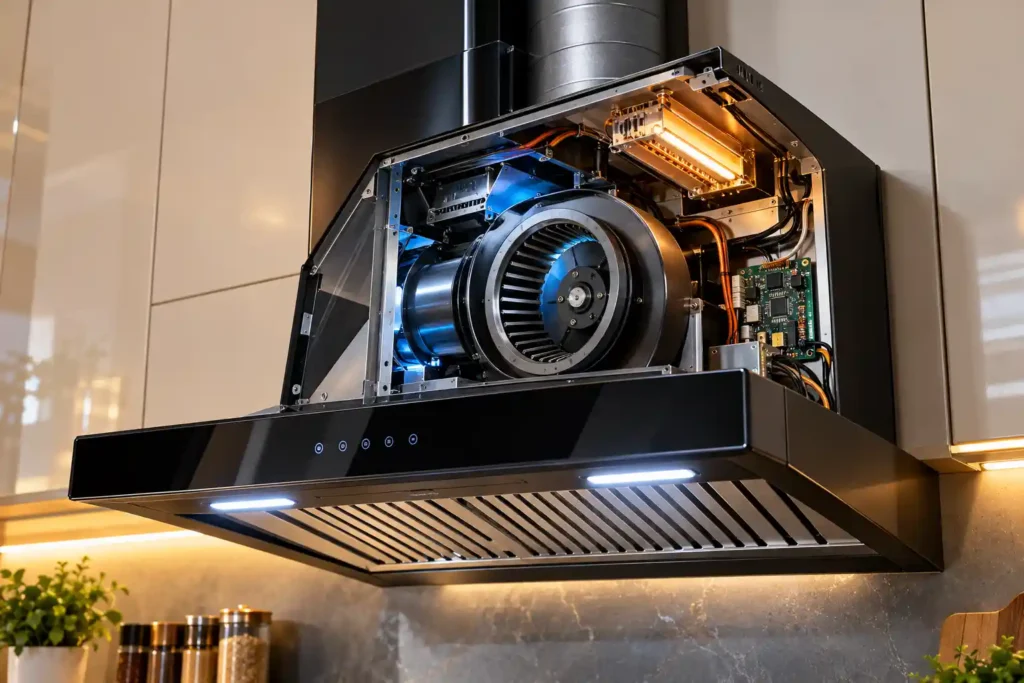
A chimney’s electricity use is usually much easier to estimate than its full ventilation performance: check the electrical input on the rating label or in the user manual, and combine it with the time the appliance is actually running. The motor or fan is normally the main load, but lights, controls and a powered cleaning function can also contribute.
There is no single daily usage period that applies to every Indian household. For a 180W appliance used for 1 hour daily, the example consumption is 5.4 units per 30-day month. At 2 hours daily, the same appliance uses 10.8 units. Your model and usage may differ.
Table 1: Component-Wise Power Consumption of a Kitchen Chimney
| Part or Function | What to Check | How It Affects the Estimate |
|---|---|---|
| Motor and Fan | Rated input or total appliance wattage on the label | Usually the main running load. Actual input can vary by model and speed. |
| LED Lights | Power rating per lamp, if provided | Add their use time separately if the stated appliance wattage excludes them. |
| Auto-Clean Function | Whether the model uses a powered heater and its rating and cycle duration | Calculate the energy used during the cleaning cycle separately only if the data are available. |
| Controls and Standby | Standby input, if listed by the manufacturer | May add a small amount when the product is not actively running, but do not assume it is always zero. |
Do not treat the motor wattage as the complete consumption figure unless the label or manual identifies it as the appliance’s total input. When comparing products, use like-for-like rated input figures and include any separate loads that the manufacturer lists.
Watts, Units and Rupees in One Minute
Your electricity bill is calculated in units. 1000 watts used for 1 hour equals 1 unit (1 kWh).
A 180W appliance used for 1 hour consumes 0.18 units, assuming it draws 180W throughout that hour. Multiply the units by the applicable energy charge per unit to estimate that part of the cost.
Chimney Wattage by Type: Not All Chimneys Use the Same Power
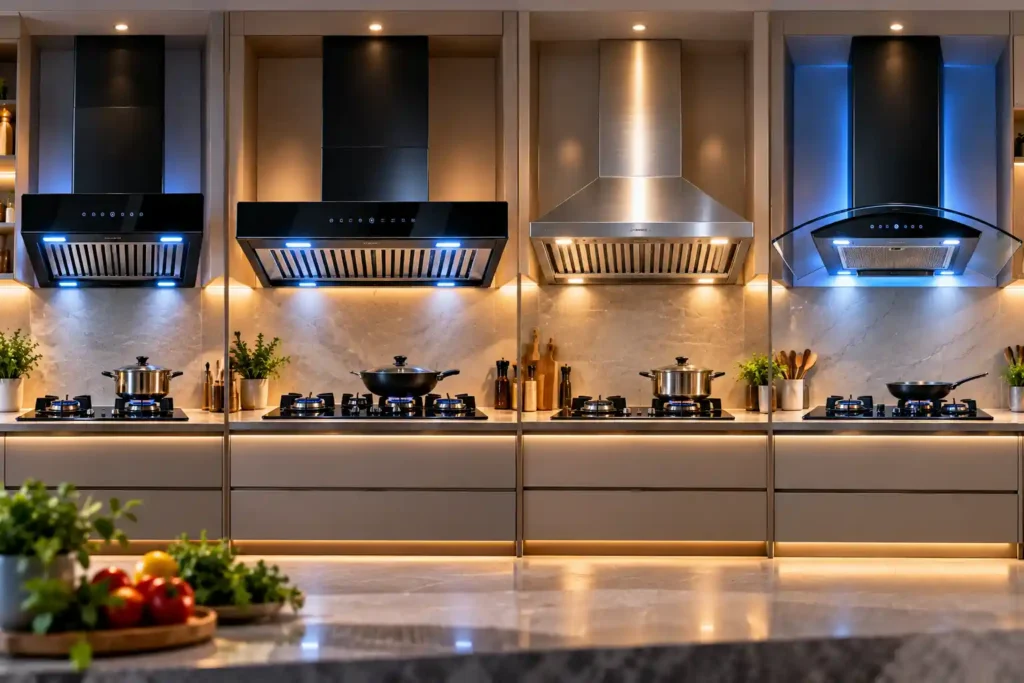
A higher suction rating does not by itself tell you how much electricity a chimney uses. Two models with different airflow ratings may have different motor designs, controls and power inputs. Compare rated electrical input and the performance needed for your kitchen rather than inferring energy use from m³/hr alone.
Does Kitchen Chimney Increase Electricity Bill With a BLDC Motor?
BLDC and conventional motor models can have different power inputs, but neither the motor label nor the suction rating alone proves the exact amount of electricity a product will use. Compare the stated total input power and manufacturer specifications for the models you are considering. Our Electric Kitchen Chimney Buying Guide explains the main chimney types and features.
If electricity consumption matters, compare the total rated input of specific models at the relevant setting, along with airflow, noise, price and warranty. BLDC motors can be efficient, but filter type and motor type are separate features. Do not assume that every filterless model uses less power than every baffle-filter model.
Table 2: Illustrative Rated Input And Monthly Running Cost Examples
| Illustrative Rated Input | Daily Usage | Monthly Units (30 Days) | Cost at Rs.9 per Unit | Cost at Rs.11 per Unit |
|---|---|---|---|---|
| 130W | 1 hour | 3.9 units | Rs.35.10 | Rs.42.90 |
| 180W | 1 hour | 5.4 units | Rs.48.60 | Rs.59.40 |
| 250W | 1 hour | 7.5 units | Rs.67.50 | Rs.82.50 |
| 180W | 2 hours | 10.8 units | Rs.97.20 | Rs.118.80 |
| 200W | 2.5 hours | 15 units | Rs.135.00 | Rs.165.00 |
The table uses selected wattages to show the arithmetic, not average figures for all BLDC, filterless or baffle-filter chimneys. If a BLDC model draws less power than a comparable conventional model for the way you use it, the difference can reduce running cost. Calculate the saving from the two models’ actual rated input and your expected daily use. For a comparison of filter systems, see our Baffle Filter Vs Filterless Chimney Guide.
Real Manufacturer Wattage Examples: How to Compare Chimney Models
Search results sometimes present a narrow wattage range for all standard or BLDC chimneys, but specifications vary by model, speed and operating mode. For example, a current Glen CH6053 BLDC Auto-Clean Chimney Listing states a 180W motor and a separate 50W heating element, while other models list different motor ratings. A motor rating is not automatically the complete appliance input. Check the rating label and manual, and confirm whether the lights or cleaning element are included in the total before calculating cost or comparing models.
| Manufacturer Listing | Published Figure | How to Interpret It |
|---|---|---|
| Glen Straight Line 6000 Junior Chimney | 155 W listed wattage | Check the model manual to confirm whether this rating represents total appliance input. |
| Elica EFL-S 607 BLDC Chimney | 110 W motor wattage | This is specifically listed as motor wattage, so do not automatically treat it as the total input of the appliance. |
| Glen CH6053 BLDC Auto-Clean Chimney | 180 W motor and 50 W heat element | The Indian manufacturer lists the motor and heating element separately. Check the manual and operating mode before estimating combined use. |
These examples are taken from different manufacturer listings and are not a controlled efficiency test or a claim that one brand is better. They show why you should compare the same kind of rating for each model. Also check whether any separately listed lights or cleaning element are already included in the total input figure to avoid counting them twice.
Example Calculation Using a Published Wattage
If 155 W represents the complete appliance’s input and it draws that power for 1 hour daily, the estimate is 155 ÷ 1000 × 1 × 30 = 4.65 units per month. At an illustrative rate of ₹9 per unit, that equals ₹41.85 for the energy component. This arithmetic example is only appropriate if 155 W is the relevant total input for the operating mode. If the figure is motor-only, use the complete appliance input from the manual instead.
Does a BLDC Motor Always Mean a Lower Electricity Bill?
Not automatically. BLDC technology can reduce power use in some models and speed settings, but savings depend on the actual appliances being compared, the selected speed and how long each runs. Compare rated input and the purchase-price difference, not just the words “BLDC” or a suction figure. Our Electric Kitchen Chimney Buying Guide and Kitchen Chimney Suction Power Guide explain other specifications to check.
Is a BLDC Chimney Worth the Extra Cost for Electricity Savings?
A BLDC motor can reduce electricity use in some models, but a higher purchase price is worth paying for energy savings only if the actual difference in power draw and your cooking hours justify it. Compare the complete appliance input or credible consumption data at comparable settings, not a motor wattage from one product with the total appliance wattage of another.
Example: Estimate the Annual Saving Before You Buy
Suppose two comparable operating setups differ by an average of 80 W while providing the ventilation you need. At 2.5 hours daily, the estimated difference is 0.08 kW × 2.5 hours × 30 days = 6 units per month. At an illustrative ₹8 per unit, that is about ₹48 per month or ₹576 per year. This is a hypothetical comparison, not a guaranteed saving for every BLDC chimney.
How to Estimate the Payback Period
Divide the extra purchase price by the estimated annual electricity saving. For example, a ₹3,000 price difference divided by ₹576 in annual savings gives a simple payback period of about 5.2 years. This estimate excludes any differences in service cost, warranty, noise, performance and future electricity tariffs. Use actual model specifications before making a buying decision.
What to Compare Alongside Wattage
Compare suction performance, power input at the speed you expect to use, noise, warranty, purchase price and maintenance needs. Our Electric Kitchen Chimney Buying Guide explains key product features, while the Auto-Clean Kitchen Chimney Guide covers cleaning-system differences.
Real Calculation: Does Kitchen Chimney Increase Electricity Bill in Rupees?
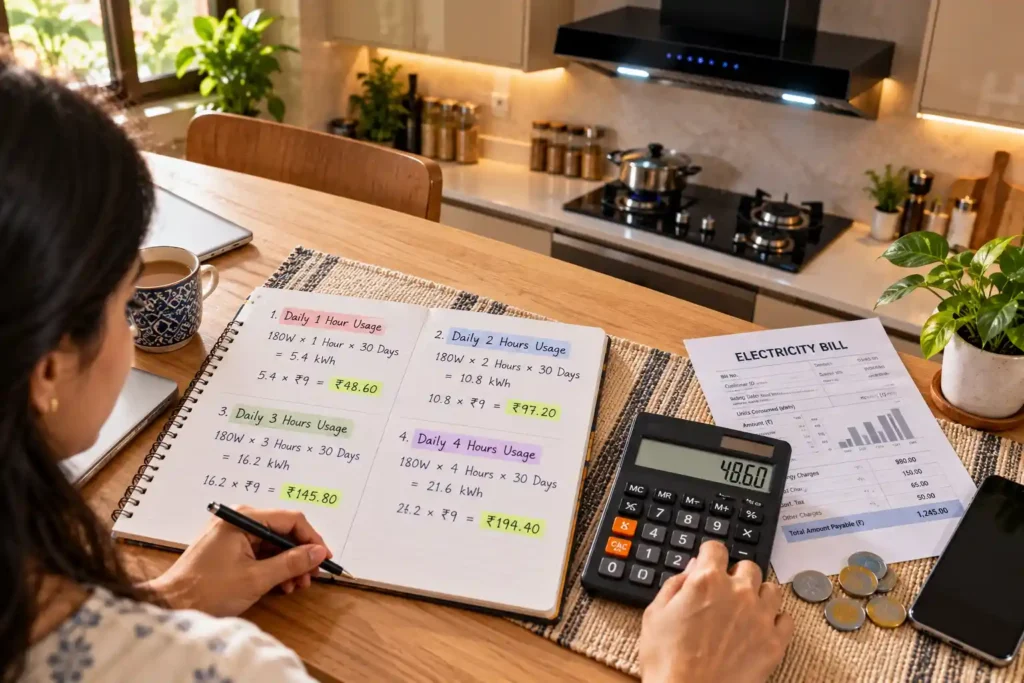
You can estimate the energy cost using this standard power-to-energy calculation. It estimates the variable energy charge, not every component that may appear on your bill.
Estimated Monthly Energy Cost (Rs.) = (Total Input Wattage in W ÷ 1000) × Hours Used Per Day × Days Used in the Month × Applicable Energy Charge Per Unit.
Look for the electrical input or rated power on the appliance rating label or in its user manual. Some product pages list motor power separately from total input, so check which figure is being stated before using it in the calculation.
Example 1: Normal Family, 1 Hour Daily
This is an example usage scenario, not a claim about the average household. Track how long your own chimney runs to get a more useful estimate.
Assumed total appliance input: 180W. Illustrative electricity rate: Rs.9 per unit. This is a calculation example, not a standard wattage for all 60cm or filterless chimneys.
Calculation: (180 / 1000) x 1 hr x 30 days x 9 = 5.4 units = Rs.48.6 per month. At Rs.11 per unit, the same chimney costs Rs.59.4 per month.
For this example, the estimated energy cost is Rs.48.60 per month at Rs.9 per unit. The cost changes with the actual input power, operating time and applicable rate.
Example 2: Heavy Cooking, 2 Hours Daily
This suits joint families or anyone who cooks three times a day.
Calculation: (180 / 1000) × 2 hours × 30 days = 10.8 units. At Rs.9 per unit, the energy cost is Rs.97.20. At Rs.11 per unit, it is Rs.118.80. These results assume 180W input throughout the stated run time and exclude other bill components.
Example 3: Older 200W Motor, 2.5 Hours Daily
For this illustrative calculation, assume the chimney’s total input is 200W and it runs for 2.5 hours daily. Actual models and households may use different amounts of power and time.
Calculation: (200 / 1000) × 2.5 hours × 30 days × Rs.9 per unit = 15 units and Rs.135 per month. This is an illustrative calculation, not a measured figure for every older motor or a prediction of the relative cost of other appliances.
Example 4: What Does Auto-Clean Cost Per Month?
Some auto-clean systems include a heating element, while the design and cycle vary by model. If your chimney has a heater, estimate its additional energy using the heater’s rated power and the total time it actually runs.
For this example, assume the heater runs for 10 minutes twice per month, or 20 minutes (one-third of an hour) in total. Check your model’s manual to confirm whether that cycle assumption applies.
Calculation: (1000 / 1000) x 0.33 hrs x 9 = 0.33 units = Rs.2.97 per month.
Table 3: Ready-Made Monthly Cost Table
Does kitchen chimney increase electricity bill for your usage? Find your daily hours below and read the answer instantly.
| Your Daily Chimney Usage | Chimney Wattage | Monthly Units | Cost at Rs.9 per Unit | Cost at Rs.11 per Unit |
|---|---|---|---|---|
| 30 mins per day | 180W | 2.7 units | Rs.24.3 | Rs.29.7 |
| 1 hour per day (example) | 180W | 5.4 units | Rs.48.6 | Rs.59.4 |
| 1 hour per day | 250W (powerful 90cm) | 7.5 units | Rs.67.5 | Rs.82.5 |
| 1.5 hours per day | 180W | 8.1 units | Rs.72.9 | Rs.89.1 |
| 2 hours per day (heavy use) | 180W | 10.8 units | Rs.97.2 | Rs.118.8 |
| 2.5 hours per day (older motor) | 200W | 15 units | Rs.135 | Rs.165 |
| Hypothetical 1,000W load for 20 mins/month | 1000W during cycle | 0.33 units | Rs.2.97 | Rs.3.63 |
Does Kitchen Chimney Increase Electricity Bill the Same in Every State?
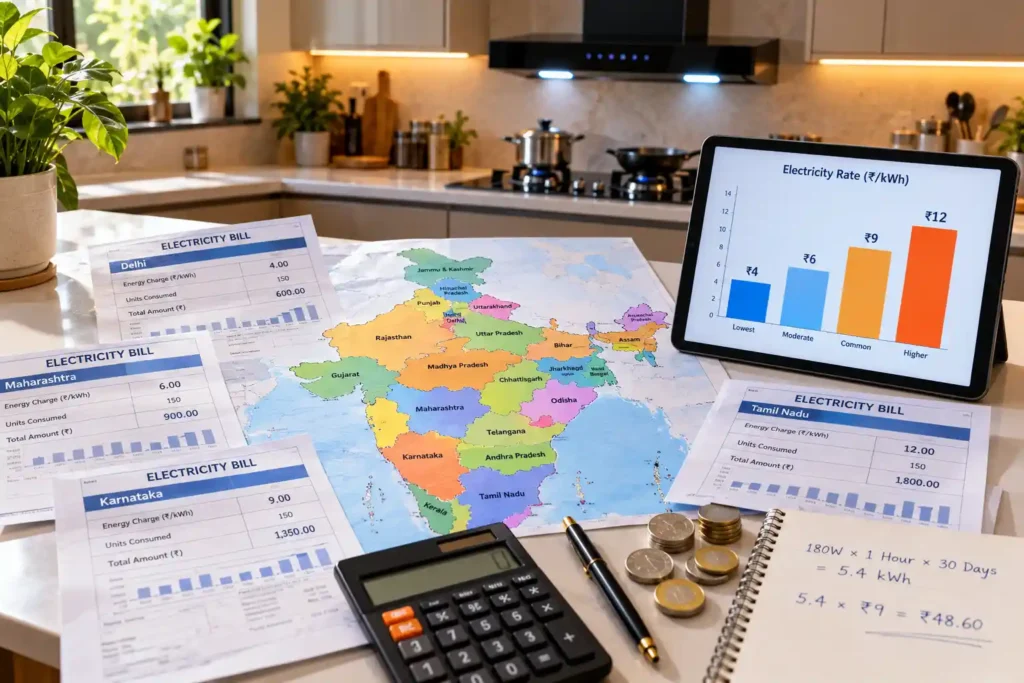
The Rs.9 and Rs.11 rates used in the examples are illustrations, not a claim about the price paid by every Indian household. Domestic electricity bills can include energy charges, slab rates, fixed charges, electricity duty, subsidies and other components. Actual rates and tariff structures are set under the relevant state’s or utility’s approved tariff schedule.
Use the effective per-unit rate that applies to your consumption where possible. If your bill has separate slabs or charges, the simple calculation below estimates the energy component only, not the entire bill. The Central Electricity Authority’s Tariff And Duty Reports provide state-wise tariff information.
Table 4: Same Chimney, Different Tariffs (180W, 1 Hour Daily, 5.4 Units)
| Your Rate per Unit | Monthly Cost |
|---|---|
| Rs.4 | Rs.21.6 |
| Rs.6 | Rs.32.4 |
| Rs.7 | Rs.37.8 |
| Rs.9 | Rs.48.6 |
| Rs.11 | Rs.59.4 |
| Rs.12 | Rs.64.8 |
Does Kitchen Chimney Increase Electricity Bill Enough to Change Your Slab?
Some domestic tariffs use consumption slabs, while subsidies, fixed charges and other terms differ by state and consumer category. The effect of additional chimney units depends on your tariff structure and how close your household is to a slab boundary. For example, a 180W chimney used 1 hour daily adds 5.4 units in a 30-day month; 2 hours daily adds 10.8 units.
Check the latest bill and your utility’s current schedule to see whether those units affect your rate or only the energy-charge total.
Does Kitchen Chimney Increase Electricity Bill More at Peak Hours?
India’s Time-of-Day (ToD) tariff rules allow time-based rates, but the actual domestic billing arrangement, time slots and implementation depend on the applicable rules, state tariff orders and meter setup. The Ministry of Power’s Time-of-Day Tariff Explanation describes the national framework. Do not assume that every household is billed at a different rate for every hour.
If your bill shows ToD rates, use the rate for the time the chimney runs. Otherwise, use the applicable energy rate from your bill for this estimate.
Does Kitchen Chimney Increase Electricity Bill More Than Other Kitchen Appliances?
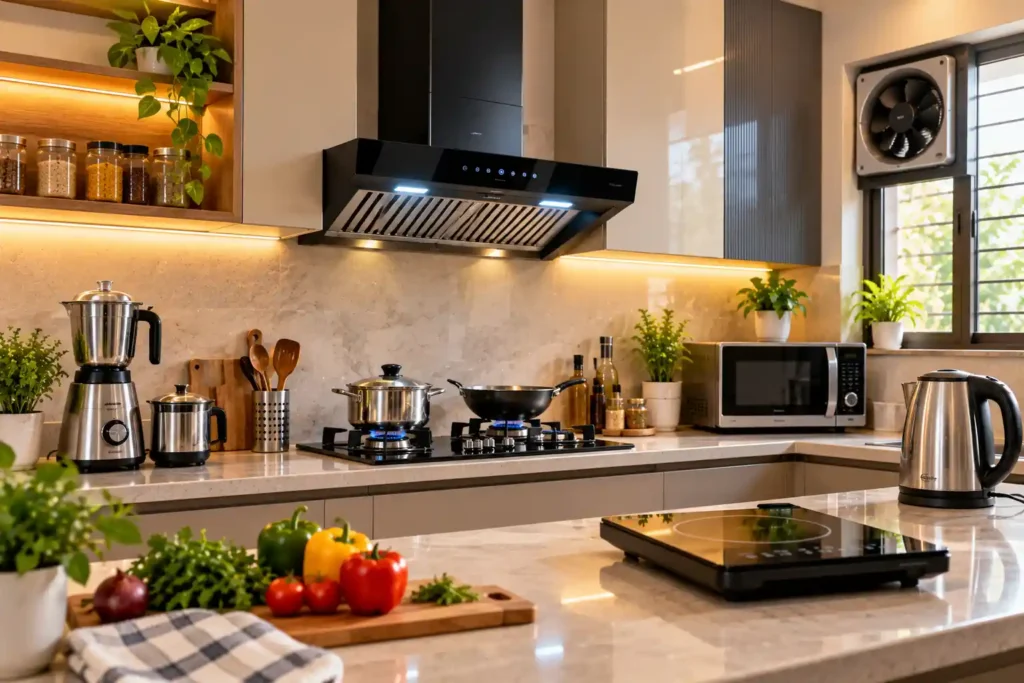
A chimney’s running cost is best compared with other appliances using actual input power and real operating time. Rated wattage alone is not enough to forecast a household’s monthly bill, particularly for appliances that cycle, run at variable speeds or are used only briefly.
Table 5: Why Rated Wattage Does Not Equal Monthly Cost
| Appliance | Why A One-Hour Comparison Can Mislead |
|---|---|
| Kitchen Chimney | Use the appliance’s rated input and the actual time it runs. Motor input can vary by model and speed. |
| Exhaust Fan | May draw less power, but provides different airflow and grease-capture performance. |
| Mixer Grinder | Usually runs in short bursts. Its nameplate wattage does not mean it operates continuously for a full hour. |
| Microwave Oven | Check electrical input rather than cooking output. The heater cycles on and off during many cooking programs. |
| Air Conditioner | Input changes with model, temperature, load and compressor operation. Use the energy label or measured data. |
| Kettle or Induction Cooktop | These can have high rated input, but are often used at different power settings and for shorter periods. |
| Water Geyser | Energy use depends on heating time, water temperature, thermostat and insulation, not rated wattage alone. |
Calculation example, not a measured appliance comparison: at a constant 750W input, 10 minutes uses 0.125 units. At a constant 180W input, 40 minutes uses 0.12 units. Actual mixer-grinder and variable-speed appliance consumption depends on the load and how the motor operates, so use measured or manufacturer-provided consumption where available.
An exhaust fan does use less power, but it does not capture grease the way a chimney does. Our Kitchen Chimney Vs Exhaust Fan Comparison covers that trade-off in full.
Need strong suction for oily Indian cooking without a big power draw? Our Chimney Suction Power Guide shows how to pick the right capacity.
5 Factors That Make a Kitchen Chimney Increase Your Electricity Bill
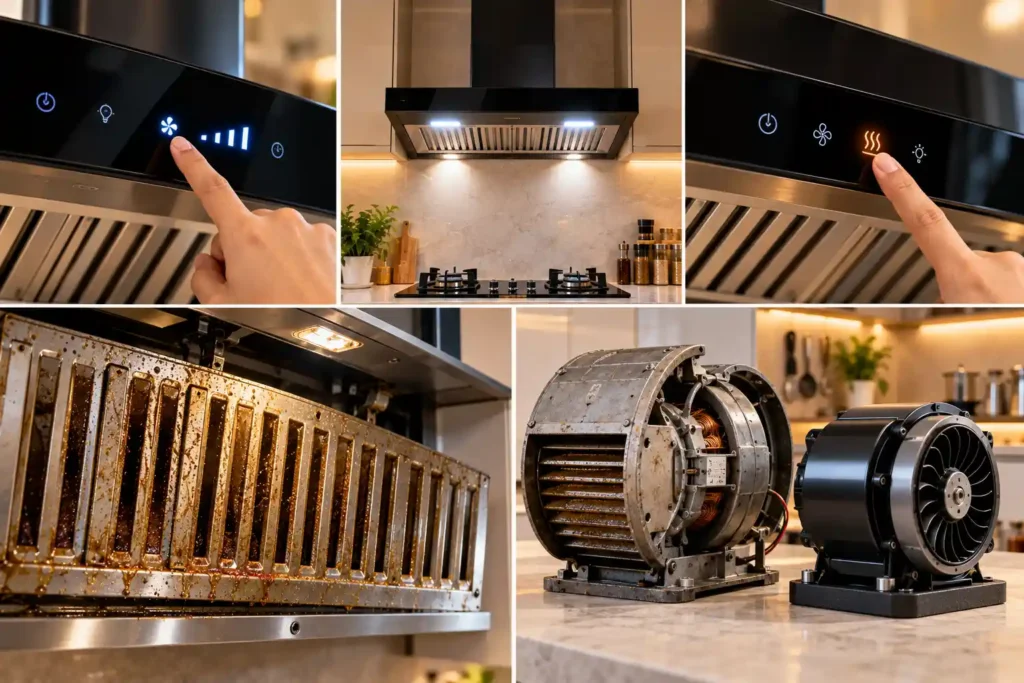
If your actual cost is higher than an estimate, first confirm the appliance’s total input rating, speed setting, daily run time and tariff. These factors can explain differences more reliably than assuming one motor type or filter automatically consumes more power.
- Using a higher setting when it is not needed, or a low setting that fails to capture fumes. Choose the speed that suits the cooking and ventilation conditions. Power draw at each speed varies by model. Our How To Use A Kitchen Chimney Properly guide explains everyday operating habits.
- Leaving the LED lights on for hours. LEDs use very little, but leaving them on overnight as a night lamp is wasted power.
- Running auto-clean more often than recommended. Use the interval and method specified in your model’s manual. Different automatic cleaning designs have different maintenance requirements and energy use.
- Neglecting routine maintenance. Grease build-up can reduce airflow and capture performance, which may lead to longer run time or a higher selected speed. Follow the product’s cleaning instructions and our Kitchen Chimney Cleaning Guide.
- Choosing without comparing input power. BLDC motors can offer better efficiency in some models and operating conditions, but performance, noise and durability still vary by product. Compare actual rated input, expected use, warranty and price before paying extra for a particular motor type.
Does Kitchen Chimney Increase Electricity Bill When It Has Auto-Clean?
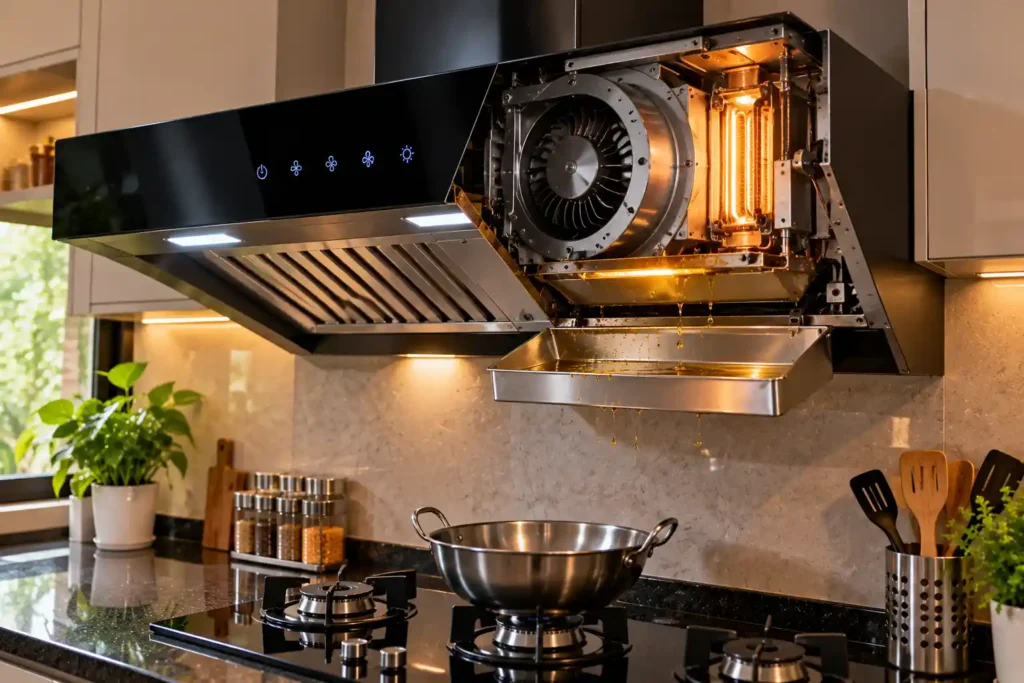
It is reasonable to include the cleaning function in the estimate if the model draws additional power during that cycle. The cost depends on the rated input and actual cycle duration.
Auto-clean designs use different components and ratings, so do not assume every model has a 1,000W heater. For example, the manufacturer’s Glen CH6053 BLDC Auto-Clean Chimney Specifications list a 180W motor and a separate 50W heating element. As an arithmetic illustration only, if a 50W element ran for a total of 20 minutes in a month, that element would use about 0.017 units, costing around ₹0.15 at ₹9 per unit or ₹0.18 at ₹11 per unit. This is not a claim about that model’s cleaning-cycle duration or actual monthly use. Check your model’s manual, use the real cycle time and avoid counting a component twice if its consumption is already included in the total appliance input.
The effect on the bill is usually best assessed from the rated input and duration of your own model’s cleaning cycle. Auto-clean designs vary, so do not assume every model has a separate heater or that the motor and fan behave in the same way when grease builds up. Our Auto-Clean Kitchen Chimney Guide explains common designs and maintenance considerations.
How Often Should You Run the Clean Cycle?
Follow the manufacturer’s recommended cleaning interval for your specific model and cooking pattern. Do not schedule cycles more frequently than the manual recommends, and do not assume that every automatic cleaning feature uses the same heater power or cycle time.
Does Kitchen Chimney Increase Electricity Bill in Your Home? Measure It in 5 Steps
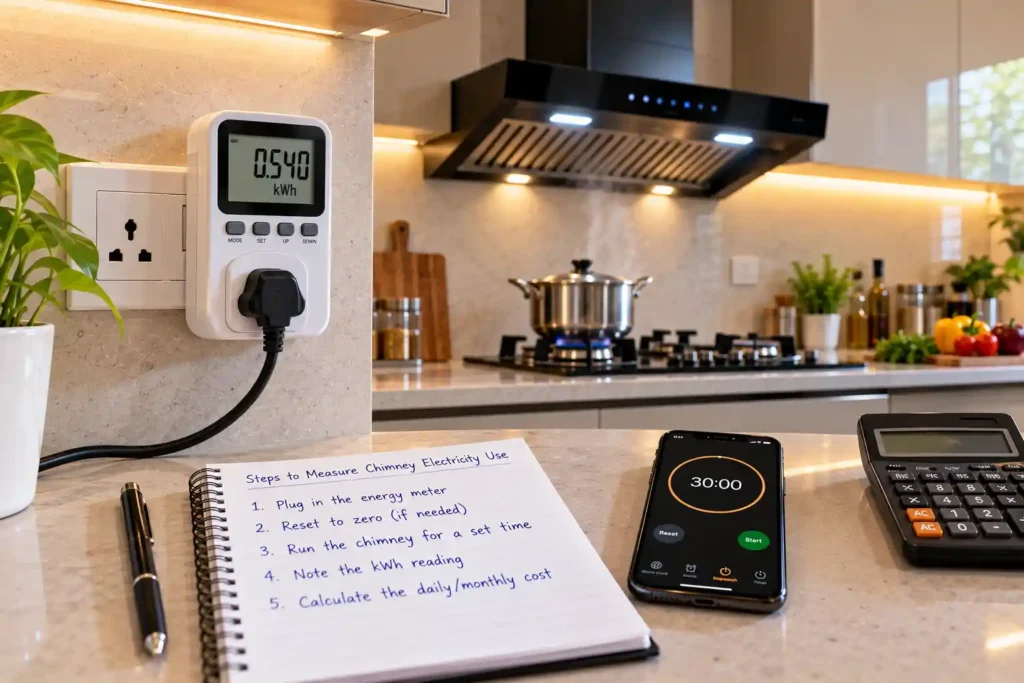
- Find the rated wattage on the sticker or in the manual.
- Track your real usage. Use a phone timer for one week and note the daily average in hours.
- Convert to units per day. Multiply watts by hours, then divide by 1000.
- Convert to units per month. Multiply the daily figure by 30.
- Multiply by your rate from your latest electricity bill to get the monthly cost in rupees.
For a measured figure, a suitable plug-in energy meter can help if the chimney uses a compatible plug and socket and the meter is rated for the load. Do not improvise with adapters, open wiring or an underspecified meter. If the unit is hardwired or the rating is uncertain, ask a qualified electrician to measure consumption safely.
What This Electricity Estimate Includes and Excludes
The simple watts-to-units formula is useful for planning, but it is an estimate of energy consumption. It is not necessarily the final change in your total bill.
Check Whether The Wattage Is For The Motor Or The Whole Appliance
Product specifications sometimes list motor power separately from total input or other functions. Use the total electrical input for the operating mode you want to estimate, where the manufacturer provides it. If the lights or a powered cleaning cycle have separate ratings, calculate those separately only when they are not already included in the total figure.
Treat The Unit Rate As An Estimate
If your household has slab-based charges, subsidy adjustments, fixed charges or time-of-day rates, multiplying units by one rate may not match the exact change on the bill. Use the tariff that applies to your connection and consumption level, and treat this calculation as the energy-charge estimate.
A Safer Way To Measure Real Consumption
A suitable plug-in energy meter can measure a chimney only when the plug, socket and meter ratings are compatible with the appliance. Do not insert homemade adapters or handle live wiring. For hardwired appliances or uncertain electrical ratings, ask a qualified electrician to measure consumption safely.
7 Practical Ways to Manage Your Chimney’s Electricity Cost

These practical steps can help avoid unnecessary electricity use while keeping ventilation effective. The goal is a reasonable running cost, not zero consumption or switching the hood off before the cooking fumes have cleared.
- Choose a suitable speed. Use the setting that captures smoke and cooking fumes effectively for the task. Higher settings may use more power on some models, but do not use an unnecessarily low speed when it fails to ventilate the cooking area.
- Maintain the filters and oil collector. Clean or empty serviceable parts at the intervals in the manual and according to visible grease build-up. Do not assume every filter type has the same cleaning schedule.
- Switch off the lights when you do not need them.
- Follow the recommended run-on time. If the manual recommends running the hood briefly after cooking, use that guidance to clear remaining fumes. Avoid unnecessary operation, but do not stop ventilation solely to save a small amount of electricity while smoke or fumes remain.
- Compare motor efficiency using actual specifications. A BLDC model may reduce consumption relative to a comparable conventional motor, but savings depend on the actual models, power ratings, speed setting and usage hours. Calculate the difference before paying extra for the feature.
- Follow the approved duct layout. Use the diameter and routing recommendations in your model’s manual, and avoid unnecessarily long or obstructed runs. Duct resistance can affect performance, but there is no single maximum length or bend count for every model. See our Ducted Vs Ductless Chimney Guide and Kitchen Chimney Installation Guide.
- Match the hood to your stove. A correctly sized hood captures smoke without needing high speed, as our 60cm Vs 90cm Chimney Size Guide explains.
Final Verdict: Does A Kitchen Chimney Increase The Electricity Bill?
Yes, a kitchen chimney adds electricity consumption, but you can estimate the energy cost with a simple calculation. For a 180W appliance running 1 hour daily, the example is 5.4 units per 30-day month. That costs Rs.48.60 at Rs.9 per unit or Rs.59.40 at Rs.11 per unit, assuming the appliance draws 180W throughout that time.
Your actual cost may be lower or higher depending on the model’s total input, speed settings, extra functions, daily usage and the rate structure on your bill. Use the product rating and your own electricity tariff rather than relying on a category-wide average.
For many households the additional energy charge may be modest, but the amount depends on wattage, daily use and the applicable tariff. Use your own appliance rating and latest bill to decide rather than assuming the cost will be invisible.
Still choosing a model? Compare options in our Chimney Brand Comparison Guide.
FAQs: Does Kitchen Chimney Increase Electricity Bill? People Also Ask
How many units does a kitchen chimney consume per month?
As an illustration, a chimney with a constant input of 180W to 250W used for 1 hour daily consumes 5.4 to 7.5 units in a 30-day month. Actual consumption depends on the model’s total input, speed setting and operating time. A 200W appliance running 2.5 hours daily would use 15 units under that assumption.
Does kitchen chimney increase electricity bill a lot?
The cost is often manageable, but it depends on wattage, usage hours and tariff. For example, a 180W appliance at 1 hour daily costs about Rs.48.60 a month at Rs.9 per unit, or Rs.59.40 at Rs.11. At 2 hours daily, those examples rise to Rs.97.20 and Rs.118.80, respectively.
Does kitchen chimney increase electricity bill if I use it 2 hours a day?
It depends on the appliance’s total input and your tariff. For example, a chimney drawing 180W continuously for 2 hours daily uses 10.8 units over 30 days. The energy charge would be Rs.97.20 at Rs.9 per unit or Rs.118.80 at Rs.11 per unit. These estimates exclude fixed charges and other bill components.
Does kitchen chimney increase electricity bill more with 1800 m³/hr suction than 1200 m³/hr?
Not necessarily. Suction rating and electrical input are different specifications. A model with higher airflow may still use less power than another model, depending on its motor and design. Compare the rated input and airflow figures on the exact product specifications.
Does kitchen chimney increase electricity bill with a BLDC motor?
A BLDC model may use less electricity than a comparable conventional motor, but there is no universal monthly cost for the BLDC category. Calculate each model’s estimated cost from its rated input and your daily operating time, using the same tariff for a fair comparison.
Does kitchen chimney increase electricity bill if the filter is dirty?
A dirty filter can reduce airflow or smoke capture and may lead you to run the chimney longer or at a higher setting. It does not mean the electrical input always rises in a fixed way, so clean serviceable filters as directed by the manufacturer and use the actual run time when estimating cost.
Does kitchen chimney increase electricity bill if I only use Speed 1?
Lower settings often use less power, but the change depends on the model. Select a speed that captures the cooking fumes effectively, and use the user manual’s guidance for different cooking conditions rather than choosing a setting only to save electricity.
Does kitchen chimney increase electricity bill if I run it after cooking too?
It adds electricity use in proportion to its wattage and the extra minutes. For example, a 180W appliance operated for an additional 5 to 10 minutes daily uses about 0.45 to 0.9 units over 30 days, or roughly Rs.4 to Rs.8 at Rs.9 per unit. Follow the manufacturer’s recommended run-on time to clear remaining fumes.
Does kitchen chimney increase electricity bill in a small kitchen or 1BHK flat?
Kitchen size does not directly change the appliance’s rated wattage. For example, a 180W model used 1 hour daily consumes 5.4 units per 30-day month, which costs Rs.48.60 at Rs.9 per unit whether the home is a 1BHK or a larger flat. Actual use and tariff determine the cost.
Does kitchen chimney increase electricity bill more than an exhaust fan?
An exhaust fan may use less power than a chimney, but the difference depends on the actual rated input of both products. For illustration, if a 180W chimney and a 60W fan each run for 1 hour daily over 30 days, the chimney uses 3.6 additional units. At Rs.9 per unit, that is Rs.32.40 more for the energy component.
That extra cost buys grease capture, which an exhaust fan does not provide.
Does kitchen chimney increase electricity bill when auto-clean runs?
It depends on the model’s cleaning design, rated input and actual cycle duration. For example, the manufacturer’s Glen CH6053 BLDC Auto-Clean Chimney Specifications list a 50W heating element separately from the 180W motor. If that element ran for a total of 20 minutes in a month, it would use about 0.017 units, which is roughly ₹0.15 at ₹9 per unit or ₹0.18 at ₹11 per unit. This is an illustration of the heater’s energy only, not the total chimney cost or a claim about the model’s actual cycle duration. Use the rating and duration for your exact model, and do not double-count a component already included in total appliance input.
Which chimney consumes the least electricity, baffle or filterless?
Filter type alone does not determine electricity use. A BLDC motor may be more efficient than a comparable conventional motor, but compare the wattage and other specifications of actual models. Cleaning needs depend on the filter and design, not only the motor type.
Can I run a kitchen chimney on an inverter?
It depends on the chimney’s total input, the inverter’s continuous and surge capacity, battery condition and what other appliances are connected. Check the appliance manual and inverter specifications before use. Do not assume that all chimneys or their cleaning functions are suitable for a home inverter.
Does a kitchen chimney need a special socket or wiring?
Follow the voltage, plug, input power and earthing requirements shown in your model’s manual and rating label. If the chimney includes a powered cleaning function, check its additional electrical requirements rather than assuming the motor’s rating covers every operating mode.
Ask your electrician to confirm the socket and MCB rating before installation.
How can I reduce my chimney’s electricity bill?
Use a speed that captures cooking fumes effectively, clean and maintain the appliance as directed, and follow the approved duct layout. Compare BLDC and conventional models using their stated input power, expected run time, purchase price and warranty to estimate any long-term savings.
What is the ideal wattage for a home kitchen chimney?
There is no single ideal wattage for every kitchen. Compare the total rated input and airflow of individual models, then consider noise, speed control, ducting and your cooking pattern. An efficient motor can be useful, but base the running-cost calculation on the specifications supplied for the exact model.
Does a 90cm Chimney Use More Electricity Than a 60cm Chimney?
Not necessarily. Width alone does not establish energy use. Compare the total input power, motor design, selected speed and any separately rated features on the exact models. A wider model with a different motor may draw more or less power than a narrower model, so do not use width as a substitute for the rating label.
How Much Does It Cost to Run a Kitchen Chimney in India for a Year?
It depends on the total input, operating hours and your tariff. For illustration, a chimney drawing 180W for 2 hours daily uses 10.8 units per 30-day month, or 129.6 units over 12 such months. At ₹9 per unit, the estimated energy cost is ₹97.20 per month or ₹1,166.40 per year. This excludes fixed charges and any tariff slabs, and it is not a measured cost for every model.
Editorial Note
This article helps Indian homeowners estimate kitchen chimney electricity use from wattage, operating time and an illustrative per-unit rate. The figures are worked examples, not guarantees of the exact amount on an individual electricity bill. Actual consumption depends on the appliance, operating mode, usage and the tariff that applies to the household. Our standards for accuracy, corrections and reader-first content are explained in the Editorial Policy.
Trusted Sources
- Glen CH6053 BLDC Auto-Clean Chimney Specifications for its listed motor and heat-element wattage.
- Glen Kitchen Chimney Power Consumption And Cost Guide for a manufacturer-published explanation of running costs.
- Central Electricity Authority Tariff And Duty Reports, including the March 2026 report for India.
- Puducherry Electricity Department Guide To Checking Electricity Units for the standard relationship between watts, operating hours and units.
- Ministry Of Power Time-of-Day Tariff Explanation for background on time-based electricity tariffs.
How This Guide Is Researched and Kept Current
For this update, we checked publicly available Indian manufacturer specifications and official Indian electricity tariff information. Calculations use stated wattage assumptions, a 30-day month and clearly identified example rates. A product listing may state motor wattage separately from a heating element or total appliance input, so check the exact model’s rating label and manual before estimating your own cost. We do not claim laboratory testing or live meter measurements for every chimney. Product specifications and electricity tariffs can change, so confirm current details with the manufacturer and your electricity distribution company before making a purchase or bill estimate.
Our editorial standards and product-evaluation approach are available in the Editorial Policy and Product Review Methodology.
About the Author