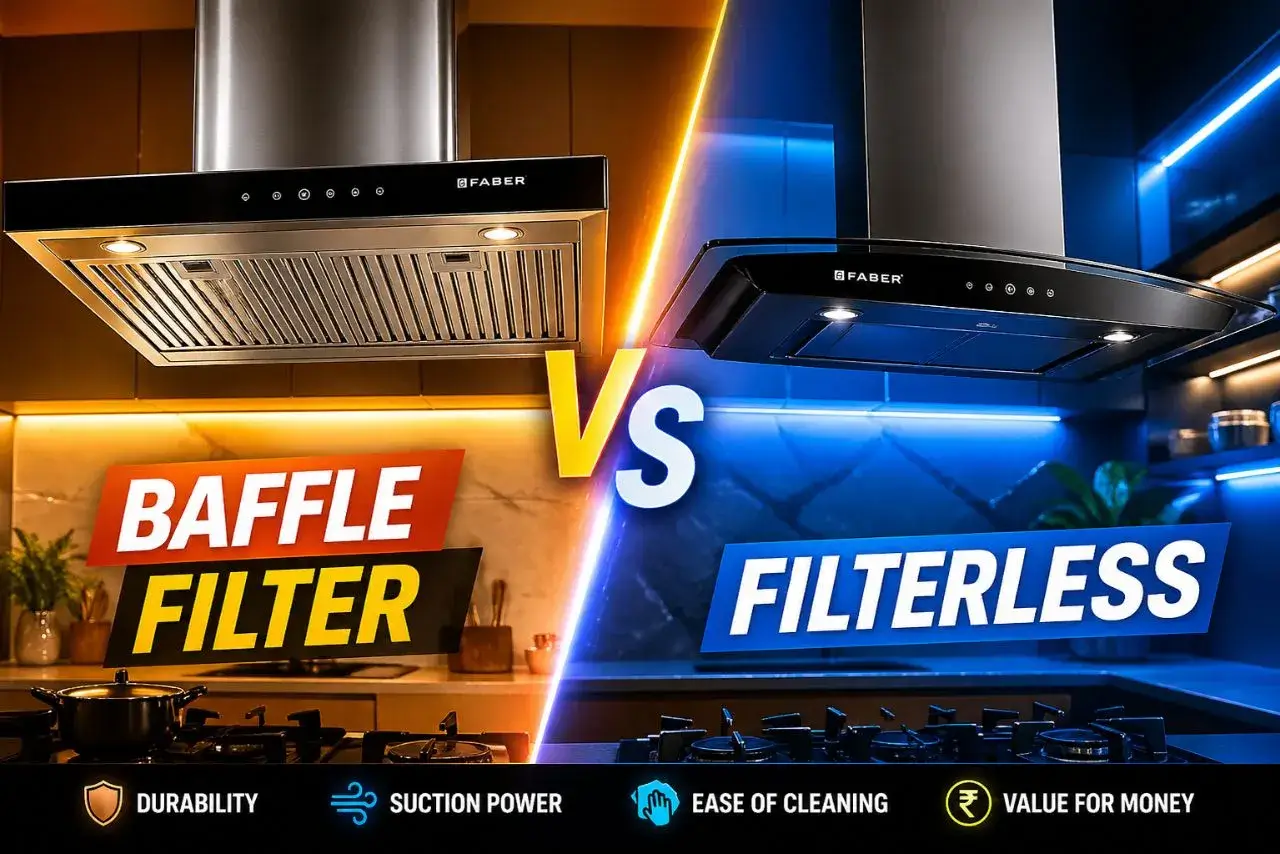
The debate of Baffle Filter vs Filterless Chimney Which is Better, has been going on for years in Indian households. Both technologies have real strengths and real weaknesses. In this guide, I am going to break it all down, from how each kitchen chimney works, to maintenance costs, to which one actually handles that daily tadka and deep frying better. Let us get into it.
If you have ever stood in a kitchen appliance store staring at two chimneys, one labeled “baffle filter” and the other “filterless,” and had absolutely no idea which one to pick, you are not alone. I have been there too. And honestly, the salesperson did not help much either.
Here is a stat that might surprise you: Indian households use an average of 15 liters of cooking oil per month, according to industry estimates. That is a LOT of grease going into the air. So picking the right kitchen chimney is not a small decision.
What is a Baffle Filter Chimney and How Does It Work?
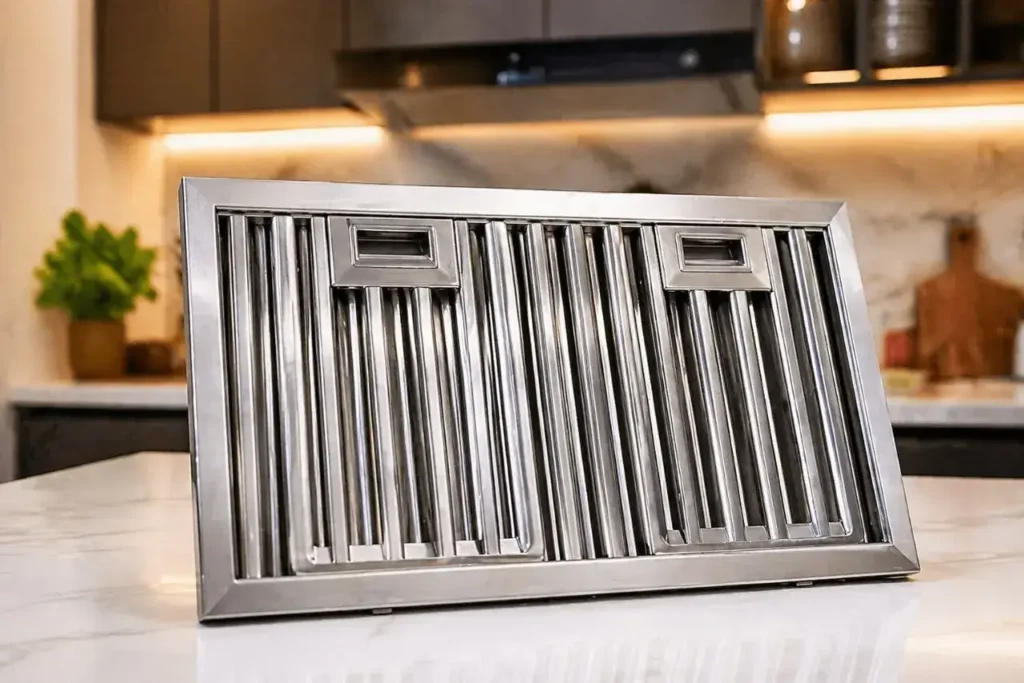
When I first heard the term “baffle filter,” I thought it sounded like something from a science textbook. But the concept is actually pretty simple once you see it in action.
A baffle filter chimney uses a series of curved stainless steel or aluminum panels arranged in a maze-like pattern inside the chimney hood. When cooking smoke and greasy air rise up and enter the chimney, they are forced to change direction multiple times as they pass through these curved panels. Each time the air changes direction, heavier grease and oil particles lose speed and stick to the metal surfaces. The clean air then continues upward and exits through the exhaust duct.
This process is called the “cut and splash” mechanism. The baffles literally cut through the airflow and splash the grease onto the filter walls. It is simple, mechanical, and surprisingly effective. Most quality baffle filters are made from stainless steel, which resists rust, handles high heat well, and lasts for years with regular cleaning.
One thing I really appreciate about baffle filters is that they do not clog easily. Unlike old-school mesh filters that would get gunked up within days of heavy cooking, the curved design of a baffle filter keeps airflow moving consistently. Suction capacity for baffle filter chimneys typically ranges from 1000 m3/hr to 1250 m3/hr, which is more than enough for a medium-sized Indian kitchen.
Key Features of Baffle Filter Chimneys
- Material: Stainless steel or high-grade aluminum curved panels
- Mechanism: Cut and splash technology that forces directional changes in airflow
- Suction Capacity: 1000 m3/hr to 1250 m3/hr
- Cleaning: Manual washing every 2-3 weeks for heavy cooking kitchens
- Lifespan: Baffle filters can last the lifetime of the chimney with proper care
- Price Range: Starting from Rs 8,000 to Rs 25,000
Advantages and Disadvantages of Baffle Filter Chimney
| Advantages | Disadvantages |
| Excellent grease trapping, over 95% efficiency for heavy cooking | Requires manual chimney cleaning every 2-3 weeks |
| Durable stainless steel construction | Can be heavy and bulky to handle during filter cleaning |
| Dishwasher-safe filters for easy maintenance | May produce slightly more noise due to directional airflow |
| Lower initial cost compared to filterless chimney models | Not ideal for light-cooking or apartment kitchens |
| Works well in ductless kitchen setups | Grease buildup can affect suction power if cleaning is delayed |
| It can be heavy and bulky to handle during filter cleaning | Protects the chimney motor from direct grease contact |
What is a Filterless Chimney and How Does It Work?

Filterless chimneys are the newer generation in kitchen ventilation. When I first saw one at a friend’s house, I thought it was just a regular chimney with the filter removed. Turns out, the entire system works on a completely different principle.
A filterless chimney uses a high-speed motor to generate a powerful centrifugal force inside the hood. When cooking fumes enter the chimney, the motor spins at very high RPM, creating a vortex effect. This spinning action throws the heavier grease and oil particles outward toward the chimney walls, where they slide down into a detachable oil collection tray. The lighter, cleaner air exits through the exhaust. No filter required.
Many filterless chimneys also come with an auto-clean feature. You press a button, the motor runs a reverse-spin cycle, and accumulated oil inside the chimney gets directed into the collection tray. The entire auto-clean process takes about 9 to 15 minutes, depending on the model. That is pretty impressive.
Since there is no filter blocking the airflow, filterless chimneys tend to have higher suction capacity ratings. Most models deliver between 1200 m3/hr and 1600 m3/hr, and premium models with BLDC motors can go even higher. They are also generally quieter because the air path is unobstructed.
The trade-off, though, is cost. Filterless chimneys with auto-clean technology are priced between Rs 10,000 and Rs 35,000. They also need professional chimney servicing every 6 to 12 months to keep the motor and internal chambers clean, which can add Rs 3,000 to Rs 5,000 every service visit.
Key Features of Filterless Chimneys
- Material: High-grade metal housing with sealed, repositioned motor
- Mechanism: Centrifugal force with a high-speed motor and vortex airflow
- Suction Capacity: 1200 m3/hr to 1600 m3/hr
- Cleaning: Auto-clean button cycles every 2-3 weeks; professional servicing every 6-12 months
- Lifespan: Long-lasting but motor-dependent
- Price Range: Rs 10,000 to Rs 35,000
Advantages and Disadvantages of a Filterless Chimney
| Advantages | Disadvantages |
| Minimal day-to-day chimney maintenance | Higher upfront chimney price |
| Auto-clean feature reduces manual effort significantly | Requires professional chimney servicing every 6-12 months |
| Higher suction capacity (1200-1600 m3/hr) | Complex technology may need costly repairs |
| Quieter operation due to unobstructed airflow | Not suited for heavy commercial kitchen-style cooking |
| Sleek, modern design suits modular kitchen | Sleek, modern design suits a modular kitchen |
| No filter replacement costs | May develop odors in high-oil Indian cooking environments |
Baffle Filter Vs Filterless Chimney: Head-to-Head Comparison
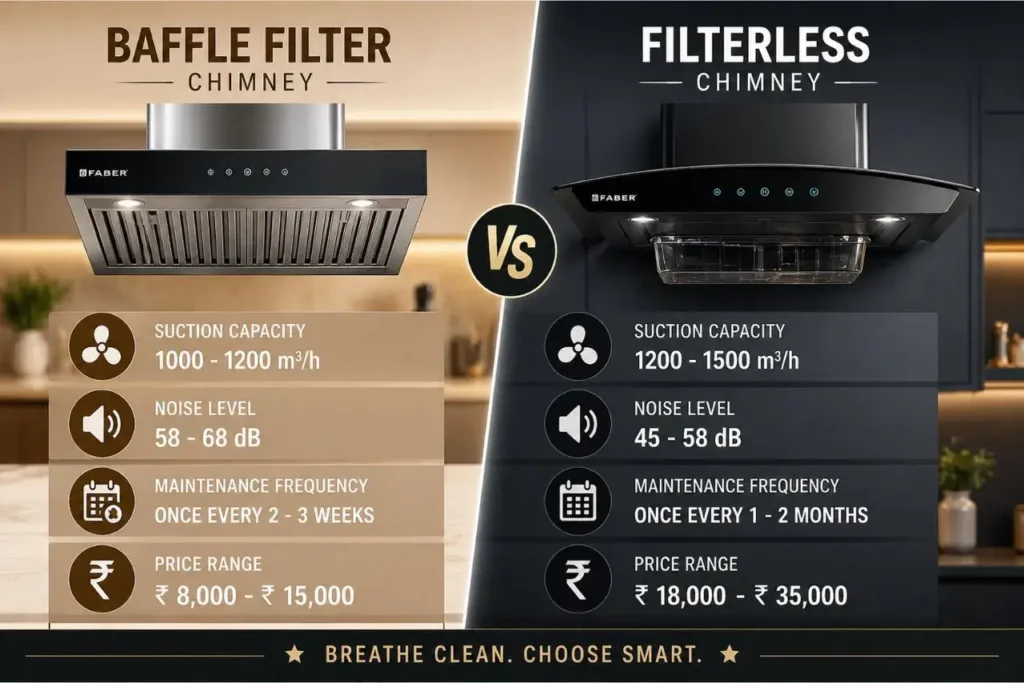
This is the part you have been waiting for. Let me lay out the real differences between a baffle filter vs filterless chimney across every category that matters to an Indian homeowner.
Grease Trapping Efficiency
For heavy Indian cooking, the baffle filter chimney wins here. Mechanical filtration through the curved panels captures fine oil particles from tadka, deep frying, and ghee-based cooking with over 95% efficiency. The grease collects on the filter panels rather than reaching the motor, which protects the internal components and keeps the chimney working well for longer.
Filterless chimneys use centrifugal force to separate grease, which works well for moderate cooking. But when you are doing daily deep frying or back-to-back cooking sessions, some fine oil particles may still pass through and coat the internal motor housing over time. That is why these chimneys need professional internal cleaning periodically.
Maintenance Requirements

This is where filterless chimneys have a clear advantage for many people. You simply press the auto-clean button every couple of weeks and empty the oil tray once a month. No scrubbing, no soaking, no wrestling with greasy steel panels in the kitchen sink.
Baffle filter chimney maintenance is more hands-on. You need to remove the filters, soak them in hot water with baking soda or dish soap for 15-20 minutes, scrub off stubborn grease, and let them dry before replacing. For a family that does heavy cooking every day, this needs to happen every 2-3 weeks. For moderate cooking, once a month is fine. Yes, the filters are dishwasher-safe, so that helps. But it is still more effort than pressing a button.
Suction Power
Filterless chimneys generally deliver higher raw suction capacity numbers. Filterless models range from 1200 m3/hr to 1600 m3/hr, while baffle filter chimneys typically offer 1000 m3/hr to 1250 m3/hr. But here is something I learned the hard way: higher suction capacity numbers do not always mean better performance in practice.
Because baffle filter chimneys physically trap grease before it enters the motor, the suction power remains consistent over time. A filterless chimney can lose effective suction if the internal chambers or turbine accumulate oil buildup and are not serviced regularly. So while the specs favor filterless models on paper, real-world performance can be very close.
Noise Levels
Filterless chimneys tend to operate more quietly because there is no filter creating resistance in the airflow. Baffle filter chimneys can produce slightly more noise due to the directional changes air is forced to make through the panels. That said, most modern baffle filter chimneys operate at 58-65 dB, which is comparable to a normal conversation. So, unless you have a very noise-sensitive household, this difference is minor.
Installation and Compatibility
Baffle filter chimneys are more flexible when it comes to chimney installation. They work in both ducted chimney (external venting) and ductless chimney (recirculation) setups. If your apartment does not allow external ductwork, a baffle filter chimney with charcoal filters is a solid option.
Filterless chimneys work best with external ducting. Without proper ducting, the centrifugal separation system loses much of its advantage. If you live in a rented apartment or a building that restricts external ductwork, a filterless chimney may not be the right fit for you.
Cost Over 5 Years: Baffle Filter vs Filterless Chimney
This is something most buyers forget to calculate. Here is a realistic breakdown:
| Cost Factor | Baffle Filter Chimney | Filterless Chimney |
| Initial Purchase | Rs 8,000 – Rs 25,000 | Rs 10,000 – Rs 35,000 |
| Filter Replacement (5 years) | Near zero (durable stainless steel) | Not applicable |
| Professional Servicing (5 years) | Minimal (DIY cleaning works) | Rs 3,000-5,000 per visit x 2-3 visits/year |
| Total 5-Year Estimated Cost | Rs 8,000 – Rs 25,000 | Rs 40,000 – Rs 80,000+ |
The filterless chimney looks cheaper to maintain day-to-day, but those professional chimney servicing fees add up fast over five years. Baffle filter chimneys, when cleaned regularly by the homeowner, have very low long-term chimney maintenance costs.
Baffle Filter vs Filterless Chimney Which is Better for Indian Cooking
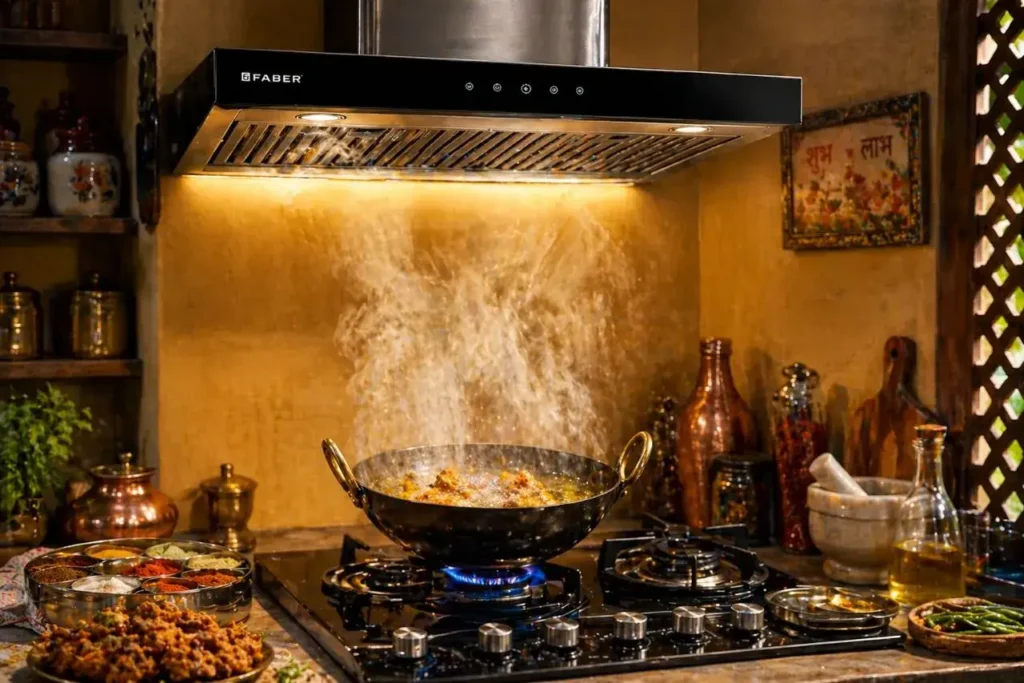
Indian cooking is unique. We use a LOT of oil, ghee, and butter, do daily tadkas with mustard seeds and curry leaves in hot oil, and deep fry samosas, pakoras, and puris. We make gravies that send thick, oily smoke upward. Standard kitchen ventilation systems designed for lighter Western-style cooking simply cannot keep up.
For this reason, baffle filter chimneys have traditionally been the preferred choice for Indian kitchens. The mechanical grease-trapping system handles thick, oil-heavy smoke better than centrifugal separation alone. The motor also stays cleaner because the baffle panels act as a protective barrier.
However, if your cooking style is more moderate, say, you cook 1-2 dishes a day with moderate oil use, or you mostly prepare salads, steamed food, or light stir-fries, a filterless chimney is a perfectly good choice. The convenience of auto-clean is genuinely useful for busy households that do not want to deal with filter cleaning.
Here is my quick decision guide:
- Choose a Baffle Filter Chimney if: You cook daily heavy Indian food (frying, tadka, ghee-based dishes), have a large family, want lower long-term costs, or cannot install external ducting.
- Choose a Filterless Chimney if: You prefer minimal hands-on chimney maintenance, cook lighter meals, have a modern modular kitchen, can install proper external ducting, and are comfortable with professional servicing costs.
Top Brands Offering Baffle Filter and Filterless Chimneys in India
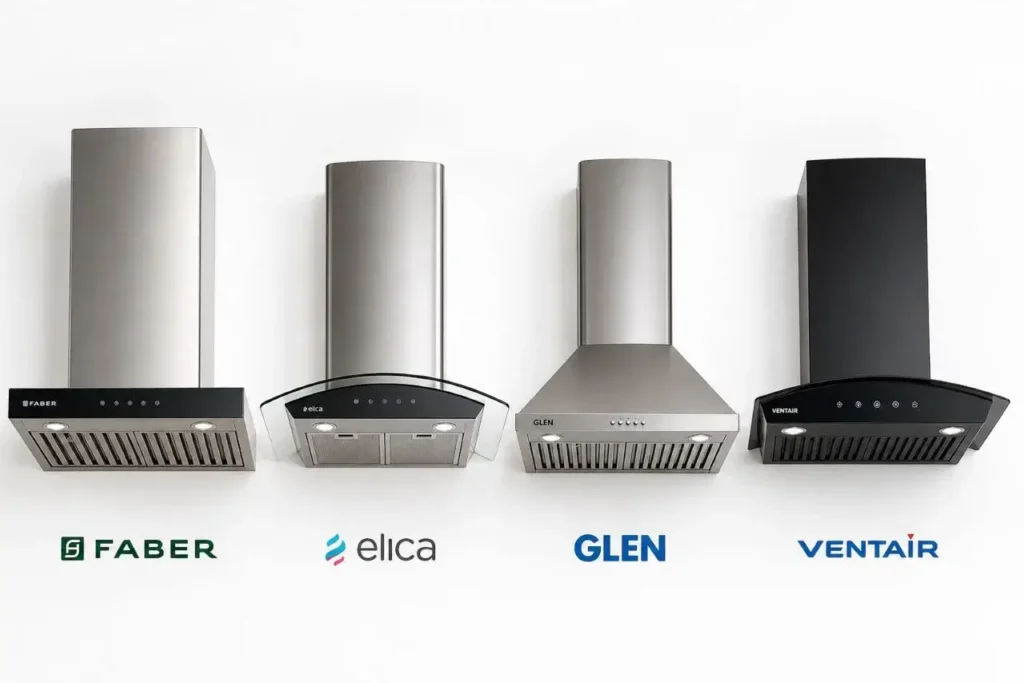
The Indian kitchen chimney market has several strong players. Here is a quick overview of what each brand offers across both chimney types:
Baffle Filter Chimney Brands
- Faber chimney: Offers triple-layer aluminum and stainless steel baffle filters with auto-clean. Popular models like the Faber 90 cm deliver 1500 m3/hr suction at a 59 dB noise level.
- Elica chimney: Known for powerful suction up to 1425 m3/hr with baffle filter auto-clean models. Good after-sales service network.
- Crompton chimney: The Intellisense 90 cm baffle filter chimney is well-regarded for Indian kitchens with smart-on temperature detection.
- Glen chimney: Offers baffle filter chimneys from 1000-1250 m3/hr with pyramid, curved glass, and island designs. Comes with a 2-year warranty.
Filterless Chimney Brands
- Ventair chimney: India’s first voice-enabled auto-clean chimney with 1600 m3/hr suction and Bluetooth. The Sapphire 5G model is a top pick for modern kitchens.
- Glen chimney: Filterless chimneys with 1200-1600 m3/hr suction, BLDC motor options, and Wi-Fi controls.
- Prestige chimney: The Edge series features motion sensor technology and smart maintenance reminders, priced between Rs 10,000 and Rs 35,000.
- Bosch chimney: Premium filterless models known for quiet operation and elegant design, suited for modular kitchens.
Maintenance Tips to Get the Most from Your Chimney

Whether you go with a baffle filter chimney or a filterless chimney, proper chimney maintenance is what determines how long it lasts and how well it performs. Here are practical tips I have picked up over the years.
For Baffle Filter Chimney Maintenance
- Remove and wash the baffle filters every 2-3 weeks if you do heavy cooking, or once a month for moderate use.
- Soak in hot water mixed with liquid dish soap or baking soda for 15-20 minutes before scrubbing.
- Most stainless steel baffle filters are dishwasher-safe; use the high-heat cycle.
- Wipe down the chimney body with a damp cloth weekly to prevent grease buildup on the exterior.
- Check the oil collector tray after each heavy cooking session and clean it before it overflows.
- Never use abrasive scrubbers on stainless steel surfaces; they scratch and make future chimney cleaning harder.
For Filterless Chimney Maintenance
- Press the auto-clean button every 2-3 weeks as recommended by the manufacturer.
- Empty the oil collection tray every month, or more frequently during heavy cooking periods.
- Wipe down internal chambers quarterly with a degreasing spray to prevent stubborn oil buildup.
- Schedule professional motor servicing every 6-12 months. This is not optional; skipping it leads to motor damage over time.
- Wipe the glass chimney exterior weekly to keep the chimney looking good.
- If you notice reduced suction power or unusual chimney noise, call a technician immediately rather than waiting for the scheduled service.
Common Mistakes to Avoid When Buying a Kitchen Chimney

I have seen friends buy kitchen chimneys based purely on brand name or looks, and then regret it six months later. Here are the mistakes you want to avoid.
Buying based on suction capacity numbers alone is one of the biggest traps. A 1600 m3/hr filterless chimney sounds amazing, but if it is not properly serviced and the internal turbine gets coated in grease, the effective suction power drops significantly. Always check what the chimney maintenance requirements are before you buy.
Another mistake is ignoring the chimney installation setup. Filterless chimneys need good external ducting to perform at their best. If you buy one for an apartment where the ductwork is long or has multiple bends, the actual suction reaching the kitchen will be far below the rated suction capacity.
People also forget to match the chimney width to the cooktop size. A 60 cm chimney works for 2-3 burners, while a 90 cm chimney is better for 4-5 burners. Getting the wrong size means cooking smoke escaping around the sides of the hood.
Finally, do not skip after-sales service research. Brands like Faber and Elica have wide service networks across India. Smaller or imported brands may look attractive on paper, but leave you stranded when you need a technician.
Conclusion: Baffle Filter Vs Filterless Chimney Which is Better?

So here is the bottom line on baffle filter vs filterless chimney: there is no universal winner. The right choice depends on your kitchen, your cooking style, and your budget.
If you cook heavy Indian food daily with lots of oil, frying, and tadkas, and you want a reliable, long-lasting kitchen chimney at a reasonable cost, go with a baffle filter chimney. It handles thick grease better, protects the motor, and costs far less to maintain over the long run.
If you want a modern, sleek chimney with minimal hands-on chimney maintenance, cook lighter meals, and are okay with periodic professional chimney servicing costs, a filterless chimney is a great choice for you.
The most important thing is to match the chimney to your actual cooking style. A high-end filterless chimney in a kitchen that does daily deep frying is going to struggle. And an overqualified Baffle filter chimney in a minimalist kitchen is just an unnecessary expense.
Think about how you cook, how much time you want to spend on chimney maintenance, and what your long-term budget looks like. That decision framework will get you to the right answer every single time.
If this guide helped you, share it with someone who is currently trying to pick a kitchen chimney. And if you have questions about specific models or brands, drop them in the comments. I read everyone.
Frequently Asked Questions: Baffle Filter Vs Filterless Chimney
1. Which chimney is best, with filter or without filter?
It honestly depends on how you cook. I have used both types in different kitchens, and here is what I can tell you from real experience.
If your household does heavy Indian cooking, daily deep frying, tadka, ghee-based curries, and spice-heavy meals, a baffle filter chimney is the better pick. The physical stainless steel baffle panels trap grease and oil particles with over 95% efficiency, and the motor stays protected because the filter catches everything before it gets that far. It is a proven, reliable system that has worked well in Indian kitchens for decades.
If you cook lighter meals, steamed food, light stir-fries, or maybe 1-2 dishes a day with moderate oil, a filterless chimney works great. The auto-clean feature means you press a button and the chimney cleans itself in about 9-15 minutes. No scrubbing, no soaking filters in the sink.
The short answer: baffle filter chimney for heavy Indian cooking. Filterless chimney for convenience and lighter cooking styles.
2. Does a filterless chimney require service?
Yes, and this is something a lot of buyers do not find out until after the purchase. I have seen people assume a filterless chimney is truly maintenance-free, and that assumption costs them later.
A filterless chimney requires professional motor servicing every 6 to 12 months. The reason is straightforward, since there is no physical baffle filter stopping grease, over time, the oil particles coat the turbine, internal chamber walls, and motor housing. If this oil buildup is not cleared by a technician, the suction power drops noticeably, and the motor can get damaged.
Here is what the maintenance schedule for a filterless chimney typically looks like:
- Auto-clean button cycle: Every 2-3 weeks
- Oil collection tray emptying: Every month
- Internal chamber wipe-down: Every 3 months
- Professional motor servicing: Every 6-12 months, this costs approximately Rs 3,000 to Rs 5,000 per visit
So no, a filterless chimney is not maintenance-free. It is lower maintenance than a baffle filter chimney in terms of daily and weekly effort, but it is not zero maintenance, and the professional servicing cost adds up significantly over 5 years.
3. Is a baffle filter better than a filterless?
For Indian cooking, a baffle filter chimney is generally the better performer. Here is why I say that with confidence.
The baffle filter uses the cut and splash mechanism, curved stainless steel panels force cooking fumes to change direction multiple times, causing grease and oil particles to separate and collect on the filter walls. This mechanical process traps oil particles with over 95% efficiency, which is hard to beat.
A filterless chimney uses centrifugal force instead. This works well for moderate oil and smoke levels, but during intense deep frying or back-to-back cooking sessions, some fine grease particles pass through and settle on the motor housing. That is why filterless chimneys need professional servicing periodically.
Where the filterless chimney wins is convenience. The auto-clean feature reduces the hands-on cleaning effort dramatically compared to manually washing baffle filters every 2-3 weeks.
So to answer directly: Baffle filter chimney is better for grease trapping efficiency and long-term cost. A filterless chimney is better for ease of daily maintenance. Which one is “better” depends entirely on your cooking style and how much time you want to spend on upkeep.
4. Which filter is better for chimneys?
There are several chimney filter types available in the Indian market, and each one is built for a different kind of kitchen. From my experience testing and using these, here is how they rank:
Baffle filters are the best overall for Indian kitchens. Made from stainless steel or aluminum, they use the cut and splash mechanism to trap grease without clogging easily. They are dishwasher-safe, durable, and can last the lifetime of the chimney with proper cleaning.
Mesh filters or cassette filters are older technology. They work by layering fine metal mesh to trap grease, but they clog quickly in heavy Indian cooking environments and need more frequent replacement. They are found in older or budget chimney models.
Charcoal filters are used in ductless chimneys where there is no external exhaust duct. They absorb cooking odors and recirculate clean air back into the kitchen. These need replacement every 3-6 months at approximately Rs 500 to Rs 1,500 per set, which adds to long-term cost.
No filter (filterless) uses centrifugal force instead of a physical filter. This is the most modern approach, suited to kitchens that can install proper external ducting.
Ranked for Indian kitchens: Baffle filter is the top choice, followed by filterless with proper ducting, then charcoal filter for ductless setups, then mesh or cassette filter as the least preferred option.
5. What are the 4 types of filter?
When it comes to kitchen chimney filters, there are four main types you will come across in India:
1. Baffle Filter: The most popular type for Indian cooking. Uses curved stainless steel or aluminum panels to separate grease and oil particles from cooking fumes through the cut and splash mechanism. Highly durable, dishwasher-safe, and effective at suction capacity from 1000 m3/hr to 1250 m3/hr. Ideal for deep frying, tadka, and ghee-based cooking.
2. Mesh Filter (Cassette Filter): An older design made from multiple layers of aluminum or stainless steel mesh. Traps large grease particles but clogs frequently in heavy Indian cooking environments. Requires regular cleaning or replacement every 3-6 months. Found mainly in budget or older chimney models.
3. Charcoal Filter (Carbon Filter): Used specifically in ductless chimneys where no external exhaust duct is available. Contains activated carbon that absorbs cooking odors, smoke, and some grease particles. Does not eliminate all contaminants and needs replacement every 3-6 months. Works best when combined with a baffle filter or mesh filter for better grease trapping.
4. No Filter (Filterless): The newest technology in kitchen chimney design. Uses a high-speed motor and centrifugal force to spin grease particles into an oil collection tray without any physical filter. Comes with an auto-clean feature and requires professional servicing every 6-12 months. Best for kitchens with proper external ducting and moderate cooking oil use.
6. What are the two basic filter types?
At the most fundamental level, kitchen chimney filters can be grouped into two basic categories:
1. Physical Filters: These are filters you can see, touch, remove, and clean. They physically intercept grease, oil particles, and cooking fumes as air passes through the chimney hood. This category includes baffle filters, mesh filters, and charcoal filters. Physical filters create a barrier between cooking smoke and the chimney motor, protecting internal components from grease buildup. They require hands-on maintenance, either regular manual washing or periodic replacement.
2. Filterless Systems (Technology-Based Filtration): These use technology rather than a physical barrier to remove grease from cooking fumes. Filterless chimneys rely on centrifugal force generated by a high-speed motor to spin oil and grease particles into an oil collection tray. There is no filter to wash or replace, but the system still requires professional servicing every 6-12 months to clean internal components and maintain suction power.
In simple terms, physical filters are lower-cost and hands-on; filterless technology is higher-cost and more automated. For Indian kitchens with heavy cooking, physical baffle filters remain the more reliable option of the two.
7. What are three different types of filters?
The three most commonly used kitchen chimney filter types in India are:
1. Baffle Filter: The most widely used filter type in Indian kitchens today. Made from curved stainless steel or aluminum panels, it works on the cut and splash mechanism, forcing cooking fumes through a series of directional changes that separate grease from clean air. Baffle filters do not clog easily, handle heavy Indian cooking well, and are dishwasher-safe for easy maintenance. Suction capacity stays consistent at 1000-1250 m3/hr over time. Cleaning is needed every 2-3 weeks for heavy cooking kitchens.
2. Cassette Filter (Mesh Filter): An older but still available option. Uses stacked layers of fine aluminum or stainless steel mesh to trap grease particles. Effective for light cooking but prone to clogging in heavy Indian cooking conditions where oil use is high. These filters need more frequent cleaning than baffle filters and may need full replacement over time. Cost of replacement runs around Rs 500 to Rs 1,500 per set.
3. Charcoal Filter (Carbon Filter): Used in ductless chimneys where no external exhaust duct is available. Activated carbon inside the filter absorbs cooking odors and lighter smoke particles, recirculating cleaner air back into the kitchen. Important note: charcoal filters do not trap grease as effectively as baffle filters. They are best used as a secondary layer in combination with a baffle or mesh filter. Replacement every 3-6 months is required at a cost of roughly Rs 500 to Rs 1,500.
8. Does a filterless chimney require a duct?
Yes, a filterless chimney works best with proper external ducting, and this is one of the most important things to verify before buying one. I cannot stress this enough. I have seen homeowners buy a premium filterless chimney only to find out their apartment building does not allow external ductwork.
Here is how it works: a filterless chimney uses centrifugal force to separate grease particles from cooking fumes and collects the oil in a tray. But the remaining smoke, moisture, and cooking odors still need to go somewhere. Without external ducting, that air recirculates inside your kitchen. The centrifugal separation process handles grease, but without a duct to carry cooking fumes outside, smoke and odors build up indoors.
Some filterless chimneys can technically be used in ductless mode with charcoal filters added, but performance suffers significantly. The suction capacity advantage, which can reach 1600 m3/hr in ducted mode, drops considerably in ductless operation.
Before buying a filterless chimney, check:
- Whether your building or apartment allows external ductwork
- The length and number of bends in the duct path, longer or more curved ducts, reduce effective suction
- Whether a 60 cm chimney or a 90 cm chimney size is right for your cooktop width
If external ducting is not possible, a baffle filter chimney with a charcoal filter added for ductless recirculation is the more practical choice.
9. How often should filters be changed?
The answer varies depending on which chimney filter type you have and how much you cook. Here is a breakdown based on my experience and manufacturer guidelines:
Baffle Filters (Stainless Steel): These do not need to be replaced at all under normal use, just cleaned regularly. Clean every 2-3 weeks for heavy Indian cooking (daily frying, tadka, high oil use), or once a month for moderate cooking. Soak in hot water with dish soap or baking soda for 15-20 minutes before scrubbing. Most are dishwasher-safe. With consistent cleaning, stainless steel baffle filters can last the entire lifespan of the chimney.
Mesh Filters (Cassette Filters): These need cleaning every 2-4 weeks and full replacement every 6-12 months, depending on how heavily they are used. Replacement cost is approximately Rs 500 to Rs 1,500 per set. If you notice that cleaning no longer restores suction power, it is time to replace the filter.
Charcoal Filters (Carbon Filters): These cannot be cleaned, only replaced. Replacement is needed every 3-6 months, regardless of how much you cook, because the activated carbon becomes saturated and loses its odor-absorbing ability. Replacement cost runs about Rs 500 to Rs 1,500 per set.
Filterless Chimneys: No filter replacement needed, but the oil collection tray must be emptied monthly, and professional motor servicing is required every 6-12 months.
Quick summary: baffle filters = clean regularly, rarely replace. Charcoal filters = replace every 3-6 months. Mesh filters = replace every 6-12 months.
10. Are expensive filters always better?
Not always, and I have learned this the hard way after spending more than I needed to on certain models. Price is not the only thing that determines how well a kitchen chimney filter performs.
A mid-range stainless steel baffle filter chimney priced between Rs 10,000 and Rs 15,000 from a reliable brand like Faber, Elica, or Glen will outperform a poorly designed premium filterless chimney in a heavy Indian cooking environment every single time. What matters more than price is:
Filter material: A stainless steel baffle filter outlasts and outperforms an aluminum mesh filter regardless of which one costs more. Stainless steel resists rust, handles high heat, and is more durable over the years of use.
Match to cooking style: An expensive filterless chimney at Rs 30,000 with 1600 m3/hr suction is not the best choice for an apartment that cannot install proper external ducting. A Rs 12,000 baffle filter chimney with correct ducting will deliver better real-world performance.
Brand service network: A premium chimney from a brand with no service centers near you is a liability. Brands like Faber and Elica have wide service networks across India, which matters for long-term chimney maintenance.
Suction capacity vs actual need: A 1500 m3/hr chimney is overkill for a small 2-3 burner kitchen. You do not need to spend extra for suction power that exceeds your actual cooking volume.
So expensive filters and chimneys can be worth it, but only when they match your kitchen setup and cooking style. Do not pay for features you will not use.
11. How to know if a filter is bad?
There are several clear warning signs that your chimney filter is not working properly. I always tell people to pay attention to these signals before the problem gets worse.
Reduced suction power: This is the most obvious sign. If you notice that cooking smoke is not being pulled into the chimney as quickly as it used to be, the filter is likely clogged with grease buildup. Try cleaning the baffle filter first. If suction does not improve after a thorough cleaning, the filter may need replacement.
Visible grease overflow: If grease is dripping from the chimney onto your stovetop or walls, the oil collector tray is full, or the filter is so clogged it can no longer hold grease. This needs immediate attention.
Unusual chimney noise: A clogged or damaged filter can change the airflow pattern inside the chimney, causing rattling, vibrating, or increased noise levels beyond the normal 58-65 dB range.
Persistent cooking odors: If strong cooking smells linger in the kitchen even when the chimney is running at full power, the filter is not capturing smoke and oil particles effectively. For charcoal filters, this almost always means replacement is overdue.
Visible damage or warping: Stainless steel baffle filters can warp at extreme heat. If the curved panels are bent out of shape, the cut and splash mechanism no longer works correctly, and the filter needs replacing.
Discoloration that does not clean off: A dark yellow or brown coating that remains even after soaking and scrubbing indicates heavy grease buildup that has hardened over time. At this point, replacement is more effective than further cleaning attempts.
12. What happens if you don’t change your filters?
Neglecting chimney filter maintenance is one of the most common mistakes I see, and the consequences go beyond just reduced performance. Here is what actually happens over time.
Suction power drops dramatically: A clogged baffle filter or mesh filter restricts airflow significantly. The chimney motor has to work harder to pull cooking fumes through the blocked filter, which reduces effective suction capacity well below the rated figure. Cooking smoke starts escaping into the kitchen instead of being pulled into the chimney hood.
Grease buildup becomes a fire risk: This is the most serious consequence. Accumulated grease inside a chimney is highly flammable. Cooking oil vapors and built-up grease near a heat source create a genuine fire hazard. Regular chimney filter cleaning and filter replacement when needed is not just about performance; it is a safety issue.
Motor damage occurs: When grease bypasses a neglected filter and reaches the chimney motor, it coats the motor windings and bearings. Over time, this causes overheating, reduced efficiency, and eventually motor failure. Replacing a chimney motor costs significantly more than routine chimney maintenance.
Cooking odors spread through the home: A blocked filter cannot trap cooking fumes effectively, which means smoke, oil vapors, and strong cooking smells recirculate through the kitchen and spread to other rooms.
Long-term chimney lifespan shortens: A chimney that runs for years with clogged filters and neglected maintenance will fail far earlier than one that is cleaned on schedule. A well-maintained baffle filter chimney can last 10-15 years or more. A neglected one may need replacement in half that time.
The fix is simple: clean baffle filters every 2-3 weeks, replace charcoal filters every 3-6 months, and schedule professional servicing for filterless chimneys every 6-12 months. Staying on schedule costs far less than emergency repairs or early replacement.