Written by Mohammed Saqib, researcher and writer at Kitchen Chimney. Last updated: October 23, 2026
Choosing the right 60cm kitchen chimney or 90cm chimney is one of the most consequential decisions in a chimney purchase, more consequential than brand, in some ways. A wrong size means smoke escapes from the outer burners, oil sticks to tiles just outside the suction zone, and no amount of motor power fixes a hood that simply isn’t wide enough. If you’re confused about the right chimney size for your kitchen, this guide walks through exactly how to decide, including the middle-ground option most buying guides skip.
Quick Answer: Should You Choose a 60cm or 90cm Chimney?
Start by measuring the actual width of your hob, then choose a chimney hood that is at least as wide and fits the manufacturer’s installation requirements. A 60cm hood often suits a compact 2- or 3-burner hob around 60cm wide. A 90cm hood is usually a better match for a wider 4- or 5-burner hob or a cooktop approaching 90cm. If your hob falls between these sizes, check whether a 75cm or 76cm model is available. Burner count, kitchen size and rated suction alone cannot determine the correct width.
Before buying, also confirm the hood’s real dimensions, clearances from nearby cabinets, duct route or recirculation setup, and the manufacturer’s recommended installation height. A wider hood can improve coverage, but it still needs to fit your kitchen safely.
Width, Suction and Installation Height: Three Different Checks
These specifications work together, but they answer different questions. Choose the hood width to cover the cooktop, compare suction ratings for your cooking and ventilation needs, and follow the model-specific instructions for installation height. A high suction number cannot compensate for a hood that is too narrow, and width alone does not tell you how much air a chimney moves.
| What to Check | What It Tells You | How to Use It |
|---|---|---|
| Hood width in cm | How much of the cooktop the hood can cover | Measure the hob and compare it with the hood’s actual width and capture design. Where possible, choose a hood at least as wide as the cooking surface. |
| Rated suction in m³/hr | The manufacturer’s stated airflow rating | Compare the exact models and consider cooking intensity, duct length, bends and outlet arrangement. Do not assume every 90cm model has more suction than every 60cm model. |
| Installation height | The permitted distance between the hood and the hob | Follow the installation manual for the exact chimney and cooktop combination. Do not use one universal height for every model. |
| Duct route and diameter | How air can travel from the hood to the outlet | Check the manufacturer’s duct recommendations and avoid unnecessary bends or restrictions. See our Kitchen Chimney Installation Guide. |
Why These Specifications Should Not Be Compared in Isolation
For Indian cooking that includes frequent tadka, frying or grilling, consider the full setup rather than picking the highest advertised suction rating. The right width improves coverage, the airflow rating helps compare ventilation capacity, and suitable installation and ducting help the appliance perform as intended. For more detail, read our Kitchen Chimney Suction Power Guide.
What Does 60cm and 90cm Mean in a Kitchen Chimney?
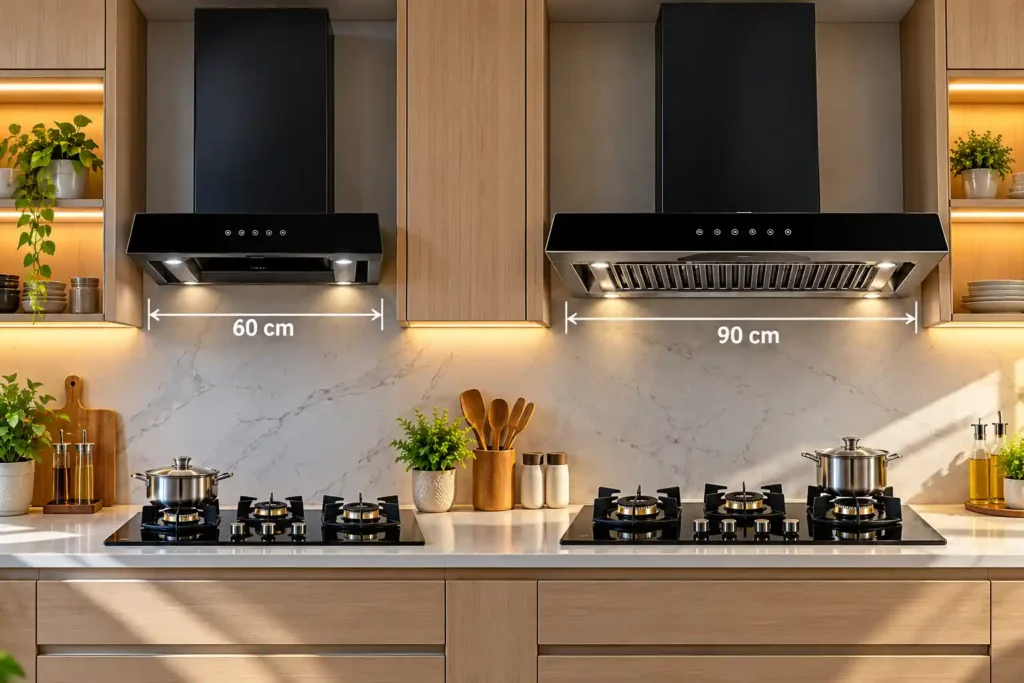
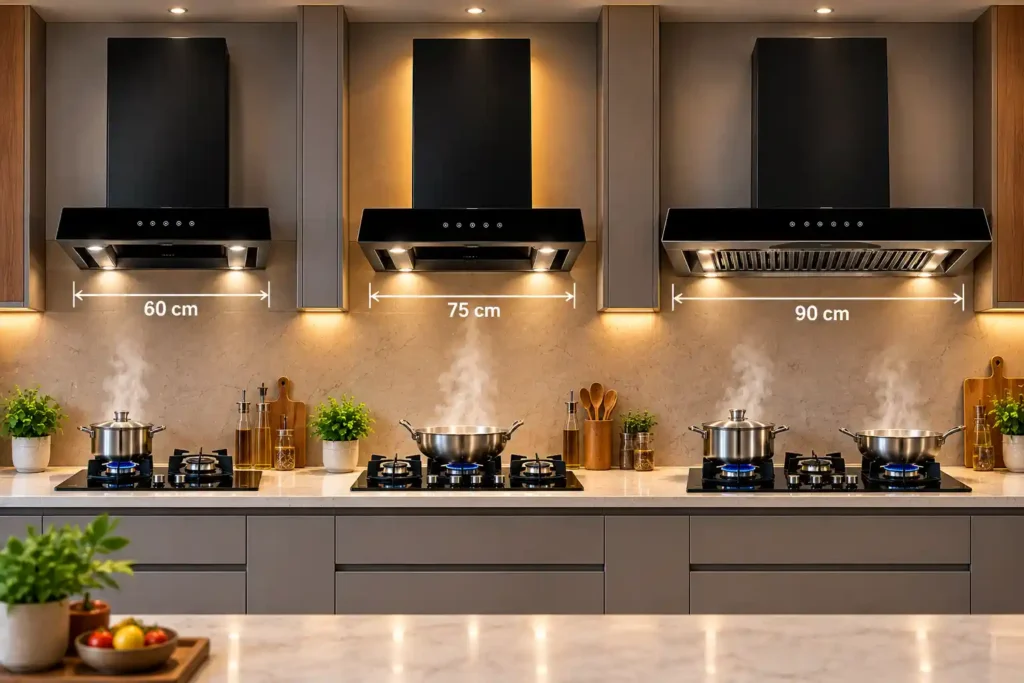
60cm and 90cm refer to the nominal width of the chimney hood, not its suction power. Check the product drawing because the overall outside width and the space required for fitting can differ between models.
60cm kitchen chimney: often suitable for a 2- or 3-burner hob that is no wider than the hood. 90cm kitchen chimney: often better for wider 4- or 5-burner hobs. Some 3-burner hobs are wide enough to need a 75cm or 90cm hood, so measure the cooktop instead of relying only on burner count.
The core rule: choose a hood at least as wide as the cooking surface where possible, and follow the model’s installation instructions. A narrower hood may leave outer burners less effectively covered. Chimney size follows the actual hob dimensions, not the other way around.
Chimney Size in Inches
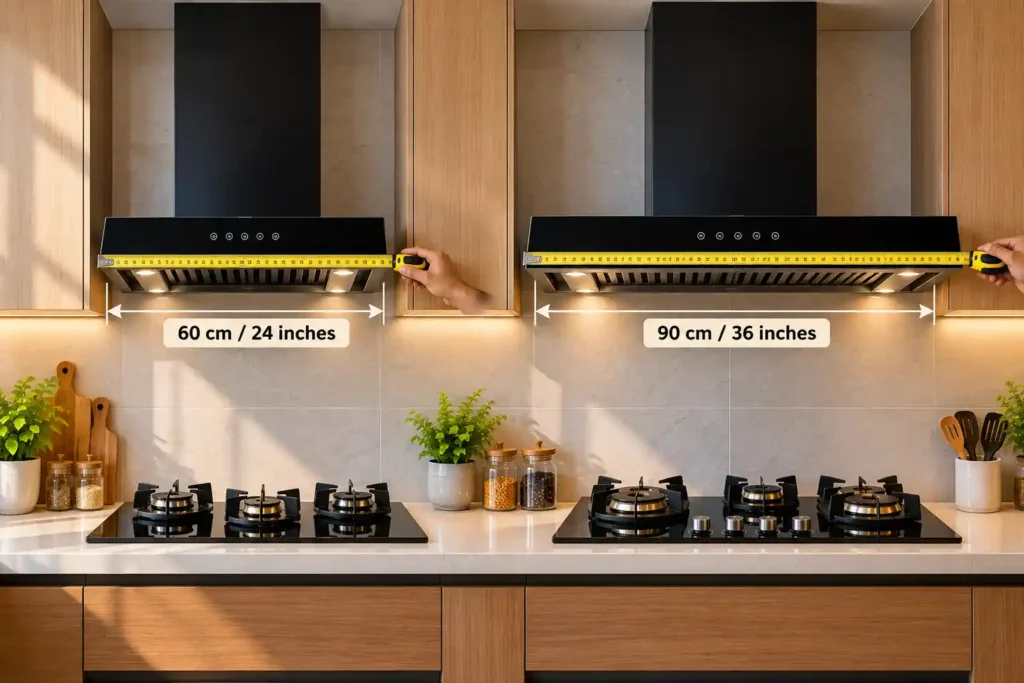
Many buyers search in inches rather than centimetres. A 60cm chimney measures approximately 24 inches (2 feet) across. A 90cm chimney measures approximately 36 inches (3 feet) across.
60cm vs 90cm Kitchen Chimney: Key Differences
| What to Compare | 60cm Chimney | 90cm Chimney |
|---|---|---|
| Nominal hood width | 60cm, about 23.6 inches | 90cm, about 35.4 inches |
| Typical fit | Compact hobs around 60cm wide | Wider hobs around 75cm to 90cm wide |
| Burner count | Often 2 or 3 burners, depending on hob width | Often 4 or 5 burners, depending on hob width |
| Kitchen floor area | Not enough by itself to choose width | Not enough by itself to choose width |
| Suction capacity | Depends on the individual model | Depends on the individual model |
| Installation space | Check the full product width and clearances | Check the full product width, cabinets and clearances |
| Price and running cost | Compare equivalent models and rated power | Compare equivalent models and rated power |
What About 75cm? The Middle Ground Most Guides Skip
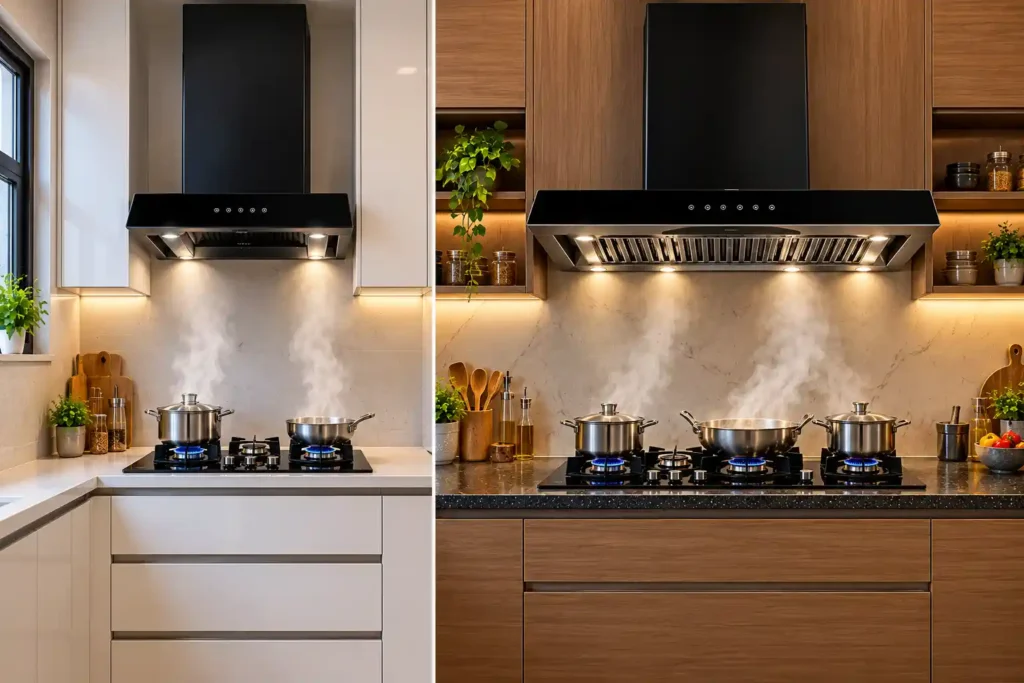
60cm and 90cm get all the attention, but a 75cm (sometimes listed as 76cm) option exists and solves a real problem: some kitchens genuinely sit between the two. A 60cm hood feels tight over a wide 3-burner stove, while a 90cm hood looks oversized and eats into cabinet space that isn’t there to spare.
A 75cm or 76cm chimney can be a useful middle option when the hob is wider than 60cm but a 90cm hood will not fit the planned cabinet run. Match the selected hood to the actual hob width and check the exact model’s outside dimensions and installation clearances. Availability varies by brand and model, so confirm stock and the product drawing before finalising cabinetry.
When Should You Buy a 60cm Kitchen Chimney?
A 60cm kitchen chimney can be a sensible choice for a compact hob and limited wall space, provided its width suits the actual cooking surface and the model offers suitable ventilation performance.
Buy a 60cm chimney if:
- Your 2- or 3-burner hob is around 60cm wide or narrower than the hood, as confirmed by measurements
- Your kitchen has limited wall space and the model’s required clearances can be met
- Your kitchen is a straight-line or galley layout, where a narrower hood fits the counter run naturally
- You want a budget-friendly, compact option
Width and suction are two separate decisions. A suitably sized 60cm hood can work for regular Indian cooking when the model’s airflow, duct route and maintenance meet the household’s needs. For help comparing rated suction with cooking intensity and installation constraints, see our Kitchen Chimney Suction Power Guide.
When Should You Buy a 90cm Kitchen Chimney?
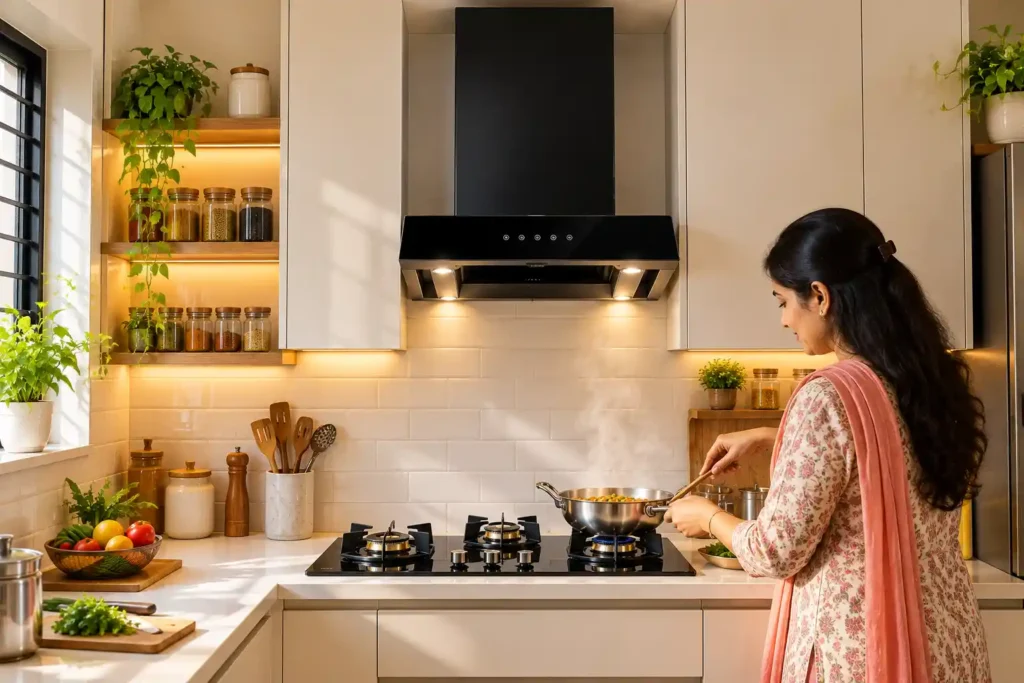
A 90cm kitchen chimney provides a wider capture area and is commonly considered for wider hobs, multiple burners in use, or layouts where a wider hood better suits the cooking surface. Width alone does not guarantee higher suction, which varies by model.
Buy a 90cm chimney if:
- Your measured hob is wider than a 60cm hood and calls for a wider model
- Your cooking surface is wide or several burners are commonly used at once
- You cook multiple dishes simultaneously and do heavy frying
- Your kitchen is an L-shaped, U-shaped, or island layout
- You have compared the rated airflow of specific models and selected one suited to your cooking intensity and duct arrangement
If a four-burner hob is wider than the hood, some fumes from the outer cooking zones may escape more easily. A wider hood can improve coverage, but check the actual hob width and the manufacturer’s size guidance because four-burner hobs are not all the same size.
Kitchen Layout Shape Matters as Much as Burner Count

Most buying advice stops at burner count, but the shape of your kitchen changes the calculation too.
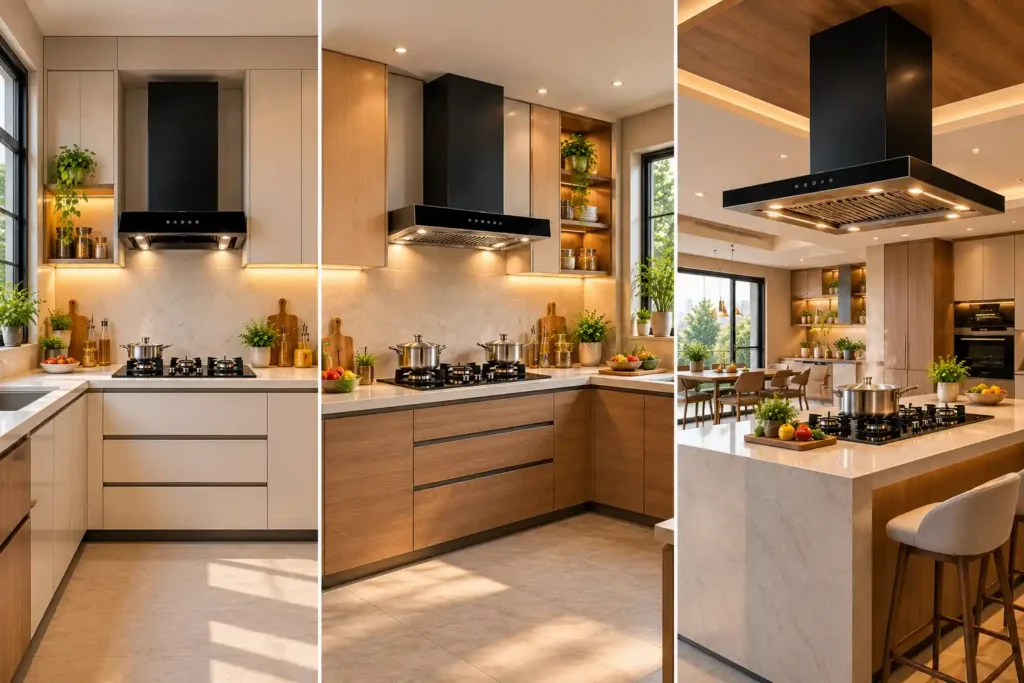
Straight-Line and Galley Kitchens
These suit 60cm comfortably in most cases, since the stove is typically positioned centrally with wall space on either side that doesn’t need covering.
L-Shaped and U-Shaped Kitchens
Choose the hood based on measured hob width and the available mounting space. In L-shaped and U-shaped kitchens, also check nearby cabinets, side walls and cross-draughts, which may make a wider hood useful if it fits safely. The layout shape alone does not determine the size.
Island Kitchens
An island hob needs a compatible ceiling-mounted or island hood centred over the cooking surface. A 90cm unit is common for wide island hobs, but the required width depends on the actual hob and the model’s capture design. Open space around an island can make drafts more relevant, so confirm the choice with the manufacturer’s guidance or installer.
How to Choose the Right Chimney Size for Your Kitchen
Follow these steps to find the right chimney size for your kitchen:
- Measure your stove, not your counter. Measure the actual width of the hob. Start with a hood that is at least as wide as the cooking surface and compare the exact model’s published dimensions and coverage. If the hob falls between 60cm and 90cm, check whether a 75cm or 76cm hood is available.
- Consider the kitchen layout. Straight-line, L-shaped, U-shaped and island kitchens can differ in side clearance, cabinetry and cross-draughts. Let the layout inform the choice where needed, but do not select a wider hood based on shape alone.
- Check the complete fitting space. A nominal 90cm hood may need more clearance for installation, flue cover, cabinets or side panels. Measure the space and compare it with the exact model’s installation drawing instead of relying on one universal wall-width figure.
- Factor in your cooking style. For frequent tadka, frying or grilling, compare rated airflow, fan noise and the duct requirements of specific models. Width and suction are separate considerations. For clearances and duct routing, see our Kitchen Chimney Installation Guide.
Measure the Hob and Check the Fit Before You Buy
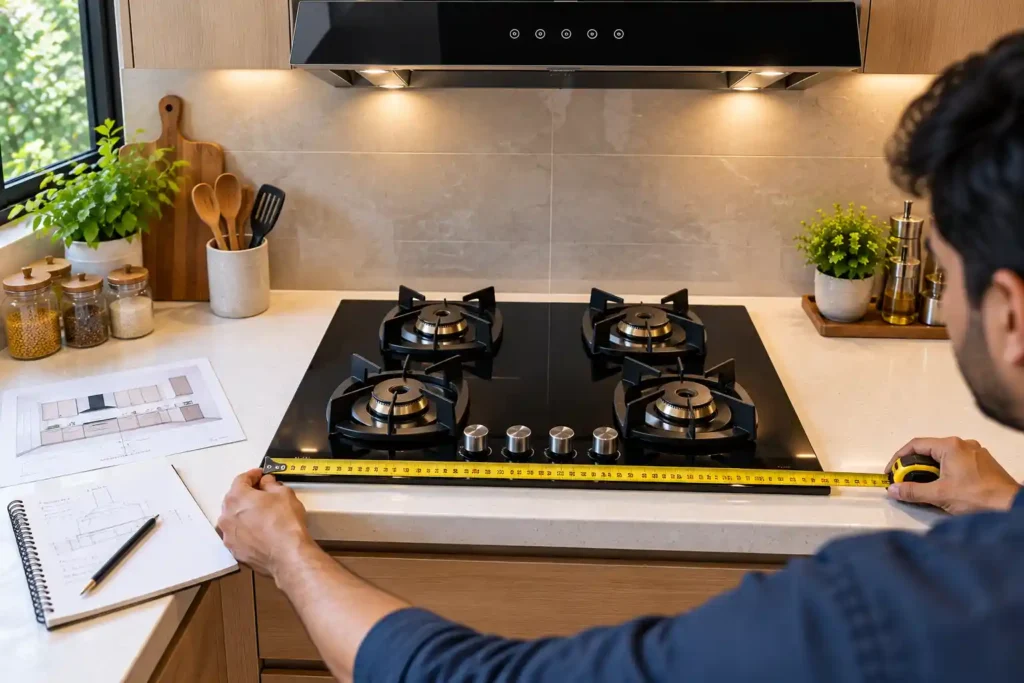
A chimney size guide is a starting point, but a tape measure and the installation drawing for the exact model are what prevent a poor fit. Make these checks before you order the hood or finalise modular cabinets.
Measure the Actual Cooking Surface
- Measure from the leftmost to the rightmost edge of the hob or stove body, not the counter or the gap between burners.
- Compare that width with the hood’s published width and capture area. Do not choose based on the burner count alone because three-burner and four-burner hobs come in different widths.
- If the hob is wider than 60cm, check a 75cm or 76cm model as well as a 90cm option. The correct choice depends on its dimensions and the manufacturer’s recommendations.
Check Cabinets, Flue Cover and Side Clearance
Confirm the full hood width, mounting bracket location, chimney cover or flue dimensions and the clearance required from side cabinets or adjacent walls. Leave the access and service space specified in the product manual. A hood that fits between cabinets on paper may still be unsuitable if a door, shelf or side panel blocks installation or servicing.
Measure Before Finalising Modular Kitchen Cabinets
If the kitchen is being built or renovated, select the hood model before the overhead cabinet sizes are finalised. Give the kitchen installer the manufacturer’s installation drawing, not only the nominal 60cm or 90cm product label. This helps avoid rework and preserves the required ventilation clearances.
Check Installation Height and Ducting Separately
Hood width does not determine the correct distance above the hob. Follow the exact model’s clearance instructions, and confirm the duct diameter and route if the chimney vents outdoors. For these installation details, use our Kitchen Chimney Installation Guide. If an external duct is not possible, compare the trade-offs in our Ducted Vs Ductless Kitchen Chimney Guide.
Two Sizing Mistakes to Avoid
Why Chimney Size Should Never Be Smaller Than Your Stove
A hood narrower than the cooking surface provides less direct coverage of the outer zones, which can make smoke capture less effective. More suction does not change the physical width of the hood. Where possible, choose a model at least as wide as the hob and check the manufacturer’s sizing guidance for that product.
Why Bigger Isn’t Always Better
A wider hood can be suitable even over a smaller hob if it fits the kitchen and offers a useful capture advantage. However, it may cost more, require cabinet changes or look out of proportion in a compact setup. Electricity use depends on the model’s motor, rated power and selected speed, not on hood width alone. Compare the exact models rather than assuming that a larger hood always wastes power.
Filter Size and Cleaning Differences by Chimney Size
Filter size, layout and cleaning access vary by model. A 90cm hood may have larger removable components, but cleaning frequency is determined more by filter design, cooking volume, grease build-up and the user manual than by width alone. Check whether each filter can be removed and washed conveniently in your sink. Our Kitchen Chimney Cleaning Guide explains safe cleaning and maintenance.
If hands-on cleaning time is a genuine concern at the larger size, an Auto-Clean Kitchen Chimney Guide reduces that burden substantially regardless of width, worth considering specifically if you’re leaning toward 90cm for a heavy-cooking household.
Price Difference: 60cm vs 90cm Chimney
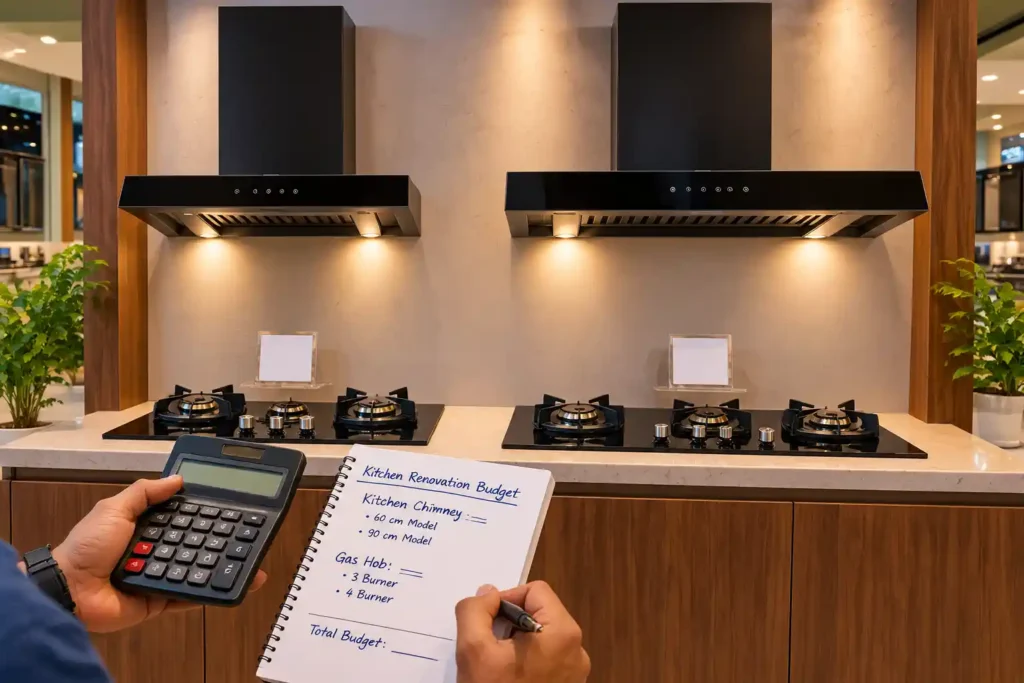
A 90cm model may cost more than a similar 60cm version, but there is no reliable fixed price difference across all brands. Motor type, rated airflow, filter system, auto-clean features, controls, materials and current offers affect the final price. Compare models with similar features and check the current seller price. Our Kitchen Chimney Brand and Price Guide provides broader buying context.
Real-World Examples for Indian Kitchens
Use these examples as a starting point, not as a substitute for measuring your hob and checking the product manual. Indian homes vary widely in stove dimensions, cabinet spacing and cooking habits, even when the burner count looks similar.
| Your Setup | Size to Compare First | What to Verify Before Buying |
|---|---|---|
| Compact 2-burner stove, about 55 to 60cm wide | 60cm | Confirm the hood’s actual width and that its capture area covers the hob. |
| 3-burner stove, about 65 to 75cm wide | 75cm or 76cm | Compare the exact hood width, cabinet gap and manufacturer sizing advice. |
| Wide 4-burner hob, about 75 to 90cm wide | 90cm | Check full coverage, side clearance and the space needed for the flue cover. |
| Small kitchen with a wide hob | Choose by hob width first | Kitchen floor area does not make a narrower hood cover a wider cooking surface. Measure the installation space carefully. |
| Open-plan or island cooking area | Size matched to the hob and hood design | Check cross-draughts, ceiling support, duct route and the model’s installation requirements. |
Do Not Treat Manufacturer Size Charts as Universal Rules
Manufacturer guides are useful for understanding their own ranges, but recommended pairings can differ by hood shape and capture design. One brand may list a 60cm hood for a broader range of burners, while another may recommend 75cm for a similar cooktop. Measure the hob and follow the instructions for the exact chimney model you plan to install. If your cooktop is wider than the hood, ask the manufacturer or installer to confirm suitability before purchasing.
Final Verdict: Which One Should You Buy
Hob around 60cm wide: start by comparing 60cm hoods whose published dimensions and fitting requirements suit your space.
Hob between 60cm and 90cm: check 75cm or 76cm models, or step up to a 90cm hood if needed to cover the cooking surface.
Hob approaching 90cm wide: a 90cm hood is a more natural starting point, subject to the specific model’s coverage and installation instructions. For island or open-plan layouts, also consider cross-draughts and the hood’s capture design.
Never compromise on size to save money, and don’t oversize for appearance either. An incorrectly sized chimney, in either direction, doesn’t solve your smoke and oil problem the way matching it to your actual stove does. If you’re still comparing chimney types, filters, and brands before buying, our Complete Kitchen Chimney Buying Guide is a good next stop.
Frequently Asked Questions
1. Which size chimney is best for a 3 burner gas stove?
Measure the hob first. A compact 3-burner hob around 60cm wide may suit a 60cm hood if the model’s installation guidance supports that fit. If the hob is wider, compare 75cm or 90cm hoods so the cooking surface is covered appropriately. Layout can affect capture, but burner count alone is not enough to decide.
2. Can I install a 90cm kitchen chimney in a small kitchen?
Yes. The kitchen’s floor area does not automatically rule out a 90cm hood. Measure the hob, wall or cabinet run and the exact model’s required fitting clearances. A wider hood can be suitable above a smaller hob if it fits and meets the manufacturer’s instructions, although it may not be necessary for every compact setup.
3. Which chimney has more suction power, 60cm or 90cm?
Not always. Width and suction capacity are separate specifications. Some 60cm models offer higher rated airflow than some 90cm models. Compare the published airflow, motor, sound level, duct requirements and cooking needs of the exact models you are considering.
4. What is the ideal chimney size for a modular kitchen?
Measure the hob and check the available cabinet space. A 60cm hood can fit a compact hob, while a wider hob may call for a 75cm or 90cm model. Modular cabinetry can restrict the choice, so check the chimney’s full dimensions and installation diagram before cabinets are finalised.
5. Can I use a 60cm chimney for a 4-burner hob?
Check the actual width of the four-burner hob. If the cooking surface is wider than the hood, coverage may be reduced and a wider chimney is generally preferable. Burner count alone does not decide compatibility, so follow the manufacturer’s hood-to-hob recommendations and compare the dimensions.
6. What chimney size works best for an island kitchen?
Choose a ceiling-mounted island hood that is at least as wide as the hob or matches the manufacturer’s recommended coverage. A 90cm model is common for wider island hobs, but the exact size depends on the cooking surface and hood design. Consider cross-draughts and ceiling support during planning.
7. Is 75cm a good compromise between 60cm and 90cm?
Yes, when the hob width and the hood’s published coverage make 75cm or 76cm the right fit. It can bridge the gap between 60cm and 90cm, but check actual product dimensions, clearances and stock with the brand. Do not choose it just because it is the midpoint between two sizes.
8. How Do I Measure My Hob Before Buying A Chimney?
Measure the cooktop’s overall width from its leftmost to rightmost edge, not the counter, cabinet or distance between the outer burners. Compare that measurement with the hood’s stated width and installation drawing. If you are replacing a hob or chimney, verify both products’ dimensions before ordering.
9. Should A Kitchen Chimney Be Wider Than The Hob?
Where practical, choose a hood at least as wide as the cooktop, and consider a slightly wider model if the layout allows it. Follow the manufacturer’s recommendations because hood shape, capture area and installation height can affect how well it collects cooking fumes.
10. Does A 90cm Chimney Always Have More Suction Than A 60cm Chimney?
No. The width does not set the suction rating. Compare the airflow rating and technical specifications of the exact products, then consider the duct length, bends, filters and your cooking habits. A wider hood and a higher suction rating solve different parts of the selection decision.
11. Does A 90cm Chimney Use More Electricity Than A 60cm Model?
Not automatically. Electricity use depends on the motor’s power draw, its speed setting, control system and how long you run it. Compare the wattage or energy information on the specific models rather than assuming that the wider hood must use more electricity.
12. Is Chimney Size Based On Kitchen Area Or Hob Width?
Start with the hob’s actual width and the hood’s capture design. Kitchen layout, ceiling or cabinet space, cooking intensity and ventilation route help determine which suitable model to choose, but kitchen floor area by itself does not decide whether you need a 60cm or 90cm hood.
Editorial Note
This article is intended to help Indian homeowners choose a chimney size based on measurable fit and manufacturer instructions. It is general buying guidance, not a claim that every model has been physically tested by our team. Read our Editorial Policy to understand our standards for accuracy, corrections and useful reader-first content.
Trusted Sources
The sizing guidance in this article was cross-checked against published information from Glen’s Kitchen Chimney Size Guide, KAFF’s Kitchen Chimney Sizing Guide, Faber’s Kitchen Chimney Buying Guide, and IFB’s Kitchen Chimney Selection Guide. These are manufacturer-published sources, so recommendations may reflect each brand’s own product range. Confirm the full dimensions, capture area, clearances and installation instructions for the exact model you intend to buy. Prices and availability vary by seller and date.
How This Guide Is Researched and Kept Current
This guide compares manufacturer-published sizing guidance and focuses on practical checks readers can complete before purchase, including hob width, cabinet space, flue clearance and ducting. We do not present manufacturer claims as independent laboratory results, and we avoid treating burner count or kitchen floor area as a universal sizing rule. Product dimensions and installation requirements can change, so check the current manual and product drawing before ordering. Our approach to reviewing product information is described in the Product Review Methodology.
About the Author