A lot of people get this wrong. They walk into a store, see two chimneys sitting side by side, notice one says 800 m³/hr and the other says 1200 m³/hr, and just assume bigger is better. So they buy the 1200 one without asking a single question.
Sometimes that’s the right call. Sometimes it’s complete overkill for a small kitchen that barely uses two burners.
Kitchen chimney suction power is the single most important spec you’ll read on that product box. Get it right and your kitchen stays smoke-free even during the heaviest biryani sessions. Get it wrong and you’re either wasting electricity or watching smoke drift out of the kitchen anyway.
I’ve seen both happen. And trust me, neither feels great.
Last updated: September 2026.
According to kitchen appliance data from Indian e-commerce platforms, suction capacity is the number-one search filter used when buying a kitchen chimney online in India. People care about it. They just don’t always understand what they’re looking at.
This post breaks it down properly. What m³/hr actually means, how to calculate the right chimney suction capacity for your kitchen size, why Indian cooking needs more power than most international guides suggest, and what happens to suction over time. By the end, you’ll know exactly which kitchen chimney suction power is right for your home.
What Does m³/hr Mean in a Kitchen Chimney?
Let’s start at the beginning because this is where most people get lost.
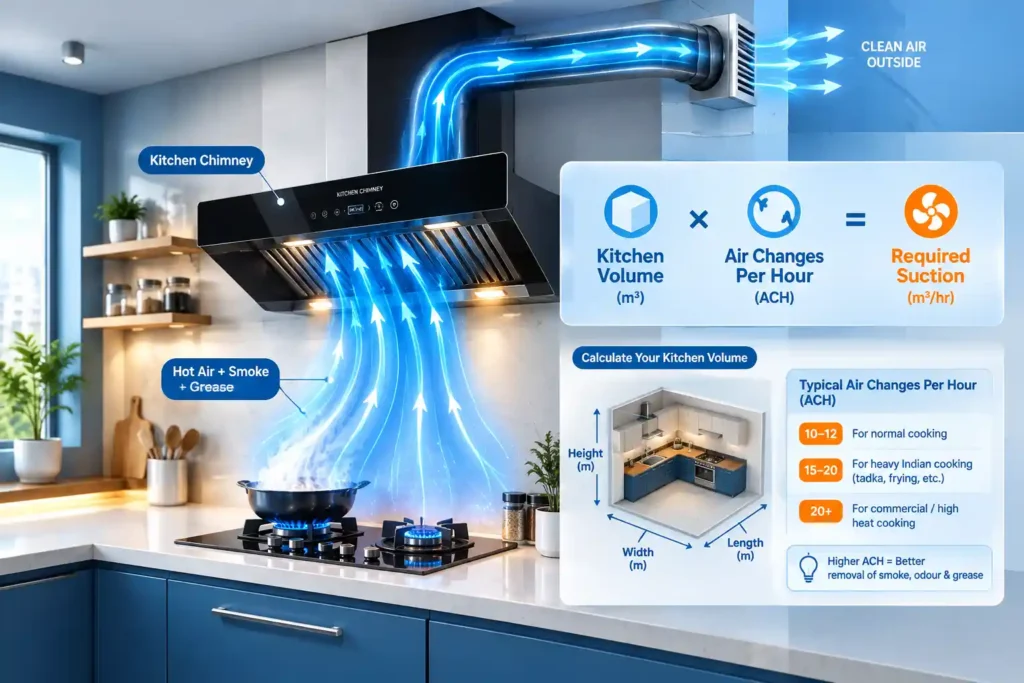
m³/hr stands for cubic metres per hour. It measures how much air volume a chimney’s motor can pull through per hour. A chimney rated at 1000 m³/hr can theoretically pull 1000 cubic metres of air through its filters every hour.
Simple enough. But here’s where it gets useful.
The Basic Formula for Calculating Chimney Suction Power
There is a standard formula used by kitchen appliance engineers to calculate the minimum required suction capacity for any room:
Required Suction (m³/hr) = Kitchen Volume (m³) x Air Changes Per Hour
Kitchen volume is just length x width x height in metres.
Air changes per hour (ACH) is how many times the full air volume of the kitchen needs to be replaced every hour to keep it clean. For Indian cooking, the recommended ACH is 10 to 15 times per hour, not the 8 to 10 times recommended for lighter Western cooking.
Example calculation:
- Kitchen size: 3 metres x 4 metres x 2.7 metres height
- Kitchen volume: 32.4 m³
- Recommended ACH for Indian cooking: 12
- Required suction: 32.4 x 12 = 388.8 m³/hr minimum
But wait. Most chimney manufacturers recommend adding a 20% efficiency buffer on top of that number to account for filter resistance, duct bends, and motor wear over time.
So: 388.8 x 1.20 = 466 m³/hr effective minimum for that kitchen.
Calculate Your Own Kitchen’s Suction Need in 3 Steps
- Measure your kitchen and find the volume. Multiply length x width x height in metres.
- Multiply by 12 (the recommended air changes per hour for Indian cooking) to get your baseline requirement.
- Multiply that result by 1.20 to add the 20 percent efficiency buffer, then adjust further if you’re installing ductless or have a long, bent duct run, as covered further down.
That’s still well within a basic 600 m³/hr chimney. But scale the kitchen up to 5 metres x 4 metres with high ceilings, and you’re quickly looking at 900-1000 m³/hr.
Rated Suction vs Effective Suction (This Matters a Lot)
Here is something the spec sheet almost never tells you.
The rated suction capacity printed on the box is measured under ideal lab conditions: no filters, no duct resistance, brand-new motor running at full speed. That number is the absolute best-case scenario.
In your actual kitchen, with a baffle filter installed, a duct with two bends, and a motor that’s six months old, effective suction drops by 20 to 35% depending on conditions.
So a chimney rated at 1200 m³/hr might deliver 800 to 960 m³/hr in real use.
This is exactly why most experienced buyers and kitchen designers in India add a buffer when choosing chimney suction power, and why going slightly above the calculated minimum is always the smarter call.
Rated vs Effective Suction: What to Expect
| Chimney Rating | Expected Real-World Suction | Notes |
|---|---|---|
| 600 m³/hr | 420 to 480 m³/hr | Fine for very light cooking |
| 800 m³/hr | 560 to 640 m³/hr | Small kitchens, moderate cooking |
| 1000 m³/hr | 700 to 800 m³/hr | Standard Indian household sweet spot |
| 1200 m³/hr | 840 to 960 m³/hr | Heavy cooking, large kitchens |
| 1500 m³/hr | 1050 to 1200 m³/hr | Open kitchens, island setups |
Why Indian Cooking Needs Higher Suction Power Than Most Guides Suggest

Most international chimney buying guides were written with European or American cooking in mind. Light sauteing. The occasional pasta. A roast on Sunday.
Indian cooking is a different situation entirely. And it’s worth understanding why, because it directly changes the suction capacity you need. Unfiltered cooking smoke is also a documented contributor to indoor air pollution, according to the World Health Organization’s research on household air pollution, which is part of why getting this number right matters beyond just comfort.
The Three Biggest Smoke Generators in Indian Kitchens
1. Tadka (tempering)
This is the most intense single moment in Indian cooking for a chimney. When mustard seeds, curry leaves, dried chillies, and whole spices hit hot oil in a small pan, the smoke generated in those 15 to 30 seconds is substantial. The chimney motor needs to react fast and pull hard. A weak or slow chimney simply cannot capture that burst effectively.
2. Deep frying
Puris, pakoras, samosas, bhajias. Deep frying for Indian cooking generates a continuous stream of grease-laden smoke at high oil temperatures, often between 170°C and 200°C. That grease mist needs to be captured before it coats every surface in the kitchen. Low suction power means the grease drifts outward instead of upward.
3. Pressure cooking with spices
The steam release from a pressure cooker carries concentrated spice vapour. It’s not heavy smoke, but it travels fast and spreads quickly through an open kitchen. A chimney with adequate airflow capacity keeps this contained.
Suction Power Needed by Cooking Style
| Cooking Style | Typical Dishes | Recommended Suction |
|---|---|---|
| Very light | Boiling, steaming, light saute | 600 to 800 m³/hr |
| Moderate Indian | Dal, sabzi, chapati, occasional frying | 800 to 1000 m³/hr |
| Regular Indian | Full meals daily, weekly deep frying | 1000 to 1200 m³/hr |
| Heavy Indian | Daily deep frying, multiple burners, catering | 1200 to 1500 m³/hr |
The 1000 to 1200 m³/hr range covers the majority of Indian households cooking full meals twice a day. That’s the range worth anchoring on unless your kitchen is unusually large or you cook at very high intensity.
How Kitchen Size Affects the Suction Power You Need
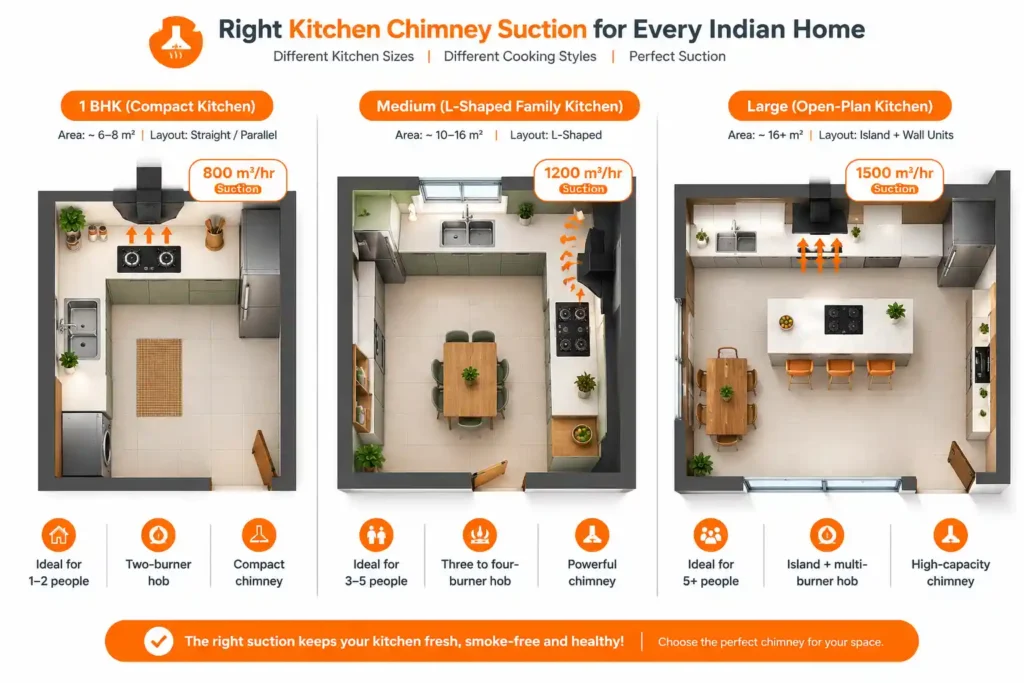
Kitchen size is the other half of the equation. A powerful chimney in a tiny kitchen is overkill. The same chimney in a large open-plan space may still struggle.
Small Kitchen (Up to 100 sq ft)
These are typically 1 BHK or studio apartment kitchens. Compact, often with just 2 burners and limited ceiling height.
Recommended suction: 600 to 800 m³/hr
Key points:
- Volume is low, so even 600 m³/hr handles moderate cooking well
- If you deep fry frequently, push to 800 m³/hr
- A ductless chimney is often the only option in high-rise apartments; 800 m³/hr compensates for the reduced efficiency of recirculation
Medium Kitchen (100 to 150 sq ft)
The most common kitchen size in Indian 2 BHK and 3 BHK apartments and independent houses. Usually has a 3 to 4 burner hob, standard ceiling height.
Recommended suction: 900 to 1200 m³/hr
Key points:
- For daily Indian cooking at this scale, 1000 m³/hr is the practical minimum
- 1200 m³/hr gives comfortable headroom for heavy cooking days
- Ducted installation at this size gives noticeably better results than ductless
Large Kitchen (Above 150 sq ft)
Large independent houses, duplex kitchens, open-plan kitchen-dining layouts. Often have 4 to 5 burners, higher ceilings.
Recommended suction: 1200 to 1500 m³/hr
Key points:
- Open layouts need higher capacity because smoke can travel horizontally before the chimney captures it
- Island chimneys in open kitchens need 1400 to 1500 m³/hr minimum due to ceiling-mount position
- Multiple simultaneous burners running at high heat require the upper end of this range
Kitchen Size vs Suction Power Quick Reference
| Kitchen Size | Cooking Level | Minimum Suction | Recommended Suction |
|---|---|---|---|
| Small (up to 100 sq ft) | Light to moderate | 600 m³/hr | 800 m³/hr |
| Medium (100 to 150 sq ft) | Regular Indian | 900 m³/hr | 1000 to 1200 m³/hr |
| Large (above 150 sq ft) | Heavy Indian | 1200 m³/hr | 1400 to 1500 m³/hr |
| Open-plan / Island | Any | 1400 m³/hr | 1500 m³/hr |
Suction Power and Hood Width Work Together
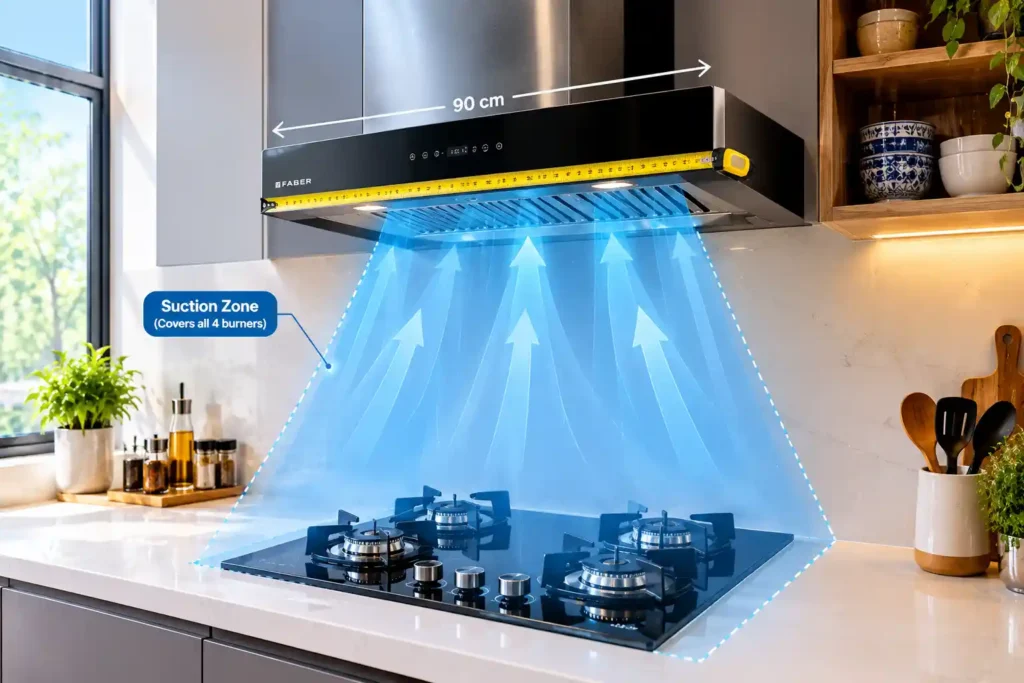
There is a second number that matters almost as much as m³/hr, and most suction guides leave it out entirely: the physical width of the hood. A high-suction motor behind a hood that is narrower than your cooktop still lets smoke escape from the outer burners, since the suction zone simply does not reach that far.
The Burner Count to Hood Width Rule
A practical rule used by installers: the hood should be at least as wide as your cooktop, and ideally a little wider so the suction zone fully covers the outer burners.
| Burner Count | Recommended Hood Width | Notes |
|---|---|---|
| 2 burners | 60cm | Standard for compact and 1 BHK kitchens |
| 3 burners | 60cm to 75cm | 60cm works if burners are closely spaced |
| 4 burners | 90cm | Anything narrower and outer burner smoke tends to bypass the hood |
| 5 or more burners, island layouts | 90cm to 120cm | Island installations need extra width since there is no wall to help contain smoke on either side |
Keep the installation height between 65 and 75cm above a gas hob. Too low increases fire risk near the flame, too high lets the suction zone widen and weaken before it reaches the cooktop, undermining even a well-matched m³/hr rating.
Ducted vs Ductless: How Installation Type Changes the Suction You Need
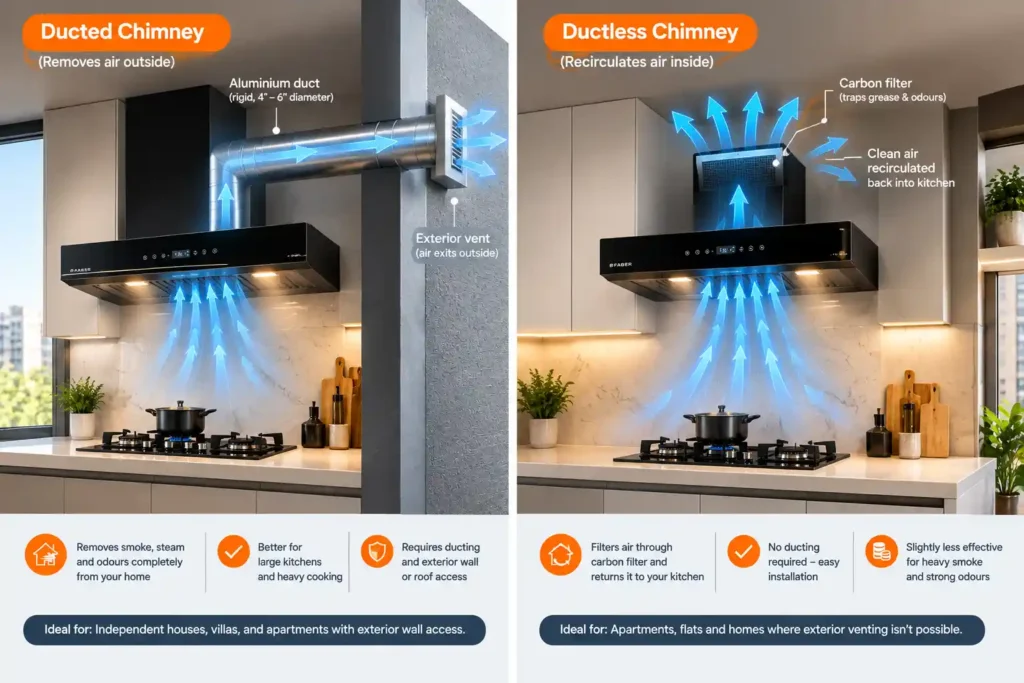
This is a point that almost every chimney buying guide skips past. And it makes a real difference to the number you should be buying.
Ducted Chimney and Suction Loss from Ductwork
A ducted kitchen chimney pushes filtered air out through a duct to the exterior. Every metre of duct and every bend the air has to travel through reduces effective suction.
Here is the practical rule:
- Every 90-degree bend in the duct reduces suction by approximately 10 to 15%
- Every additional metre of straight duct beyond 2 metres reduces suction by roughly 5%
- A flexible accordion duct (the silver corrugated type) reduces suction by up to 20% compared to rigid aluminium duct of the same length
What this means when buying: If your kitchen requires a duct run of more than 2 metres with 2 or more bends, size up. A kitchen that calculates out to 900 m³/hr minimum should be fitted with a 1200 m³/hr chimney to compensate.
Ductless Chimney and the Recirculation Penalty
A ductless recirculating chimney filters air through a baffle or mesh filter plus a carbon filter, then returns the cleaned air into the kitchen. No duct, no exterior venting.
The problem: ductless chimneys lose roughly 20 to 30% of their rated suction effectiveness compared to ducted models, because they’re pushing air through more filter resistance and have no external draw.
So if you’re buying a ductless chimney for a medium Indian kitchen, don’t buy a 900 m³/hr model. Buy 1200 m³/hr so the real-world effective suction lands where you need it.
Suction Adjustment by Installation Type
| Installation Type | Rated Suction Needed | Why |
|---|---|---|
| Ducted, straight short duct | As calculated | Minimal loss |
| Ducted, 2+ bends or long run | Add 20 to 30% | Duct resistance |
| Ductless, recirculating | Add 25 to 35% | Filter and recirculation resistance |
Why Chimney Suction Power Drops Over Time (and How to Fix It)
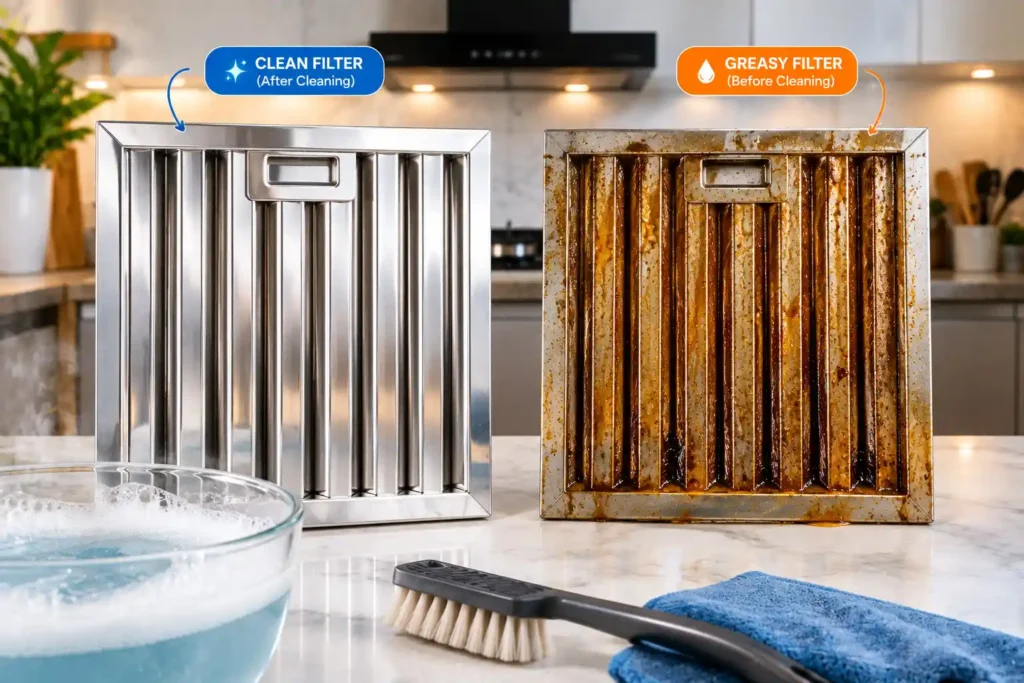
This is one of the most overlooked parts of the whole kitchen chimney suction power topic.
Your chimney’s effective suction capacity drops as filters accumulate grease. It’s not a defect. It’s just physics. A clogged filter creates more resistance, and the same motor working against more resistance moves less air.
How Fast Does Suction Drop?
For an average Indian household cooking 2 full meals daily:
- After 2 weeks without cleaning: suction drops by approximately 15 to 20%
- After 1 month without cleaning: suction drops by 25 to 35%
- After 2 months without cleaning: suction can drop by up to 50%
A chimney rated at 1200 m³/hr delivering 960 m³/hr when new can be delivering as little as 480 to 600 m³/hr after two months of heavy cooking without a filter clean. That’s a massive performance drop, and most people blame the chimney without realising the filter is the issue.
The Fix Is Simple
Clean your baffle filter every 15 to 20 days if you cook Indian food daily. That’s it. A clean filter restores full suction performance almost instantly.
Practical cleaning steps:
- Remove the baffle filter
- Soak in hot water with a few tablespoons of dishwashing liquid for 20 to 30 minutes
- Scrub with a soft brush, paying attention to the curved sections where grease collects
- Rinse thoroughly, dry completely before reinstalling
- Most baffle filters are dishwasher-safe on a high-temperature cycle
For auto-clean chimneys, run the auto-clean cycle every 2 to 3 weeks. Empty the oil collector tray after every cycle.
Other Factors That Reduce Effective Suction Over Time
- Motor wear: After 5 to 7 years, the blower motor gradually loses rpm. Annual servicing catches this early.
- Duct blockage: Bird nests, dust, or collapsed flexible duct reduce suction in ducted installations. Check the exterior vent grille every 6 months.
- Speed settings: Most chimneys have 3 speeds. Running on speed 1 during heavy cooking is a common mistake. Use speed 2 or 3 during tadka and deep frying.
Suction Power and Noise Level: The Trade-Off Nobody Mentions

Higher suction power generally means a louder chimney. This is a real trade-off and worth thinking about, especially in open kitchens connected to living or dining spaces.
Kitchen chimney noise is measured in decibels (dB). Here’s a practical reference:
Noise Level Guide by Suction Power
| Suction Power | Typical Noise at Max Speed | Practical Comparison |
|---|---|---|
| 600 to 800 m³/hr | 50 to 58 dB | Normal conversation level |
| 900 to 1100 m³/hr | 58 to 65 dB | Slightly louder than a normal conversation |
| 1200 to 1500 m³/hr | 65 to 72 dB | Similar to a busy office or busy restaurant |
Most Indian households find chimneys in the 58 to 65 dB range perfectly acceptable. Above 68 dB starts to feel intrusive, especially if the kitchen opens into the living room.
How to Get High Suction Without Excessive Noise
- Buy a chimney with a higher-rated motor than you need, then run it at speed 2 rather than speed 3. You get adequate suction with less noise.
- Filterless chimney models tend to run quieter than baffle-filter models at equivalent suction because the motor faces less resistance.
- Look for chimneys marketed as silent or low-noise models. Brands like Elica and Faber have dedicated quiet-motor ranges. These use better-balanced blower wheels that reduce vibration at high speed.
- Ensure the chimney is installed with anti-vibration mounts. A chimney that vibrates against a hollow wall amplifies noise by a noticeable amount.
Advantages and Disadvantages of High Suction Power Chimneys
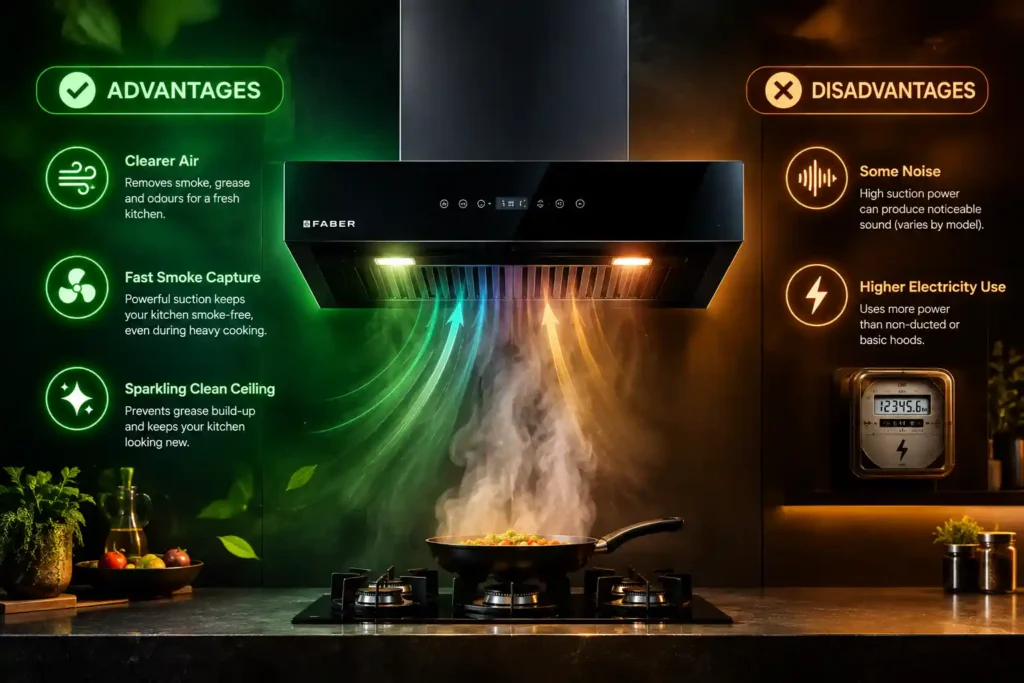
| Advantages | Disadvantages |
|---|---|
| Captures smoke faster during intense cooking | Higher noise at maximum speed |
| Handles multiple simultaneous burners | Higher electricity consumption at full speed |
| Maintains effective suction even as filters age | Slightly higher purchase price |
| Better for open kitchens with no walls to contain smoke | Overkill for small kitchens with light cooking |
Best Chimney Suction Power by Home Type in India

Let’s make this practical. Here’s a direct recommendation by home type for Indian households in 2025.
1 BHK Apartment
Compact kitchen, 1 to 2 people cooking, usually 2 to 3 burners.
Recommended suction: 750 to 900 m³/hr
Good options in this range: Glen 6071 XXL (900 m³/hr), Hindware Nevio (860 m³/hr)
- If ducted: 750 m³/hr is sufficient for light to moderate cooking
- If ductless: go to 900 m³/hr to compensate for recirculation loss
2 BHK or 3 BHK Apartment
Standard family kitchen, 3 to 4 people, daily full Indian meals, 3 to 4 burners.
Recommended suction: 1000 to 1200 m³/hr
Good options in this range: Faber Hood Crest Plus (1200 m³/hr), Elica WD HAC 60 (1200 m³/hr), Hindware Bello Plus (1100 m³/hr)
- The 1000 to 1200 m³/hr range handles daily Indian cooking comfortably with clean filters
- If you do heavy frying or cook for guests frequently, push to 1200 m³/hr
Large Independent House or Villa
Large kitchen, high ceilings, possibly an island layout, multiple people cooking simultaneously.
Recommended suction: 1200 to 1500 m³/hr
Good options: Kaff KA 90 CH (1500 m³/hr), Elica WDFL 904 HAC (1400 m³/hr), Faber Island Serie (1400 m³/hr)
- For island chimneys, 1400 m³/hr is the starting point, not the target
- Open-plan kitchens genuinely need the top end of this range
Commercial Home Kitchen or Catering Setup
If you run a home catering business or cook in very high volumes daily, standard residential chimneys may not be enough.
Recommended suction: Above 1500 m³/hr
At this level, you’re moving into semi-commercial territory. Look at brands that offer commercial-grade motors with standard residential installations.
Speed Settings and Suction: When to Use Which Mode

Most kitchen chimneys come with 3 speed settings. Understanding when to use each makes a real difference to both suction effectiveness and electricity use.
Speed 1 (Low)
Roughly 40 to 50% of rated suction. Use this for:
- Boiling water or milk
- Light steaming
- Slow cooking with minimal smoke
- Running the chimney as a background ventilator while cooking is winding down
Suction at speed 1 for a 1200 m³/hr chimney: approximately 480 to 600 m³/hr
Speed 2 (Medium)
Roughly 65 to 75% of rated suction. Use this for:
- Regular dal, sabzi, curry cooking
- Light frying
- Everyday cooking where you’re not generating heavy smoke
This is the most-used setting in most Indian households and gives a good balance of suction and noise.
Suction at speed 2 for a 1200 m³/hr chimney: approximately 780 to 900 m³/hr
Speed 3 (High)
Full rated suction. Use this for:
- Tadka and tempering
- Deep frying
- Grilling
- Any high-smoke, high-heat cooking
Always switch to speed 3 before the smoking starts, not after. A chimney that’s already capturing smoke is far more effective than one you switch to high after the smoke has begun spreading.
Suction at speed 3 for a 1200 m³/hr chimney: approximately 840 to 960 m³/hr (real-world, with filters)
Speed vs Suction vs Noise Summary
| Speed | % of Rated Suction | Noise Level | Best Used For |
|---|---|---|---|
| Speed 1 | 40 to 50% | Low | Boiling, steaming, background ventilation |
| Speed 2 | 65 to 75% | Moderate | Regular daily Indian cooking |
| Speed 3 | 85 to 95% | High | Tadka, deep frying, grilling |
People Also Ask: Kitchen Chimney Suction Power FAQs
1. What is a good suction power for a kitchen chimney in India?
For most Indian households cooking 2 to 3 meals a day including frying and tadka, 1000 to 1200 m³/hr is the practical sweet spot. Small apartments doing light cooking can manage with 800 m³/hr. Large kitchens or open layouts should look at 1400 to 1500 m³/hr.
2. Is 1200 m³/hr suction enough for Indian cooking?
Yes, for the large majority of Indian kitchens. A 1200 m³/hr chimney with a clean baffle filter delivers roughly 840 to 960 m³/hr of real-world suction, which is more than sufficient for a standard 3 BHK kitchen doing daily Indian meals including deep frying.
3. What does m³/hr mean on a kitchen chimney?
m³/hr stands for cubic metres per hour. It measures how much air volume the chimney’s motor can pull through per hour. A 1000 m³/hr chimney can theoretically move 1000 cubic metres of air in one hour. In real use with filters installed, effective suction is typically 70 to 80% of the rated number.
4. Is 600 m³/hr suction enough for Indian cooking?
Only for very light cooking in a small kitchen. 600 m³/hr chimneys struggle with daily tadka, deep frying, or cooking on multiple burners simultaneously. For regular Indian cooking, 800 m³/hr should be the minimum, with 1000 m³/hr recommended.
5. Does suction power decrease over time?
Yes. Chimney suction drops as filters accumulate grease. A chimney that’s been two months without a filter clean can lose 30 to 50% of its effective suction. Regular baffle filter cleaning every 15 to 20 days for heavy Indian cooking households restores full performance.
6. What suction power is needed for a ductless chimney in India?
Because ductless chimneys recirculate air instead of venting it outside, they’re inherently less efficient. For a kitchen that would need 900 m³/hr with a ducted chimney, buy a 1200 m³/hr ductless model to compensate for the 20 to 30% efficiency loss from recirculation and additional filter resistance.
7. Is higher suction power always better?
No. Higher chimney suction capacity means more noise and higher electricity consumption at full speed. An oversized chimney in a small kitchen is wasteful and louder than necessary. Match suction to your kitchen size and cooking intensity using the formula: kitchen volume x 12 air changes per hour, then add 20% buffer.
8. Which speed setting should I use while deep frying?
Always use Speed 3 (high) when deep frying. Switch to high speed before you start heating the oil, not after the smoke appears. This gives the chimney time to build full airflow so it captures frying smoke from the first second.
9. How do I calculate the right chimney suction for my kitchen?
Use this formula: Kitchen Volume (L x W x H in metres) x 12 x 1.20. The 12 is the recommended air changes per hour for Indian cooking, and 1.20 adds a 20% efficiency buffer. The result is your recommended minimum rated suction in m³/hr.
10. Does chimney height from the stove affect suction performance?
Yes. The further the chimney is from the cooking surface, the more smoke disperses before the chimney can capture it. The recommended installation height is 65 to 75 cm above a gas hob. Installing it higher reduces effective capture efficiency even if the rated suction is adequate.
Conclusion
Suction power is the number that decides whether your kitchen chimney actually works or just looks good above your hob.
Here’s what matters most, pulled together:
- m³/hr is the volume of air the chimney moves per hour. Rated suction is always higher than real-world suction due to filter resistance and duct losses.
- For most Indian households, 1000 to 1200 m³/hr is the right range.
- Small apartments doing light cooking can work with 800 m³/hr. Large kitchens and open layouts need 1400 to 1500 m³/hr.
- Add 20 to 30% to your calculated minimum if you’re installing a ductless chimney or have a long duct run with multiple bends.
- Clean filters are the single biggest factor in maintaining real-world suction over time. A clogged filter cuts performance more than buying the wrong capacity chimney.
- Switch to Speed 3 before tadka and deep frying, not after.
Getting suction power right means your kitchen stays clean, the air stays fresh, and you’re not scrubbing masala stains off the ceiling six months from now.
If you found this useful, the full kitchen chimney buying guide covers everything else: filter types, chimney sizes, brand comparisons, and installation tips. Worth a read before you buy.
Got questions about your specific kitchen setup? Drop them in the comments below and I’ll answer directly.
Sources & About This Guide
Suction figures, duct-loss percentages, and noise ranges in this guide are cross-checked against current manufacturer specifications from Elica, Faber, Glen, and Hindware, along with the Bureau of Energy Efficiency India for motor performance standards. Suction figures printed on any chimney box are measured in free air, with no filter or duct resistance, so treat them as a lab-condition ceiling rather than what your kitchen will actually experience.