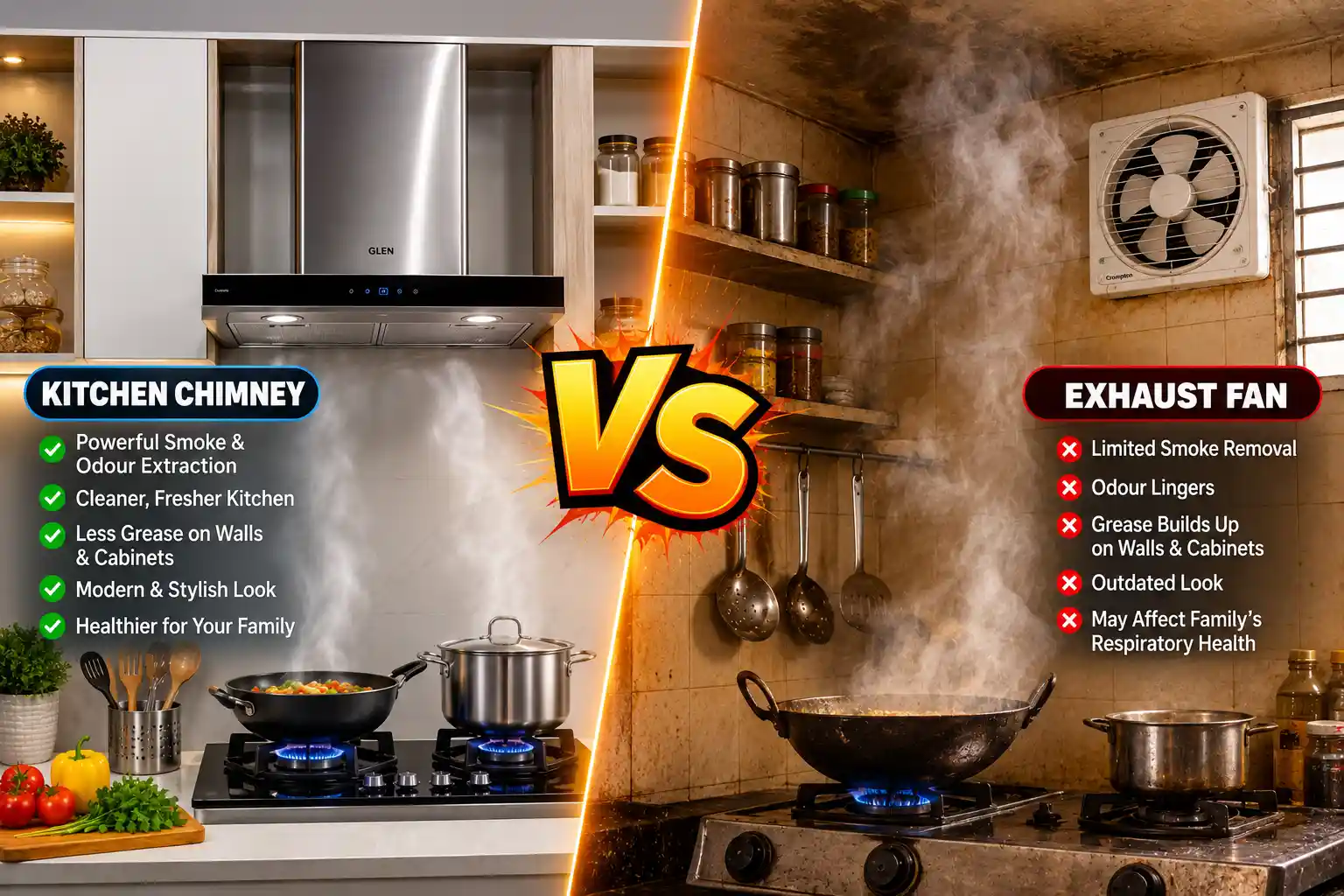
Choosing between a kitchen chimney and an exhaust fan depends on how you cook, your kitchen layout, and your budget. A chimney mounted over the hob can capture cooking fumes and grease close to the source, while an exhaust fan ventilates the room by moving indoor air outdoors. For frequent frying or oil-heavy cooking, a correctly sized and installed ducted chimney is usually better suited to capturing the cooking plume. For light cooking, good cross-ventilation, or homes where a chimney cannot be installed, an exhaust fan can still provide useful ventilation. Performance depends on the appliance, installation, airflow, and regular cleaning.
Picture this. You just finished making a big batch of dal makhani. The mustard seeds crackled in hot oil, the onions browned perfectly, and the whole house smells like a roadside dhaba. Now look at the ceiling tiles above your stove. Run your finger along the wall beside the burners.
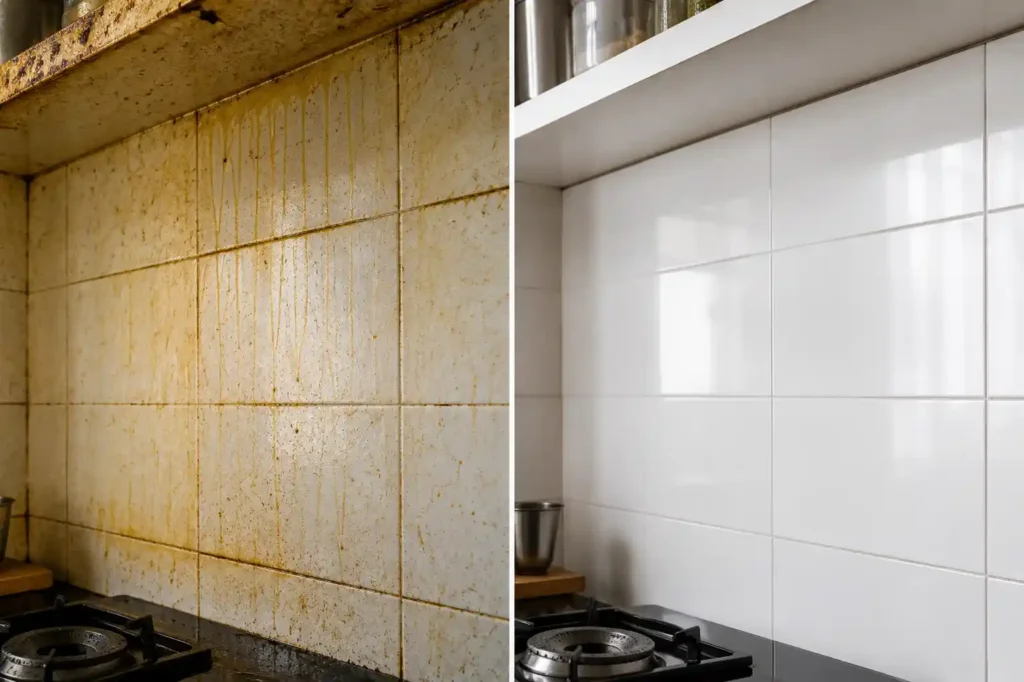
That greasy, yellowish, sticky film is what happens when your kitchen ventilation is not doing its job. It is the direct result of cooking smoke and oil particles settling on every surface around you, because nothing captured them at the source.
Written by Mohammed Saqib · Updated: October 2026.
Quick Answer: Kitchen Chimney vs Exhaust Fan
For frequent frying, tadka, and oil-heavy cooking, a well-sized ducted chimney is generally the stronger option because it captures cooking emissions near the hob and vents them outdoors. An exhaust fan is much less expensive and can help remove heat and stale air, but it has no dedicated grease filter and is not positioned to capture the cooking plume as directly.
This guide compares suction, grease filtration, noise, cost, energy use, maintenance, and installation. Use specifications as general guidance rather than guarantees: real-world performance depends on the exact model, ducting, operating speed, make-up air, and cooking habits.
| Factor | Kitchen chimney | Exhaust fan |
|---|---|---|
| Smoke and grease near the hob | Can capture the cooking plume close to the source when correctly sized and installed | Provides general room ventilation but is less effective at close capture |
| Grease filtration | Depends on filter design; regular cleaning is needed | No dedicated grease filtration |
| Upfront cost | Higher, with possible installation and ducting costs | Lower; needs a suitable wall or window opening |
| Best fit | Frequent frying and regular oil-heavy cooking | Light cooking and general room ventilation |
What Is an Exhaust Fan and How Does It Work?
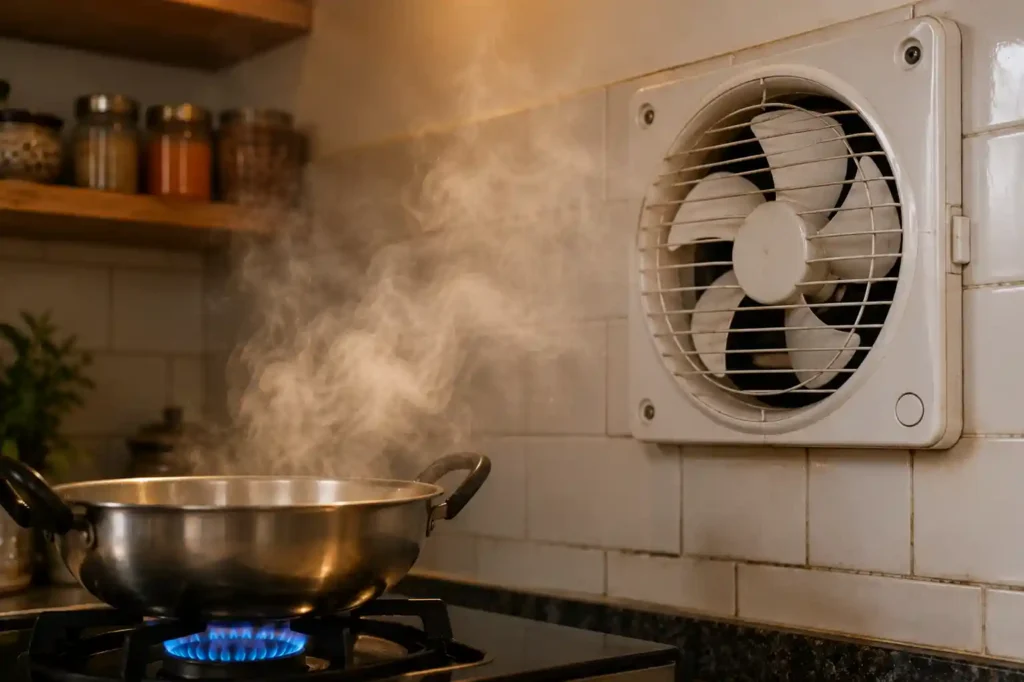
An exhaust fan is a motorised fan mounted on a kitchen wall or window. Its only job is to push stale indoor air outside. It runs on a simple AC induction motor with rotating blades. Switch it on, the blades spin, and air moves outward. That is the complete mechanism.
No filter, no grease trap. No multi-stage processing. Just a fan moving air from inside to outside. For light cooking, such as boiling dal, making tea, or reheating leftovers, this is adequate. But the moment you pick up the kadhai for a proper tadka or start deep frying, the exhaust fan is already outmatched.
How an Exhaust Fan Works
-
- The motor spins blades at a fixed speed, creating a slight negative pressure zone in the kitchen.
-
- Kitchen air, including smoke, steam, odours, and oil particles, gets pushed outward through the wall opening.
-
- Fresh air enters through door gaps, windows, or ventilation openings.
-
- No filtration occurs at any stage. Oil particles travel straight through the fan and either exit outside or settle nearby.
What it does well: removes hot air and light cooking vapours fairly quickly. Easy to install. Very low cost. No technical setup needed.
What it cannot do: provide dedicated grease filtration or capture cooking smoke as close to the hob as a well-positioned chimney. An exhaust fan can still move some smoke, heat, and vapour outdoors; how well it ventilates the room depends on airflow, placement, and replacement air.
Exhaust Fan Technical Specifications for Indian Kitchens
| Specification | Typical Exhaust Fan Values |
| Air movement capacity | 150 to 350 m3/hr |
| Power consumption | 30 to 60 watts |
| Motor type | Simple AC induction motor |
| Filtration | None |
| Installation | Wall or window opening; safe installation may require a qualified person |
| Noise level | 55 to 75 dB |
| Service life | Varies by model, usage, and maintenance |
| Price range | Rs. 500 to Rs. 3,500 |
Fan size should be chosen using the room volume, desired ventilation rate, manufacturer’s performance data, and available opening, not floor area alone. Six-, nine-, and twelve-inch fans are common sizes, but they are not universal recommendations for specific kitchen areas. Compare usable airflow and installation constraints for the exact model.
What Is a Kitchen Chimney and How Does It Work?
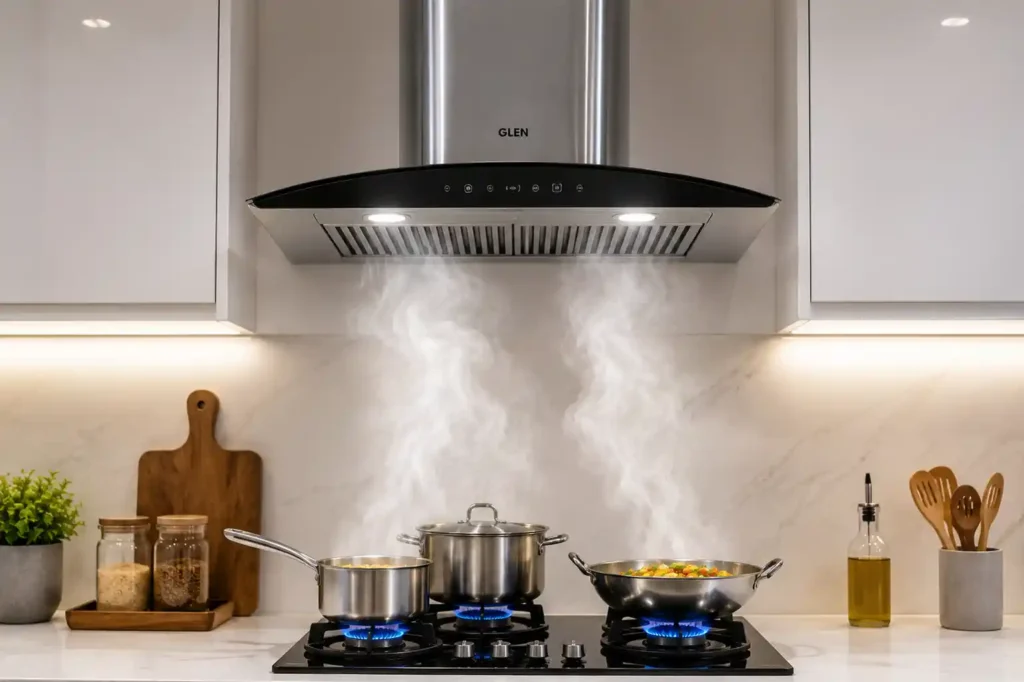
A kitchen chimney is a dedicated ventilation appliance installed directly above your cooking stove. It uses a powerful motorised suction system to pull smoke, oil fumes, steam, and cooking odours upward, directly at the source, before they spread into the rest of your kitchen or home.
Unlike an exhaust fan, a kitchen chimney for home is positioned directly over the cooktop. That positioning changes everything. By the time cooking smoke rises even 30 cm from the stove surface, it has already started spreading sideways. A chimney positioned at 65 to 75 cm above the burners captures it right at the point of origin. For more on how to choose the right model for your home, see our guide on Electric Kitchen Chimney.
How a Kitchen Chimney Works
Motor: A powerful suction motor creates the airflow. Standard chimneys use AC induction motors. Premium models use BLDC (Brushless DC) motors, which are quieter, more energy-efficient, and last longer.
Filters: These are baffle filters, mesh filters, or filterless centrifugal technology, depending on the model. All trap oil and grease particles before the air exits the chimney. For a detailed breakdown, read our article on Baffle Filter vs Filterless Chimney.
Duct or carbon filter system: In a ducted chimney, filtered air exits outside through a metal pipe. In a ductless chimney, air passes through a carbon filter that absorbs odours before recirculating back into the kitchen.
Kitchen Chimney Technical Specifications
| Specification | Typical Kitchen Chimney Values |
| Suction capacity | 800 to 1,800 m3/hr |
| Power consumption | 150 to 250 watts |
| Motor type | AC or BLDC |
| Filtration | Baffle, mesh, filterless, or carbon |
| Installation | Professional recommended |
| Noise level | 45 to 65 dB depending on speed and motor type |
| Service life | Varies by model, usage, and maintenance |
| Price range | Rs. 6,000 to Rs. 50,000 and above |
These are broad illustrative ranges, not guarantees for every model. Compare the manufacturer’s rated airflow, noise, and power figures for the exact product. Long or sharply bent ducts, an unsuitable duct diameter, filter condition, mounting height, and limited replacement air can reduce real-world capture. A higher airflow number alone does not guarantee that smoke will be captured effectively.
Kitchen Chimney vs Exhaust Fan: The Complete Head-to-Head Comparison
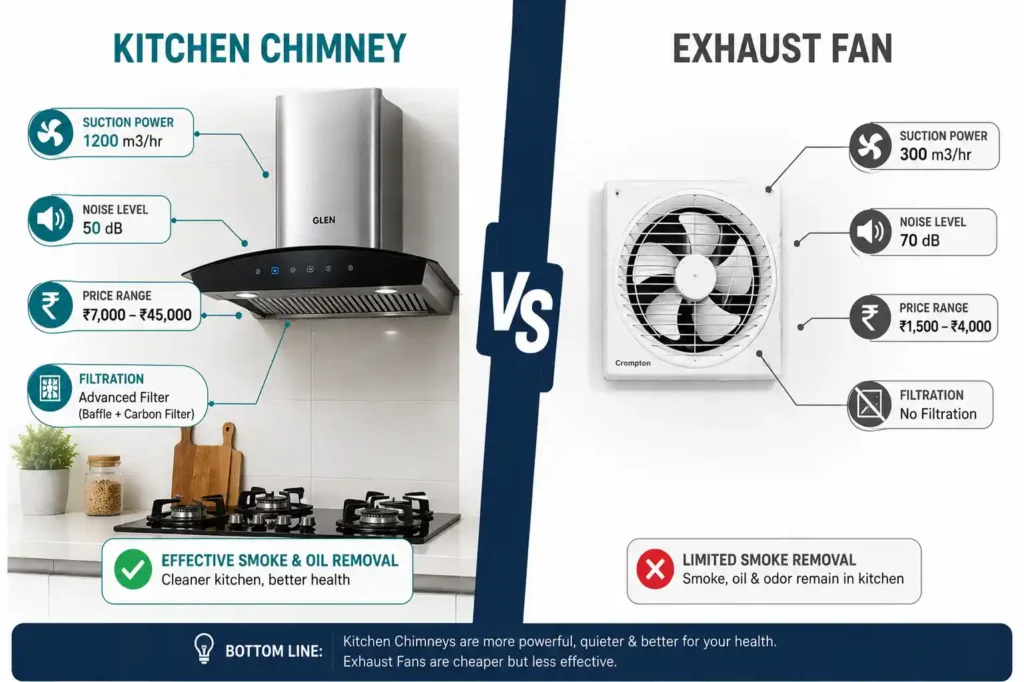
This is the section where the real differences between kitchen chimney vs exhaust fan become clear. Every factor that matters to an Indian homeowner is covered below, one by one.
Suction Power
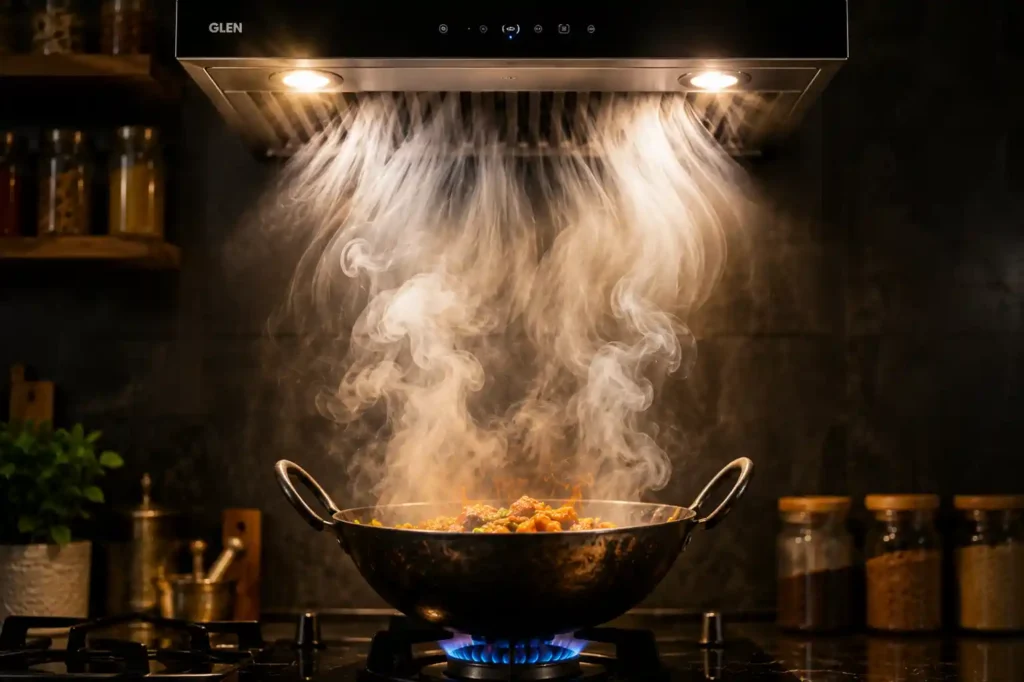
Suction power is measured in m3/hr (cubic metres per hour). This single number tells you how much air the appliance can move in one hour, and it is where the gap between kitchen chimney vs exhaust fan is most dramatic.
| Appliance | Suction Capacity | Best For |
| Standard exhaust fan | 150 to 350 m3/hr | Light ventilation, small spaces |
| Entry-level kitchen chimney | 800 to 1,000 m3/hr | Light to moderate Indian cooking |
| Mid-range kitchen chimney | 1,000 to 1,300 m3/hr | Regular daily Indian cooking |
| Premium kitchen chimney | 1,300 to 1,800 m3/hr | Heavy frying, open kitchens, large families |
Do not choose airflow from a single rule of thumb alone. Check the hood width against the cooktop, the manufacturer’s sizing recommendations, and the planned duct route. Airflow ratings are not directly comparable across every product or installation, and poor ducting can reduce performance. For model-selection context, see our guide to kitchen chimney suction power.
Grease and Oil Filtration
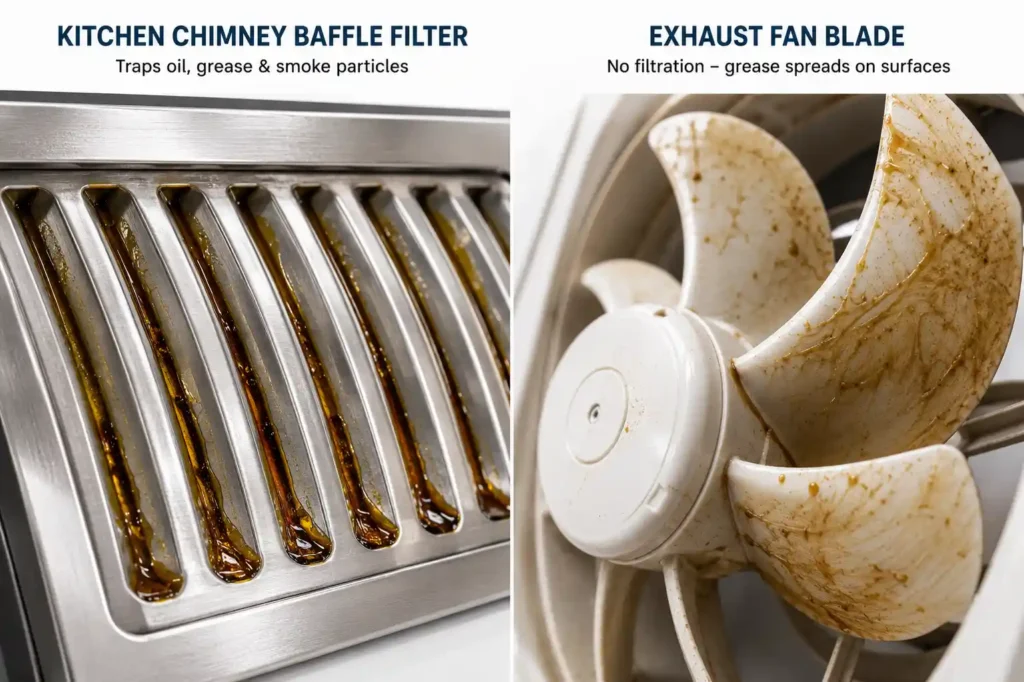
This is the most critical difference in the kitchen chimney vs exhaust fan comparison for Indian kitchens, and the one buyers most often overlook when comparing costs.
An exhaust fan does not filter anything. Oil and grease particles move through the fan blades unchanged. They either exit through the wall opening or, in apartments with limited cross-ventilation, recirculate and settle on nearby surfaces.
Many chimneys use baffle or mesh filters and an oil collector; some models use filterless designs that separate grease by centrifugal action. Performance varies by design and maintenance, so check the manufacturer’s description for the exact model. Cleaning the filter and oil collector as recommended can help maintain airflow and reduce grease buildup on nearby surfaces, but a chimney does not eliminate all airborne particles or cleaning needs.
Grease buildup is also a maintenance and fire-safety concern, whichever ventilation setup you use. A chimney filter and oil collector can collect some cooking grease, but they must be cleaned at the interval specified by the manufacturer. An exhaust fan does not collect grease in a dedicated filter, so nearby surfaces may need more frequent cleaning. Keep the cooking area and both appliances clean; neither appliance replaces safe cooking practices.
Odour Removal

The odour of fish curry or deep-fried food lingers for hours with an exhaust fan because it moves air but does not clean it at the source. A kitchen chimney captures odours directly above the stove, right where they originate. In open-plan homes where the kitchen is connected to the living or dining area, this matters particularly. Ducted chimneys remove odours entirely by venting them outside. Ductless chimneys use carbon filters to absorb them before recirculating air. An exhaust fan does neither.
Noise Levels
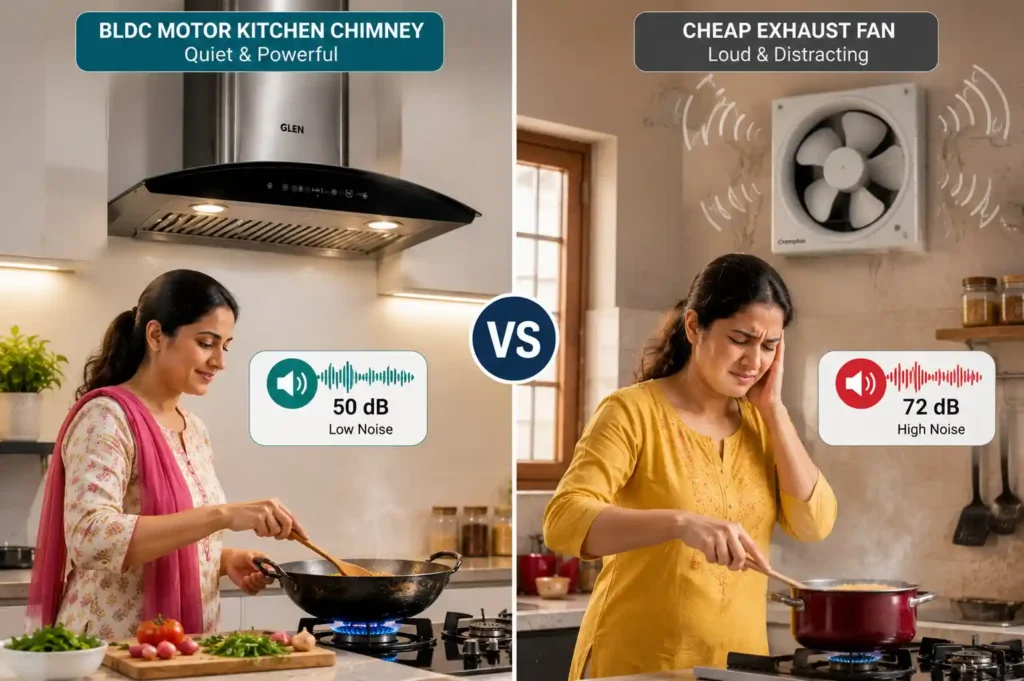
Many people assume exhaust fans are always quieter. That assumption is not accurate. A cheap exhaust fan rattles loudly because the motor and blades are not precision-balanced. Many basic exhaust fans run at 65 to 75 dB. A good kitchen chimney with a BLDC motor runs at 45 to 52 dB at medium speed, which is quieter than a normal conversation. A budget AC-motor chimney at full speed can reach 60 to 65 dB. So the noise comparison depends on which specific products you are looking at, not the appliance category in general.
Cost Comparison

| Item | Exhaust Fan | Kitchen Chimney |
| Product price | Rs. 500 to Rs. 3,500 | Rs. 6,000 to Rs. 50,000 and above |
| Installation cost | Rs. 0 to Rs. 500 (DIY possible) | Rs. 500 to Rs. 1,500 (professional) |
| Annual maintenance | Minimal, blade cleaning only | Filter cleaning or auto-clean cycles |
| Carbon filter replacement | Not applicable | Rs. 500 to Rs. 1,500 per year (ductless only) |
| Expected lifespan | 5 to 8 years | 8 to 12 years |
The upfront cost difference in this kitchen chimney vs exhaust fan comparison is real. For families on a strict budget, an exhaust fan is a practical short-term choice. But cost alone should not be the deciding factor when you factor in long-term cleaning effort, wall repainting, and cabinet maintenance.
Energy Consumption
| Appliance | Power Consumption |
| Exhaust fan | 30 to 60 watts |
| Standard AC motor chimney | 150 to 220 watts |
| BLDC motor chimney | 90 to 150 watts |
A kitchen chimney draws more power per hour. However, chimneys are designed for short-duration intensive use, typically 30 to 45 minutes during and after cooking. BLDC motor chimneys use up to 50 percent less power than conventional motors. According to the Bureau of Energy Efficiency India, BLDC motor appliances consistently outperform standard AC motor equivalents in energy efficiency ratings. At 45 minutes of daily use, a BLDC chimney adds roughly Rs. 15 to Rs. 25 to your monthly electricity bill.
Aesthetics and Kitchen Design
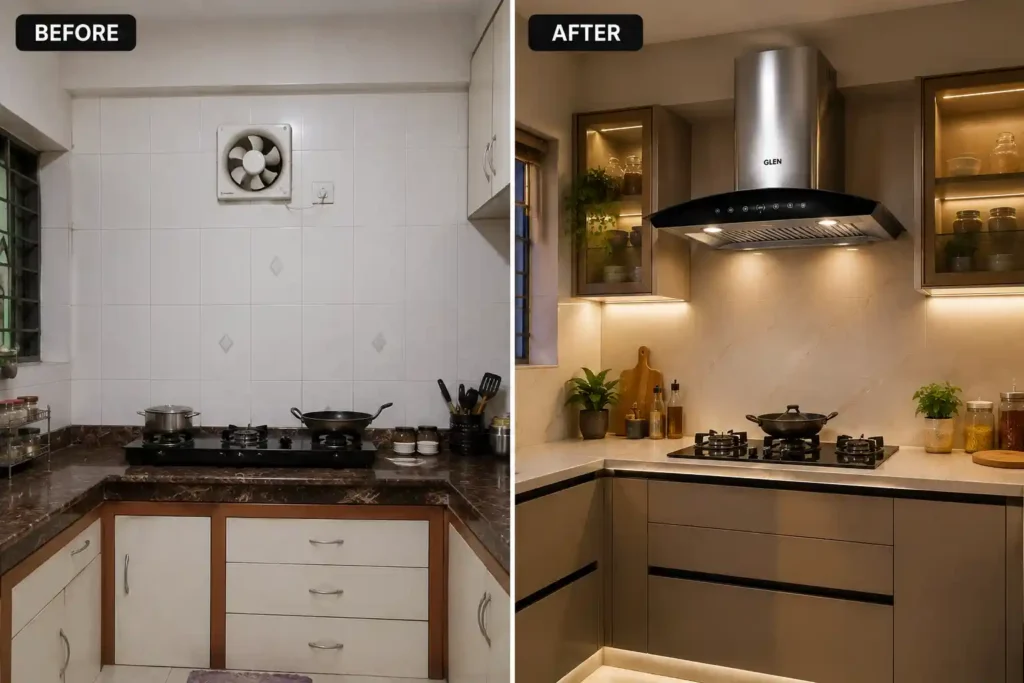
An exhaust fan is functional. It is not attractive. Most models are white plastic covers on a wall that add nothing to a kitchen’s appearance. A kitchen chimney comes in various designs and finishes: curved glass, straight-line stainless steel, built-in, and premium Italian-style models. For modular kitchens or open-plan spaces where appearance matters, a chimney is clearly the better-looking choice.
Installation
An exhaust fan can be fitted into a wall or window opening in under an hour, often without a professional. A kitchen chimney needs professional installation. Wall drilling for heavy-duty anchors, duct pipe routing for ducted models, proper height calibration, and flue alignment all need to be done correctly. A badly installed chimney performs well below its rated capacity. Installation is a one-time task; once done correctly, you do not touch it again for years.
Maintenance Comparison
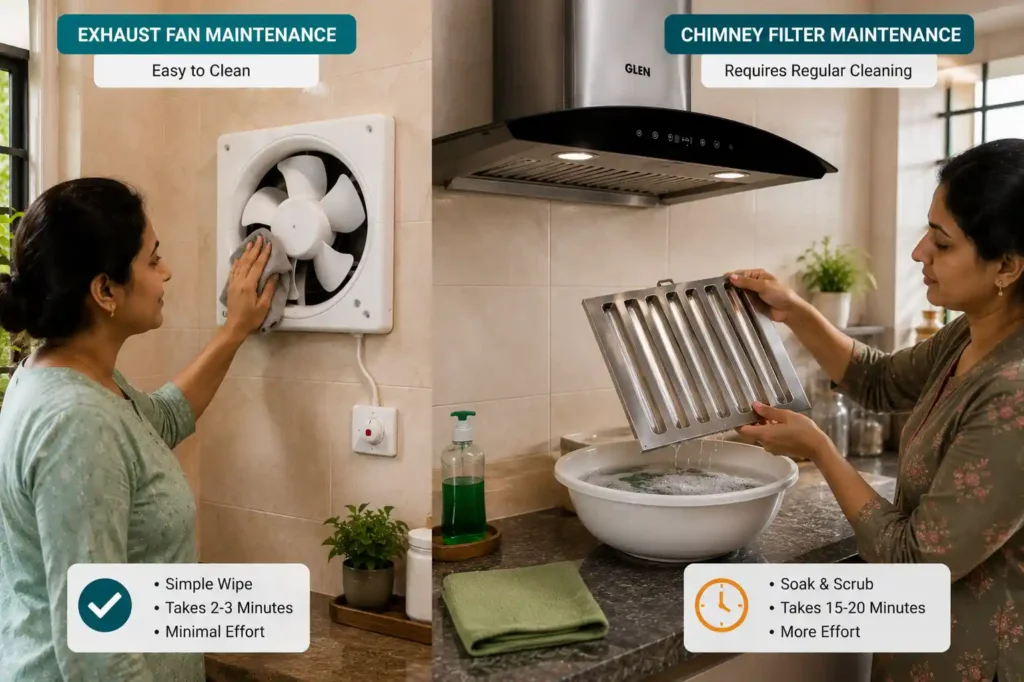
| Maintenance Task | Exhaust Fan | Kitchen Chimney |
| Regular cleaning | Wipe blades and grille monthly | Clean filters every 3 to 4 weeks (baffle) or 10 to 15 days (mesh) |
| Deep cleaning | Soak blades every few months | Filter soak plus interior wipe |
| Auto-clean cycle | Not applicable | Monthly for auto-clean models |
| Oil tray emptying | Not applicable | Every 2 to 4 weeks |
| Carbon filter | Not applicable | Replace every 6 to 12 months (ductless only) |
An exhaust fan is simpler to maintain. A kitchen chimney requires more regular attention, but the payoff is a noticeably cleaner kitchen throughout the year.
Advantages and Disadvantages of Kitchen Chimney vs Exhaust Fan
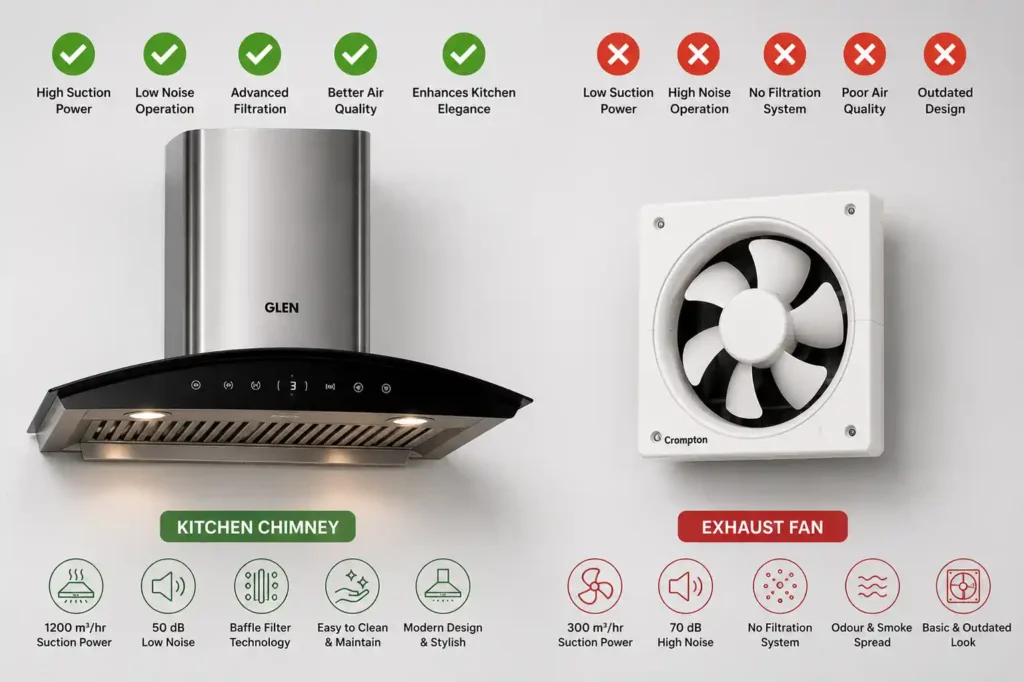
Kitchen Chimney
| Advantages | Disadvantages |
| Four to seven times more suction power than an exhaust fan | Higher upfront purchase cost |
| Traps oil and grease in filters before they settle on surfaces | Requires professional installation |
| Removes cooking odours at the source above the stove | Needs regular filter cleaning or auto-clean cycles |
| BLDC motor models operate very quietly at medium speed | Ducted models require wall or ceiling duct routing |
| Adds a modern, finished look to any Indian kitchen | Ductless models need periodic carbon filter replacement |
| Auto-clean models significantly reduce manual maintenance | Draws more electricity per hour than an exhaust fan |
| Keeps walls and cabinets cleaner over the long term | Takes up dedicated wall space above the stove |
Exhaust Fan
| Advantages | Disadvantages |
| Very low purchase cost, Rs. 500 to Rs. 3,500 | Does not filter grease or oil particles at any stage |
| DIY installation in most cases | Cannot handle heavy Indian cooking smoke effectively |
| Low power consumption, 30 to 60 watts | Grease settles on walls, tiles, and cabinets over time |
| Minimal maintenance, only blade and grille cleaning | Cooking odours linger for hours after cooking ends |
| Suitable for light cooking and small kitchens | Many basic models are louder than a mid-range chimney |
| Does not require wall duct routing | Adds nothing to the kitchen’s visual design |
Health Impact of Kitchen Chimney vs Exhaust Fan

This is the section most buying guides skip entirely. But for Indian families who cook daily, the health dimension of the kitchen chimney vs exhaust fan choice genuinely matters.
Cooking can add smoke, particles, heat, moisture, and odours to indoor air. The World Health Organization’s household air pollution guidance describes the health risks of household air pollution and the importance of cleaner household energy and ventilation. It does not establish that one consumer chimney or exhaust fan is always healthier than the other; the stove and fuel, appliance, installation, and exhaust route all matter.
An exhaust fan can help ventilate a room by moving indoor air outside, but it does not have a dedicated grease filter. A chimney positioned above the cooktop may capture more of the rising cooking plume, particularly when properly sized and ducted outdoors. Ductless models recirculate air after filtering some grease or odours; they do not vent heat, moisture, and all cooking pollutants outdoors. Follow the manufacturer’s installation guidance and provide a suitable make-up air path.
For households concerned about indoor air quality, effective ventilation is worth prioritising, especially during frying and other smoke-producing cooking. The benefit depends on the stove and fuel, the pollutants generated, and how well the ventilation system captures and exhausts them. Neither appliance should be described as a medical protection device; people with respiratory conditions should follow guidance from their healthcare professional.
When Should You Choose an Exhaust Fan?

Being straightforward here: there are genuine situations where an exhaust fan is the right choice. Not every kitchen needs a kitchen chimney.
-
- Light cooking only. Boiling dal, making tea, reheating food, and occasional steaming are all within an exhaust fan’s capability.
-
- Small kitchen with good cross-ventilation. A window adjacent to the cooking area that opens wide can supplement an exhaust fan effectively for light meals.
-
- Rented home. If you cannot drill walls or install ductwork, and the tenancy is short-term, an exhaust fan is the practical option.
-
- Budget firmly under Rs. 3,000. An exhaust fan beats no ventilation at all for families with very limited appliance budgets.
-
- Supplementary ventilation. In very hot and humid kitchens that already have a chimney, an exhaust fan on the opposite wall can assist with general heat removal. It must go on the opposite wall, not near the stove, to avoid disrupting the chimney’s suction pattern.
When Should You Choose a Kitchen Chimney?

For most Indian households that cook daily, the kitchen chimney vs exhaust fan question resolves clearly in favour of the chimney. Here is when a kitchen chimney for home is the right investment.
-
- Frequent Indian cooking. For regular tadka, frying, and oil-heavy meals, a well-sized chimney is often the better fit when it can be installed and ducted correctly. Its capture performance still depends on the model, mounting, duct route, and upkeep.
-
- Modular kitchen. A chimney completes both the functionality and the visual finish of a modular kitchen setup.
-
- Open-plan home. When the kitchen connects to the living or dining area, cooking smells and smoke are contained with a properly working kitchen chimney.
-
- Long-term kitchen cleanliness. The reduction in wall and cabinet cleaning effort is significant and immediate after installation.
-
- Building or renovating. This is the best time to plan duct routing for a ducted chimney, during construction rather than retrofitting later.
-
- Family with children or older people. The improvement in indoor air quality during cooking is a meaningful health benefit.
If you are unsure which brand suits your kitchen and budget, our guide on Which Chimney Brand Is Best covers the leading Indian brands with honest comparisons. And if you are deciding between two popular mid-range options, the Glen or Faber Chimney article gives a direct model-level comparison.
Can You Use Both a Kitchen Chimney and an Exhaust Fan Together?
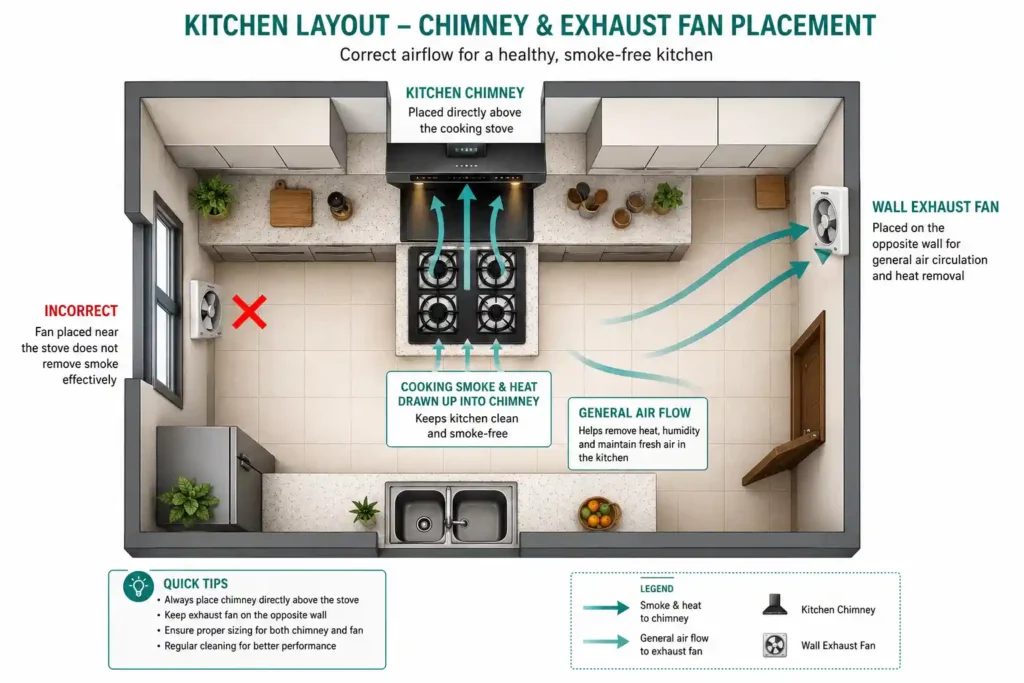
Yes, and in some kitchens this is a sensible setup. Install a kitchen chimney above the cooktop for smoke and grease, and an exhaust fan on the opposite wall for general air circulation and heat removal. This combination works well in larger kitchens or in hot and humid coastal locations.
The critical rule: the exhaust fan must go on the opposite wall from the stove. Placing an exhaust fan near the stove creates competing airflow that disrupts the chimney’s suction pattern and reduces the effectiveness of the kitchen chimney. Getting this placement right is the difference between the two appliances working together and working against each other.
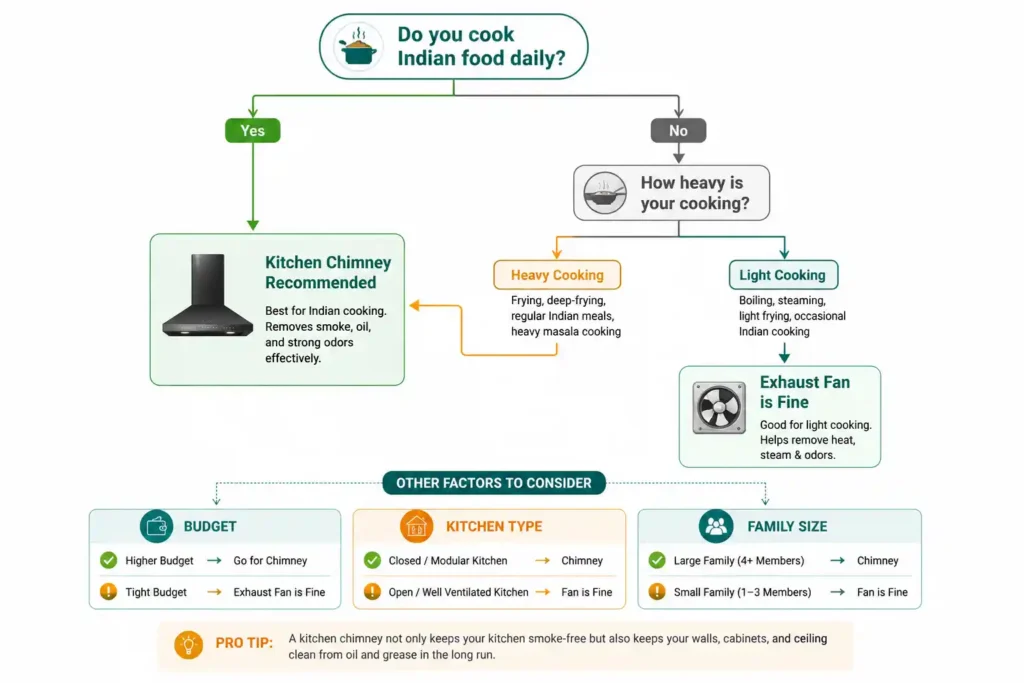
How to Decide in 3 Steps
-
- Answer honestly: how much oil and spice does your daily cooking use? Mostly boiling, steaming, or reheating → an exhaust fan is genuinely enough. Regular tadka, frying, or oil-heavy curries → you need a chimney, full stop.
-
- Check what your home or landlord allows. Can you drill walls or run ducting? If not, and you cook heavy Indian food anyway, a ductless chimney with a carbon filter is your best middle ground, not an exhaust fan.
-
- Compare total ownership costs, not just the sticker price. A budget under Rs. 3,000 and light cooking may make an exhaust fan the practical call. A chimney costs more upfront and may also require ducting, installation, filter cleaning, or replacement carbon filters. Do not assume it will pay for itself; actual savings depend on your kitchen, usage, and local service costs.
If your answers land on the chimney side for even two of these three, that is your answer. The table below breaks this down further by specific situation.
Quick Decision Guide: Kitchen Chimney vs Exhaust Fan
| Your Situation | Best Choice |
| Light cooking only: boiling, reheating, steaming | Exhaust fan is sufficient |
| Daily Indian cooking with oil and spices | Kitchen chimney |
| Rental home where wall drilling is not allowed | Exhaust fan |
| Modular kitchen being built or renovated | Kitchen chimney, ducted preferred |
| Open kitchen connected to living or dining area | A properly sized and installed chimney can help limit cooking emissions spreading into adjoining rooms |
| Total budget under Rs. 3,000 | Exhaust fan |
| Budget Rs. 12,000 to Rs. 25,000 | Mid-range kitchen chimney |
| Household prioritising indoor air quality | Prioritise effective ventilation; actual performance depends on appliance and installation |
| Small kitchen with good cross-ventilation, light cooking | Exhaust fan may work |
| Large kitchen with a wide 4-burner hob | Choose a hood wide enough for the hob and follow the manufacturer’s airflow and ducting guidance |
Illustrative Scenarios: Chimney vs Exhaust Fan in an Indian Kitchen
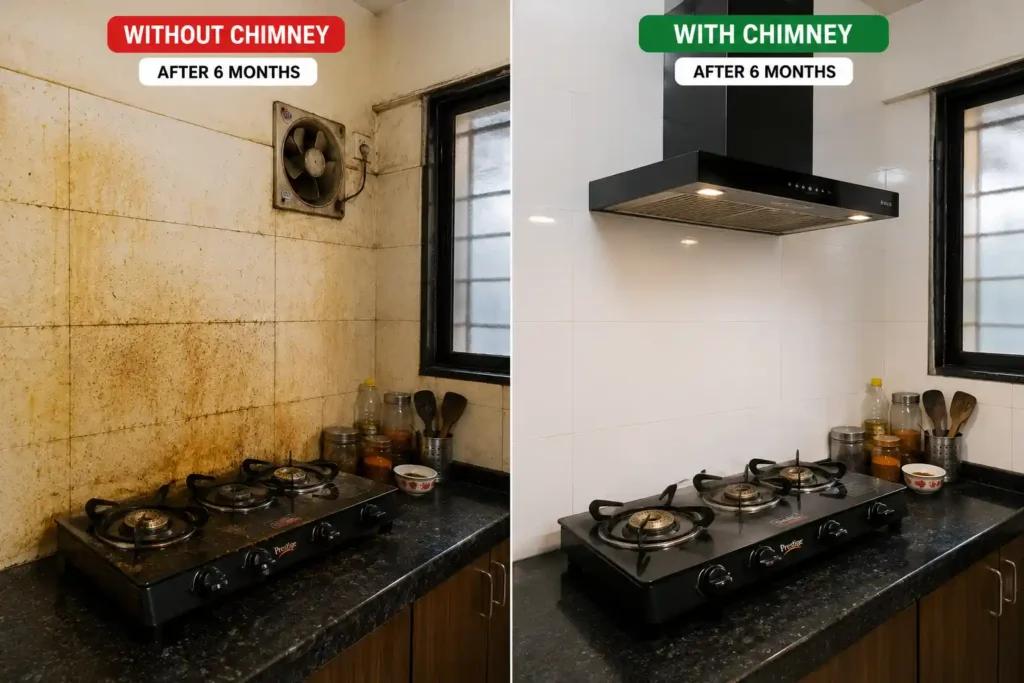
The examples below are illustrative scenarios, not results from a controlled test. Actual outcomes depend on cooking frequency, appliance capture area and airflow, duct routing, cross-ventilation, and cleaning.
Kitchen with exhaust fan only: Within six months of regular cooking, the wall directly above the stove develops a yellowish cast. Cabinet doors near the stove feel slightly sticky. Tiles behind the cooking range need scrubbing every week to stay clean. When you fry fish or make a non-vegetarian curry, the smell stays in the kitchen and often reaches the living room for hours.
Kitchen with a mid-range kitchen chimney (baffle filter, 1,100 m3/hr, ducted): After six months of the same cooking frequency, the wall above the stove is clean. Cabinet surfaces wipe easily. Tile maintenance takes much less effort. Cooking smells clear from the kitchen within 5 to 10 minutes of switching off the stove. The cooking experience itself feels noticeably better. Less heat buildup, less smoke in your eyes, and better visibility over the pots.
That difference is not subtle. It is the kind of thing you notice every single day in the kitchen chimney vs exhaust fan comparison in a live Indian kitchen.
Frequently Asked Questions
1. Is a kitchen chimney better than an exhaust fan for Indian cooking?
For frequent frying, tadka, and oil-heavy cooking, a correctly sized and installed ducted chimney is often the more suitable choice because it sits above the hob and can capture cooking emissions close to the source while venting them outdoors. An exhaust fan is less expensive and can help ventilate the room, but it has no dedicated grease filter and usually does not capture the cooking plume as directly. Check the exact product’s rated airflow and installation requirements rather than relying on a single airflow figure.
2. Can an exhaust fan replace a kitchen chimney?
An exhaust fan can provide useful general ventilation, especially for light cooking and where cross-ventilation is available. It is usually less effective than a correctly installed chimney at capturing smoke and grease close to the cooking surface, and it does not have a dedicated grease filter. If you regularly fry food or cook with a lot of oil, a chimney is worth considering; installation limits, budget, and the ability to vent outdoors still matter.
3. Which uses more electricity, a chimney or an exhaust fan?
An exhaust fan often has a lower rated wattage than a kitchen chimney, but compare the ratings on the exact models rather than relying on one range for every appliance. To estimate energy use, multiply rated watts by hours of operation and divide by 1,000 to get kilowatt-hours (kWh); multiply that by your electricity tariff for the approximate cost. Do not assume a chimney’s shorter run time will offset its higher wattage unless your own usage supports that estimate. Our kitchen chimney electricity-cost guide explains the calculation.
4. Is an exhaust fan enough for a small Indian kitchen?
For light cooking in a small kitchen under 80 sq. ft. with a window for cross-ventilation, a good 9-inch exhaust fan can handle daily needs. But if regular Indian cooking with oil and spices happens in that kitchen, a compact 60 cm kitchen chimney is the better long-term choice. This is the practical conclusion most homeowners reach in the kitchen chimney vs exhaust fan debate for small kitchens.
5. Do I need both a chimney and an exhaust fan?
Usually not. A well-selected kitchen chimney with adequate suction power handles most Indian kitchens on its own. For larger kitchens in hot and humid coastal locations, installing a chimney above the cooktop and an exhaust fan on the opposite wall for general circulation can work well. The exhaust fan must go on the opposite wall, not near the stove, to avoid disrupting the chimney’s suction in this combined setup.
6. Which is louder, a chimney or an exhaust fan?
A cheap exhaust fan is often louder than a mid-range chimney. Basic exhaust fans produce 65 to 75 dB because the motor and blades are not precision-balanced. A good kitchen chimney with an AC motor runs at 55 to 65 dB at full speed. A BLDC motor chimney runs at 45 to 52 dB at medium speed, quieter than a normal conversation. The assumption that exhaust fans are always quieter is not accurate in the kitchen chimney vs exhaust fan comparison.
7. What is the price difference between a chimney and an exhaust fan in India?
Exhaust fans generally cost much less upfront than kitchen chimneys, but prices vary by brand, size, motor, features, installation, and location. The broad price table above is only a starting point: some models cost more than Rs. 30,000, and current prices change with offers. Compare the product price plus installation, ducting, maintenance, and any carbon-filter replacements before deciding. Reduced cleaning effort may matter to you, but it is not a guaranteed financial saving.
8. Does an exhaust fan remove cooking smell from the kitchen?
Partially. An exhaust fan removes some odour by pushing kitchen air outside, but because it does not filter or trap odour-causing oil particles, smells from fish curry, deep frying, or heavy spice cooking linger for hours. A kitchen chimney, especially a ducted model, removes odours far more effectively because it extracts them directly above the stove before they disperse. This is a clear distinction in the kitchen chimney vs exhaust fan comparison for Indian kitchens.
9. Is a kitchen chimney worth it for a 1 BHK apartment?
Yes, if you cook Indian food regularly. In a 1 BHK apartment, the kitchen is often close to the living and sleeping areas. Without a kitchen chimney, cooking smells and grease-laden air spread through the entire home faster than in a larger house. A compact 60 cm kitchen chimney for home in a 1 BHK makes a real difference in cleanliness and air quality. Choose a ductless model if your kitchen walls do not face outside, and replace the carbon filter every 6 to 12 months.
10. How do I choose between a chimney and an exhaust fan for my specific kitchen?
Three questions settle the kitchen chimney vs exhaust fan choice for most homeowners. How often do you cook? How much oil and spice do you use? And what is your budget? Daily Indian meals with oil and spice mean a kitchen chimney is the right choice, even in a small kitchen. Occasional cooking, a window for cross-ventilation, and a budget under Rs. 2,000 make a 9-inch exhaust fan practical. For anything in between, a budget chimney in the Rs. 8,000 to Rs. 14,000 range is worth reaching for.
Sources & About This Guide
Specifications and figures in this guide are drawn from manufacturer listings across major Indian chimney and exhaust fan brands, cross-checked against the World Health Organization’s guidance on household air pollution and the Bureau of Energy Efficiency India for motor efficiency standards. Pricing reflects the Indian market as of September 2026.
Conclusion
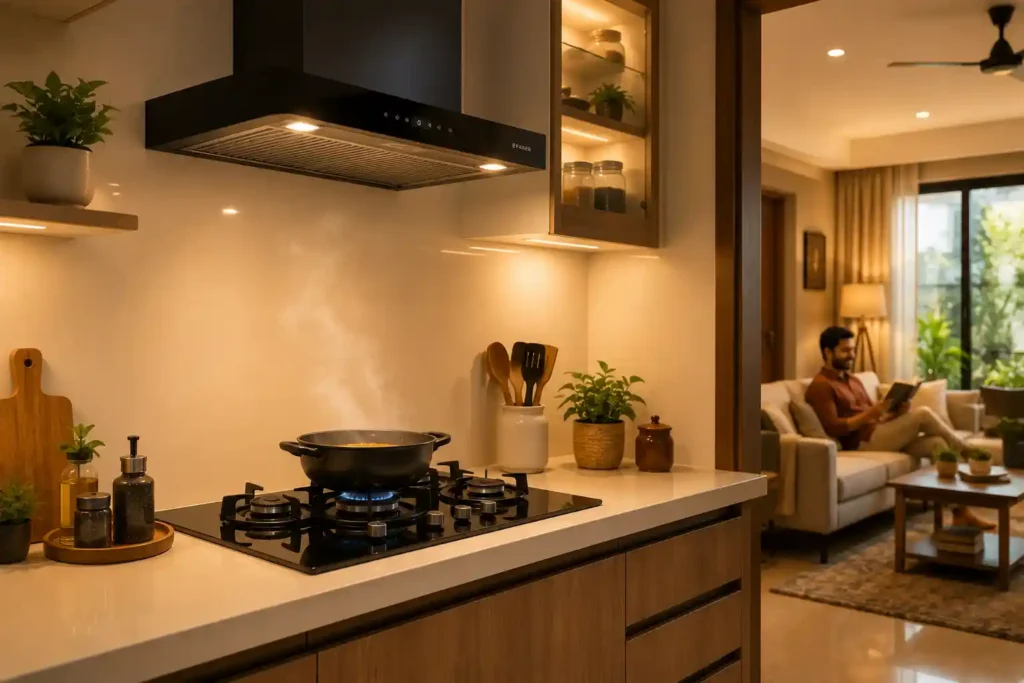
For households that frequently fry food or cook with oil and spices, a well-sized ducted kitchen chimney is often the more suitable choice because it captures the cooking plume near the hob and vents it outdoors. An exhaust fan remains a useful, lower-cost option for light cooking and general ventilation where installation constraints or budget rule out a chimney. The result depends on the exact product, installation, airflow, and maintenance, not simply the appliance category.
An exhaust fan is not without value. It is the right tool for light cooking, rental homes, or kitchens with very limited budgets. But for a family that makes regular Indian meals with tadka, frying, and heavy spices, an exhaust fan is not built for that job, and the kitchen chimney vs exhaust fan comparison makes that gap clear.
The kitchen chimney vs exhaust fan decision ultimately comes down to two things: how you cook, and what your kitchen means to you. If your kitchen is where meals are made from scratch every day, and you want those walls, tiles, and cabinets to stay clean without constant scrubbing, a good kitchen chimney is the right long-term investment.
If you decide a chimney fits your needs, compare models from established brands using current specifications, warranty terms, service availability, and installation requirements. Avoid choosing on airflow or price alone, and do not assume a particular lifespan or monthly ownership cost; these vary by model, care, use, and repair needs.
If you have a specific question about which option fits your kitchen size, cooking style, or apartment layout, drop it in the comments below.