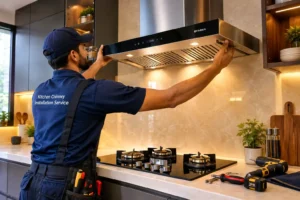
Written by Mohammed Saqib, researcher and writer at Kitchen Chimney. Last updated: October 31, 2026.
An electric kitchen chimney is a powered hood fitted above a cooktop to capture some cooking smoke, airborne grease, and fumes. The right choice depends on hob size, cooking habits, available ducting, maintenance needs, service support, and budget. No single model or headline suction rating suits every Indian kitchen. For a general overview, read our Use of a Kitchen Chimney Guide.
Cooking can release smoke, grease particles, and other pollutants, and the amount depends on the fuel, food, cooking method, and ventilation. India’s National Centre for Disease Control recommends adequate ventilation during cooking as part of household air pollution prevention. A chimney can help capture some cooking emissions when correctly selected, installed, and used, but it does not guarantee removal of every pollutant.
This guide explains how to compare electric kitchen chimneys, choose an appropriate size and airflow rating, understand filters and motor features, plan installation, estimate running costs, and maintain the appliance. Manufacturer specifications, warranty conditions, and service availability vary by model, so verify the details of the exact product before buying.
What Does Electric Kitchen Chimney Mean?
The word electric describes the chimney’s powered fan, motor, lights, and controls. It does not mean the appliance must be used only with an electric or induction cooktop. A compatible kitchen chimney can be installed above an LPG or PNG gas hob, an electric cooktop, or an induction hob, provided the manufacturer’s mounting, clearance, ventilation, and electrical requirements are met. The chimney is an extractor hood, not a cooking appliance, and it does not replace safe room ventilation.
What Is an Electric Kitchen Chimney and How Does It Work?
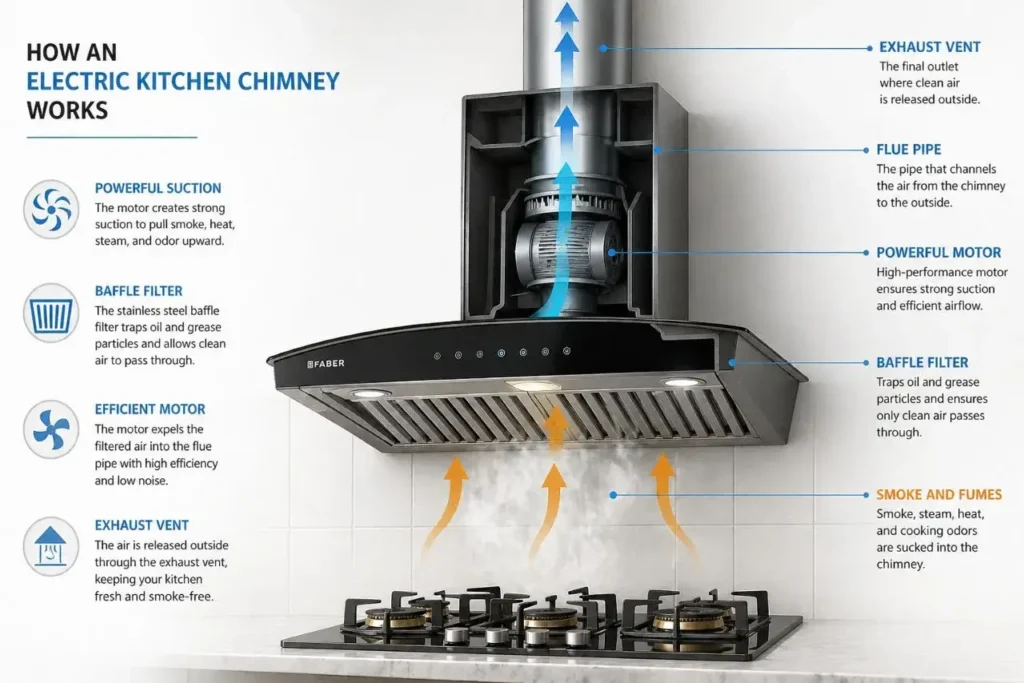
A kitchen exhaust chimney is an electrically powered kitchen ventilation system mounted above your cooktop to remove smoke, grease, heat, steam, and cooking odors from your kitchen air. Understanding how it works is the first step to using it correctly.
The Basic Working Mechanism of an Electric Chimney
The working process of an electric chimney for the kitchen follows three simple stages:
- Suction: The motor-powered fan pulls smoke and grease-laden air upward.
- Filtration: The air passes through baffle filters, mesh filters, or carbon filters that trap grease particles.
- Exhaust: Cleaned air is either pushed outside through a duct pipe (ducted) or recirculated back into the kitchen (ductless).
Ducted vs. Ductless Electric Kitchen Chimney
The choice between a ducted and ductless kitchen chimney depends on whether a suitable outdoor exhaust route is possible, your cooking habits, and the limits of your kitchen layout. See our Ducted vs Ductless Kitchen Chimney Guide for a focused comparison.
A ducted chimney carries extracted air outdoors through a duct. It is often the more practical choice when you can install a suitable duct route, especially for households that frequently fry or prepare smoky dishes. Actual capture depends on hood coverage, airflow, duct design, and installation quality.
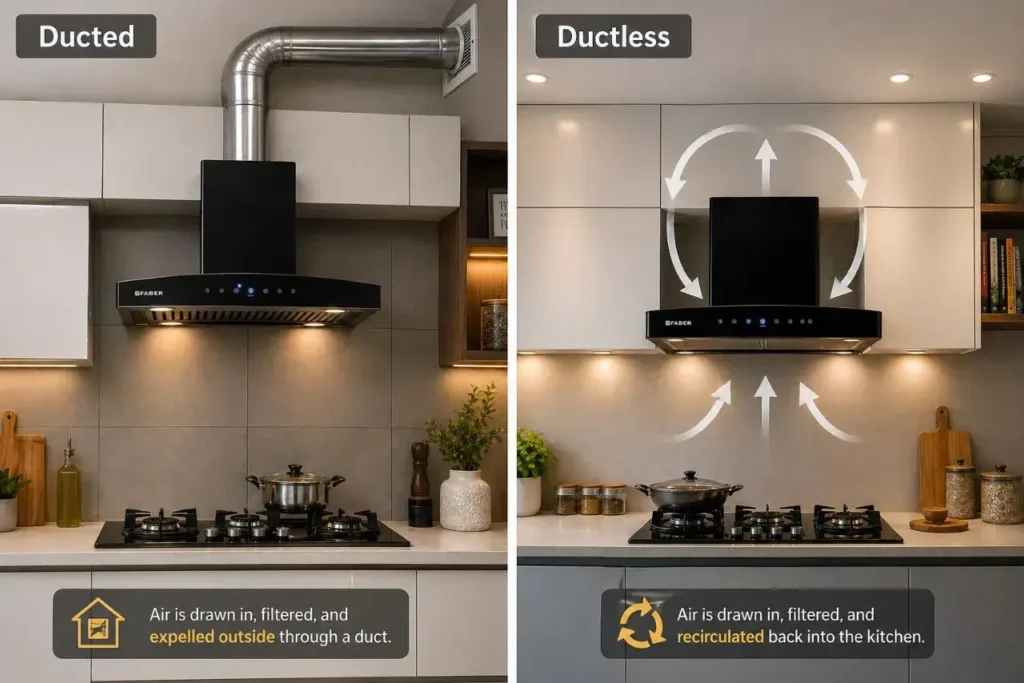
A ductless chimney recirculates air through grease filtration and, where required, a carbon filter that helps control some odours. It may suit kitchens where outdoor ducting is not practical, but it does not vent heat, moisture, or combustion gases outside. Filter replacement or regeneration intervals depend on the exact filter and usage, so follow the manufacturer’s instructions.
For frequent frying and high-heat cooking, compare a ducted model first if a safe, practical outdoor duct route is available. If ducting is not permitted or feasible, a compatible recirculating model can be an alternative, provided you understand its filtration limits and ongoing filter costs.
What an Electric Kitchen Chimney Can and Cannot Do
An electric chimney can capture some smoke, grease droplets, and cooking fumes close to the hob, but results depend on the hood’s coverage, airflow, ducting, installation, and use. Understanding its limits helps avoid choosing a model based on a single marketing claim.
A Chimney Does Not Remove Every Indoor Pollutant
A hood that vents outdoors can remove some captured cooking emissions, while a recirculating model filters air and returns it to the room. Neither design should be assumed to remove every pollutant. Maintain suitable room ventilation and follow the fuel appliance and chimney instructions.
Ductless Filtration Is Not the Same as Outdoor Exhaust
Carbon filters can help control certain odours in compatible recirculating systems, but the air returns to the kitchen. Such systems do not exhaust heat, moisture, or combustion gases outdoors. If you cook frequently and outdoor ducting is feasible, compare the trade-offs in our Ducted vs Ductless Kitchen Chimney Guide.
Types of Electric Kitchen Chimney You Should Know
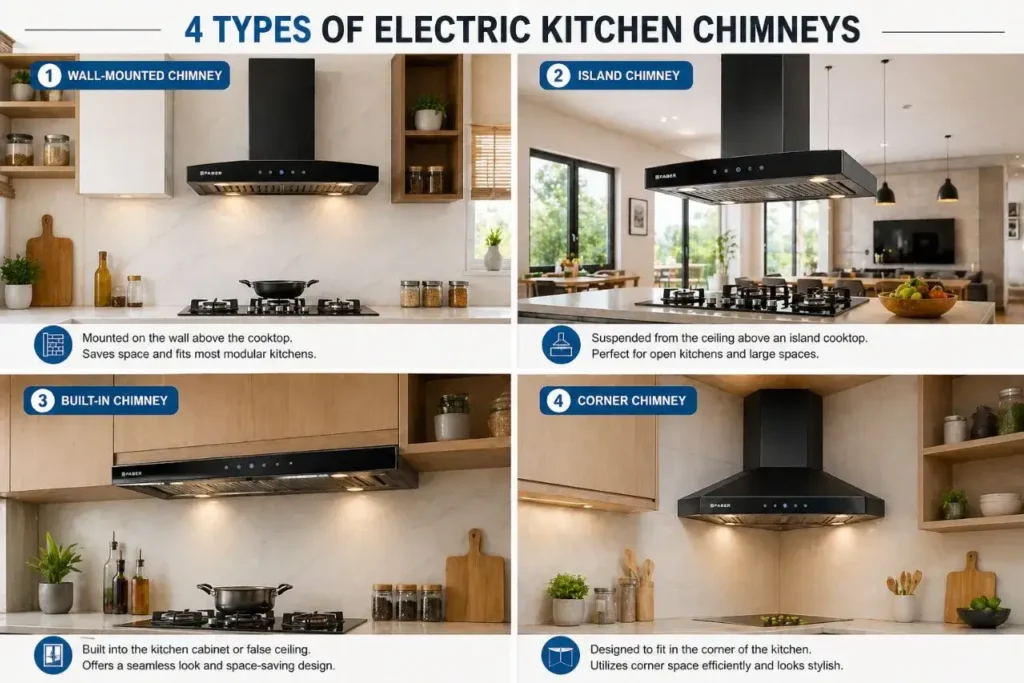
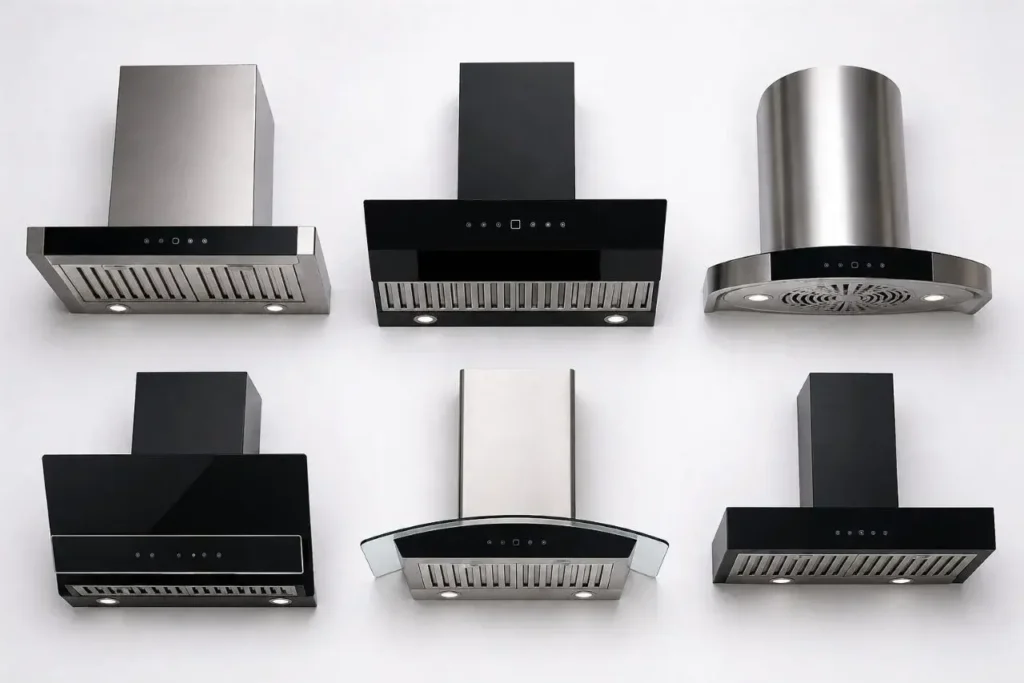
Choose the mounting style based on the position of the cooktop, wall and ceiling support, cabinet layout, and available exhaust route. Common designs include the following.
Wall-Mounted Kitchen Chimney
A wall-mounted chimney is fixed above a cooktop positioned against a wall. Many brands sell this style, but airflow, filter design, noise, dimensions, warranty, and installation requirements vary by model. Compare the specification sheets rather than assuming a brand or mounting type guarantees performance.
Island Kitchen Chimney
Designed for kitchens where the cooktop is placed on a central island with no adjacent wall. These are suspended from the ceiling and are common in premium modular kitchen setups.
Built-In Kitchen Chimney
Integrated directly into the kitchen cabinetry for a seamless look. Ideal for those who prefer a clean aesthetic in their modular kitchen interior design.
Corner Kitchen Chimney
Specifically designed for corner cooktop placements. Less common but available from brands like Glen Chimney and Kaff Chimney.
Quick Guide: Match an Electric Chimney to Your Kitchen
Use this table to create a shortlist, not as a fixed engineering specification. Measure the hob and compare the actual capture area, then confirm airflow and mounting requirements for each model. Manufacturer recommendations differ, and the duct route can change the result.
| Your Kitchen or Cooking Pattern | What to Shortlist | What to Verify Before Buying |
|---|---|---|
| Compact kitchen with a 2 or 3 burner hob | A wall-mounted chimney around 60 cm, if its hood covers the hob | Measure the hob width and depth, check the capture area, and confirm the duct route or recirculation kit. |
| Wider 3 or 4 burner hob with regular tadka and frying | A 75 cm or 90 cm model based on the actual hob dimensions | Compare the hood width and depth, airflow rating, filter design, noise, and installation clearance. |
| Open kitchen or frequent high-heat cooking | A wider hood with a suitable airflow rating and a practical outdoor duct route | Check capture area, room layout, duct length and bends, and whether the declared airflow is comparable across models. |
| Cooktop on a central island | An island or ceiling-supported hood designed for that position | Confirm ceiling structure, mounting hardware, duct path, electrical point, and installer support before ordering. |
| Apartment or rental home with no permitted outdoor outlet | A model explicitly designed for recirculating operation | Check compatible carbon-filter availability and cost. Recirculation does not exhaust heat or moisture outdoors. |
| Household that wants less manual grease cleaning | Compare filterless and auto-clean models with baffle-filter options | Read what the cleaning system actually does, how to empty the collector, and what cleaning remains necessary. |
For a closer look at the two common widths, read our 60 cm vs 90 cm Kitchen Chimney Size Guide. For the difference between exhaust and recirculation, see Ducted vs Ductless Kitchen Chimney.
How to Choose the Best Electric Chimney for Kitchen (Complete Buyer’s Checklist)
The most useful comparison is one that weighs the model’s specifications against your kitchen layout, cooking habits, cleaning preference, installation constraints, and long-term costs. Use the checklist below to compare models consistently rather than choosing by brand name alone.

Suction Power: How to Compare Ratings
Rated airflow is usually given in cubic metres per hour (m³/h or CMH). It matters, but it should not be treated as the only measure of performance. Hob width and depth, hood capture area, cooking style, duct length and bends, installation clearance, and the manufacturer’s test conditions all affect real-world results.
There is no single suction number or simple kitchen-volume formula that guarantees the right choice for every home. Use the rating as one comparison point, then check the hood dimensions, intended cooking load, installation requirements, and advice for the exact model. Our Kitchen Chimney Suction Power Guide explains the trade-offs.
How Duct Design Affects Real-World Airflow
A chimney’s rated airflow does not describe every installed setup. A long duct, several sharp bends, an undersized pipe, a restrictive outlet, or a poorly sealed joint can reduce the air reaching the hood. Keep the route as short and direct as the building allows, use the duct diameter specified for the model, and avoid adding reducers or extra bends unless the manufacturer approves them. KAFF’s Kitchen Chimney Selection Guide also highlights duct length, bends, and the distance from the hob as factors that affect airflow.
Compare Airflow, Noise, and Electrical Power Separately
These figures describe different things. Airflow in m³/h or CMH is the stated air-moving capacity, noise in dB or dB(A) describes sound output, and electrical input in watts describes power draw. A higher wattage does not automatically mean stronger extraction, and a higher airflow figure does not automatically mean a quieter chimney. Compare the exact model specifications and the fan speed at which each noise figure is measured.
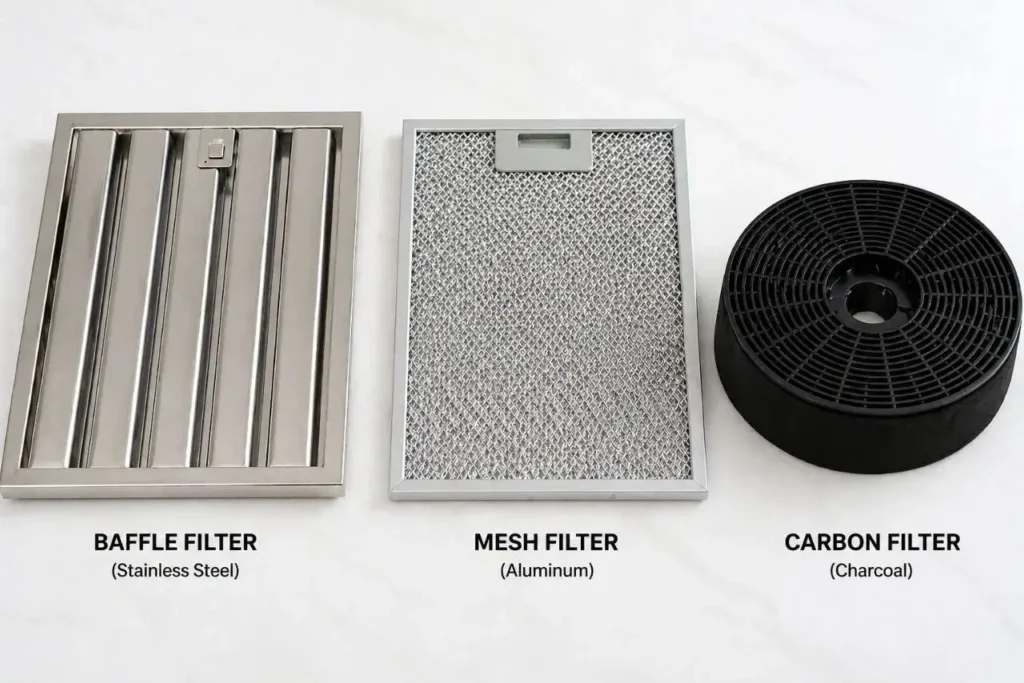
Filter Type Determines Long-Term Maintenance
Baffle filters use angled or layered metal panels to separate grease from moving air. Many are washable, but use only the cleaning method allowed by the manufacturer.
Mesh filters use layers of mesh to catch grease. They can need more frequent attention during heavy oily cooking, but cleaning and replacement needs depend on the particular design.
Carbon or charcoal filters are used in compatible recirculating setups to help reduce some odours. Many are replaced rather than washed, though reusable designs may have different instructions.
Choose the filter based on cooking habits, cleaning access, replacement-part availability, and the manual rather than assuming one type is best in every kitchen. See our Baffle Filter vs Filterless Chimney Guide for the main differences.
Auto-Clean vs. Manual Clean Chimney
“Auto-clean” is a feature label, not one universal design. Depending on the model, the system may use heat or another mechanism to help move grease into a collection cup. It can reduce some cleaning effort, but the oil collector, filters, and accessible surfaces still need care as described in the manual.
Whether the extra cost is worthwhile depends on how often you cook, the filter design, ease of cleaning, price difference, service availability, and warranty. Compare the specific model’s maintenance instructions rather than assuming every auto-clean chimney needs little or no manual cleaning. For more, see our Auto-Clean Kitchen Chimney Guide.
Chimney Size Must Match Your Cooktop
Measure the cooktop’s width and depth, then compare those dimensions with the hood’s actual capture area. A hood that is at least as wide as the hob is a useful starting point, but burner layout, hood depth, mounting height, and installation conditions also affect capture. A 60 cm or 90 cm model is common in Indian homes, but do not choose on burner count alone.
Before choosing a size, compare the layouts in our 60 cm vs 90 cm Kitchen Chimney Size Guide.
What Costs to Include in Your Budget
Prices change by brand, model, seller, offers, city, and installation package, so compare current listings rather than relying on fixed price bands. When you compare offers, check what is included in the quoted price:
- Chimney unit: Confirm the exact width, airflow rating, filter type, motor type, and included controls.
- Installation and ducting: Ask whether drilling, duct pipe, bends, clamps, wall finishing, and electrical work are included or charged separately.
- Future maintenance: Check the price and local availability of replacement carbon filters, lamps, switches, and other model-specific parts.
- Warranty coverage: Read the duration and exclusions for the motor and other parts, and check whether service visits or labour are covered.
A longer motor warranty can be useful, but it is not a complete measure of reliability. Check the written terms, service availability in your area, and the total installed cost before choosing a model.
Noise Level Matters for Daily Comfort
Noise ratings are most useful when models have been measured under comparable conditions and at the same fan speed. Check the manufacturer’s stated decibel range, especially at the speed you expect to use for frying. Duct design, mounting, vibration, and maintenance can also affect noise. Treat “silent” as a marketing description unless a specific sound rating and test condition are provided.
Electricity Consumption and Running Cost
Compare the rated power of the motor and lights, then estimate consumption using the number of hours you expect to run the chimney. Actual usage depends on the model and fan speed. Do not assume that every chimney has an official BEE star label; verify any energy label shown on the product and consult the relevant official listing when available. For help estimating running cost, see our Kitchen Chimney Electricity Bill Guide.
BLDC Motor: What to Compare
A brushless DC (BLDC) motor is worth comparing when you care about power draw and noise. However, motor type alone does not guarantee a particular sound level, energy saving, lifespan, or extraction result. Compare the stated wattage, airflow rating, noise specification, warranty, and product manual for similar models.
BLDC models may cost more upfront, so consider how often the chimney will run and whether any potential operating-cost difference matters for your use. Look for documented specifications rather than assuming the premium automatically pays for itself.
Choose a Chimney for Your Kitchen Setup
For a Compact Kitchen
Measure the hob and available wall or cabinet space before choosing a hood. Check that the capture area covers the pans you use most and that the duct route or recirculating setup is feasible. Avoid choosing a model only because its width is commonly sold for small kitchens.
For Frequent Frying and Heavy Indian Cooking
Prioritise effective capture over the burners, a suitable rated airflow, an accessible grease filter, and an exhaust route with minimal unnecessary bends. Compare the actual installation conditions as well as the headline suction number.
For an Apartment or Rental Home
Check building rules and the rental agreement before drilling through an exterior wall or common area. If ducting is not allowed, a compatible recirculating chimney may be an option, but budget for required filter maintenance and understand its limits. The Ducted vs Ductless Kitchen Chimney Guide covers the differences.
For an Island or Open-Plan Kitchen
Confirm the hob position, ceiling support, duct route, and the hood’s coverage from all sides. Island installation can be more complex than a wall-mounted model, so get an installation assessment and the full installed quote before ordering.
If You Cannot Exhaust Air Outdoors
Choose only a model designed for recirculation and confirm which filters it needs. Ask how much replacement filters cost and how often the manufacturer recommends changing or regenerating them. Do not expect recirculation to remove room heat and moisture in the same way as outdoor exhaust.
How to Plan an Electric Kitchen Chimney Installation
Installation affects capture performance, noise, and safe operation. Treat this as a planning checklist for speaking with your installer, not as a substitute for the instructions for your model or for qualified electrical work.

Installation Planning Checklist
- Measure the hob width and depth, and confirm the hood covers the cooking area.
- Choose a duct route to an outdoor outlet if the model is ducted, and ask the installer to minimise unnecessary bends while following the specified duct diameter.
- Confirm the mounting surface can support the exact model and the correct brackets are supplied.
- Check the required electrical connection, earthing, and accessible isolator or socket in the manual. Ask a qualified electrician to handle electrical work.
- Ask in advance what the quoted installation includes, such as wall drilling, ducting, clamps, flue covers, and finishing work.
What the Installer Should Confirm
Before mounting, ask the authorised installer to check these model-specific details:
- The clearance between hob and hood stated in the exact product manual.
- The duct diameter, permissible route, outlet position, and whether the outlet can exhaust outdoors.
- The power supply and earthing requirements for that particular model, rather than assuming every chimney needs the same socket.
- Wall strength, fixing hardware, access for filter removal, and enough space to open cabinets or lift the filter out for cleaning.
- Whether the building owner or housing society permits drilling, an external outlet, or connection to a designated exhaust shaft. Do not assume a shared shaft or false ceiling is an approved discharge point.
Installation Handover Checklist
- Confirm that the mounting is secure and the clearance matches the manual.
- For ducted models, check that the duct is connected, sealed, and routed to the intended outdoor outlet.
- Ask the installer to demonstrate the controls, lighting, auto-clean function if fitted, and normal operating sounds.
- Confirm how to remove and clean user-serviceable filters and how to empty the oil collector, if present.
- Keep the invoice, warranty details, installation record, and the user manual for future service.
Use the manufacturer’s authorised or qualified installer for mounting and ducting, and have electrical connections completed by a qualified electrician as required. Do not modify wiring or test live electrical parts yourself. For more installation checks, read our Kitchen Chimney Installation Guide.
How to Use an Electric Kitchen Chimney Correctly
The use of a kitchen chimney correctly is just as important as choosing and installing the right model. Many users unknowingly reduce their chimney’s efficiency through incorrect usage habits.

Use these steps as a starting point, then follow the user manual for the exact model:
- Switch the hood on when cooking begins, or earlier if the manufacturer recommends a lead-in period.
- Use a lower speed for light boiling or steaming, and increase the speed for tadka, frying, grilling, or visible fumes.
- Where practical, position smoke-producing pans under the hood’s capture area.
- Avoid a strong cross-draft blowing across the hob, while maintaining suitable room ventilation and replacement air.
- Keep the hood running for the post-cooking period stated in the manual, since run-on timers and recommendations differ by model.
- Switch the unit off and let it cool before cleaning. Empty the oil collector if fitted, and clean filters according to the specified schedule.
A post-cooking run-on period can help continue extracting remaining fumes, but the right duration depends on the chimney, cooking method, and ventilation. Do not rely on a universal percentage reduction or fixed runtime that has not been measured for your specific model.
Electric Kitchen Chimney Maintenance Guide (Keep It Running Like New)
The use of a kitchen chimney only delivers long-term value when it is maintained properly. Neglected chimneys lose suction efficiency fast and can become a fire hazard.

Cleaning Washable Metal Grease Filters
Inspect metal grease filters regularly and clean them at the interval stated in the manual. Heavy frying may require more frequent cleaning. Before removing a filter, switch off the appliance and isolate power as instructed. Use only approved detergent and cleaning methods, then let washable parts dry fully before refitting. Do not place a filter in a dishwasher unless the manufacturer permits it.
Mesh Filters and Carbon Filters
Some mesh filters are washable and others may have specific care or replacement requirements, so check the manual. Carbon or charcoal filters in recirculating models are often replaced rather than washed, although some long-life filters have other instructions. Use the specified filter for the exact model and follow its replacement or regeneration schedule.
Why Model-Specific Filter Care Matters
Filter material, cooking frequency, and whether the chimney exhausts air or recirculates it affect maintenance. Keep a note of the required replacement filter code, confirm availability from an authorised seller, and use only compatible parts. Do not assume every carbon filter needs replacement after the same number of months.
Deep Cleaning and Professional Service
Clean only the internal surfaces and components that the manual identifies as user-serviceable. Do not spray liquid into the motor, controls, lights, or electrical parts, and do not dismantle the motor or fan assembly for routine maintenance. If airflow remains weak after permitted filter cleaning, or the chimney vibrates, rattles, smells burnt, or shows electrical problems, switch it off and contact authorised service. Restricted ducting may require inspection by a qualified installer.
Troubleshooting Common Electric Kitchen Chimney Problems
| Problem | Possible Causes | Safe First Check |
|---|---|---|
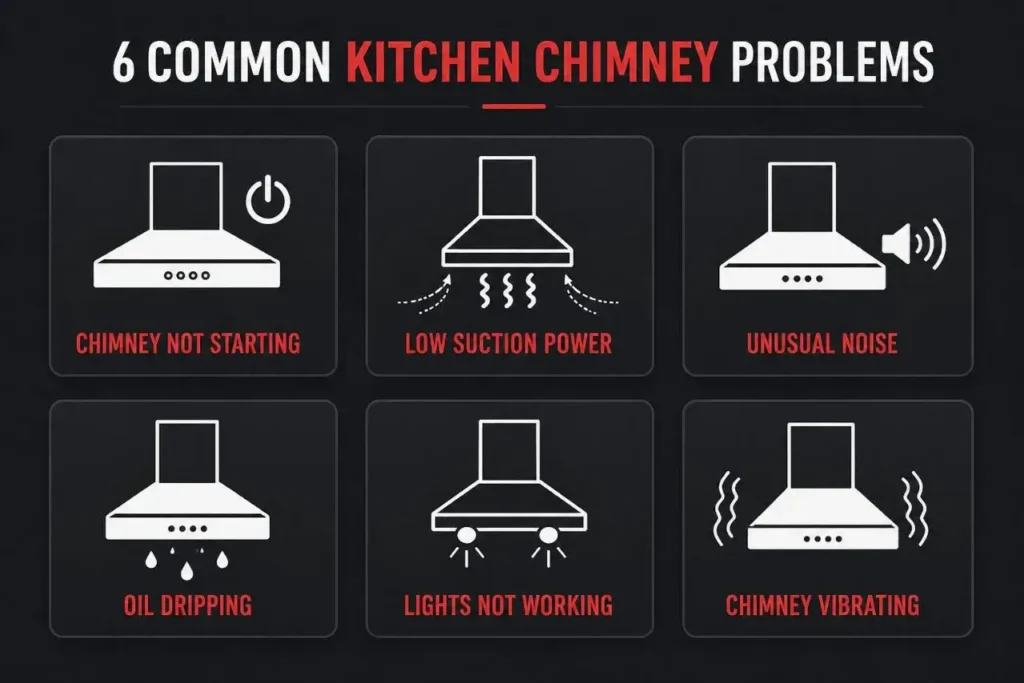
| Chimney does not start | Power supply issue, control fault, or tripped circuit | Check the supply only if safe and accessible. Do not open the appliance; contact an electrician or authorised service if it still will not start. |
| Weak smoke capture | Dirty filters, unsuitable fan setting, inadequate hood coverage, or restricted duct | Switch off and clean user-serviceable filters as directed. If airflow remains weak, request an installation or service check. |
| Unusual noise or vibration | Loose external fitting, poor mounting, duct vibration, or a mechanical fault | Switch the appliance off if the noise is sudden or severe. Do not dismantle the motor or fan assembly. |
| Oil dripping or collector overflowing | Oil cup needs emptying, filters are saturated, or the collector is not seated correctly | Switch off, allow the unit to cool, and inspect only the removable parts identified in the manual. |
| Lights do not work | Light module, control, or electrical fault | Use only the replacement method described in the manual, or arrange authorised service. |
| Persistent cooking smells in a ductless model | Carbon filter is exhausted or not fitted correctly | Check the filter instructions and replace or regenerate it only as specified. |
How to Compare Electric Kitchen Chimney Brands in India
Brands such as Faber, Elica, Hindware, Glen, Bosch, and Kaff sell kitchen chimney models in India, but ranges and specifications differ within each brand. Use the brand name as a starting point, not a guarantee of performance. Compare the exact models against the following criteria.
| What to Compare | What to Verify |
|---|---|
| Rated airflow and hood coverage | Compare the exact model’s CMH rating, hood width and depth, and specified test conditions. |
| Filter and cleaning design | Check whether grease filters are washable, whether a carbon filter is needed, and the cost of compatible replacements. |
| Motor, noise, and power | Compare the stated noise rating, power consumption, speed settings, and available specifications instead of relying on a “silent” or BLDC label alone. |
| Warranty and service | Read the warranty terms for the motor and other parts, exclusions, labour coverage, and service availability in your city. |
| Installation package | Confirm whether mounting, duct pipe, drilling, clamps, electrical work, and finishing are included in the quoted price. |
| Model fit for your kitchen | Match hood shape and width to the hob position, kitchen layout, ceiling, and a feasible exhaust route. |
This is a selection checklist, not an independent lab ranking of brands. Before purchasing, verify the specification sheet, current warranty, spare-part availability, service coverage, and installation costs for the exact model you plan to buy.
Electric Kitchen Chimney Comparison Worksheet
When two models look similar, record their complete model numbers and compare them on the same basis. This simple worksheet helps expose differences that a headline suction figure or discount can hide.
| Detail to Compare | Model A | Model B | What to Check |
|---|---|---|---|
| Full model number and width | Record from product label | Record from product label | Do not compare different sizes or variants as if they were the same model. |
| Hood width and depth | Record dimensions | Record dimensions | Check how much of the hob and outer burners the hood actually covers. |
| Rated airflow and test condition | Record m³/h or CMH | Record m³/h or CMH | Check whether the figure is a maximum rating and whether the manufacturer explains the test conditions. |
| Filter and operating mode | Record filter type | Record filter type | Confirm whether the chimney is ducted, recirculating, or supports both with the correct accessories. |
| Duct outlet and route limits | Record diameter and guidance | Record diameter and guidance | Check the specified duct size, permitted length, bends, and outlet position. |
| Noise at each fan speed | Record dB or dB(A) | Record dB or dB(A) | Compare the same speed and measurement conditions where stated. |
| Electrical input | Record watts | Record watts | Include the fan, lights, and auto-clean heater if separate ratings are published. |
| Cleaning and replacement parts | Record method and costs | Record method and costs | Check filter cleaning, oil collector care, carbon filter price, and spare-part availability. |
| Warranty and service | Record each part’s cover | Record each part’s cover | Read exclusions, registration conditions, labour coverage, and authorised service reach in your city. |
| Installed price | Record written quote | Record written quote | Include drilling, duct pipe, bends, clamps, electrical work, and finishing charges. |
Ask the seller or authorised installer to confirm unclear items in writing. A model with a lower purchase price may have a higher installed or maintenance cost once ducting, carbon filters, or service visits are included.
Common Mistakes to Avoid When Buying an Electric Chimney
- Choosing only by the highest CMH figure: Airflow, hood coverage, installation, and duct resistance all matter.
- Buying a hood that is too narrow: Compare the actual hob width and depth with the hood’s capture area.
- Ordering before checking the duct route: Confirm the outlet, pipe size, building permissions, and installation charges first.
- Assuming ductless means no maintenance: Recirculating models may require compatible carbon filters and ongoing replacement or regeneration.
- Treating auto-clean as maintenance-free: The collector, filters, and user-serviceable surfaces still need care.
- Judging a brand by its longest motor warranty: Check the separate cover for the motor, PCB, other parts, labour, and service availability.
Conclusion: Choosing an Electric Kitchen Chimney
An electric kitchen chimney can help capture some cooking smoke, grease, and fumes when its size, installation, airflow, and maintenance suit the kitchen. It is not a guarantee that all indoor pollutants will be removed, and it does not replace suitable room ventilation. Choose the product by comparing the exact specifications, installation plan, care requirements, warranty terms, local service, and total installed cost.
To summarize the key decisions you need to make:
- Match hood width and capture area to the size and layout of your cooktop.
- Compare rated airflow in context, including duct length, bends, and the kind of cooking you do.
- Choose ducted or recirculating operation based on whether outdoor ducting is feasible and what each option can remove.
- Check the filter type, cleaning method, carbon-filter replacement cost if required, and availability of compatible spares.
- Follow the installation clearance and maintenance schedule in the exact model’s manual, and use qualified installers for mounting and electrical work.
- Compare warranty conditions, authorised service in your area, noise ratings, power draw, and the full installed price.
Use the same checklist for each shortlisted model so that price, features, service coverage, and installation needs can be compared on a like-for-like basis.
The best fit is the model that suits your kitchen layout, cooking habits, maintenance preferences, and budget without relying on unsupported performance promises. Verify model-specific details before you order, and keep the manual for safe operation and long-term care.
Frequently Asked Questions About Electric Kitchen Chimney
Q1. What is the correct use of a kitchen chimney for Indian cooking?
Use a speed that captures the fumes produced by your cooking. Start with a lower setting for light cooking and increase it for frying, tadka, grilling, or visible smoke. Switch the hood on when cooking begins and follow the model’s manual for pre-run or post-run timing. A chimney does not guarantee that every pollutant will be removed.
Q2. Which suction power is best for an electric kitchen chimney?
There is no universal rating that is ideal for every kitchen. Compare the rated airflow with your hob dimensions, capture area, cooking habits, duct route, and the manufacturer’s installation guidance. A simple formula cannot determine the exact requirement for every household. Our Kitchen Chimney Suction Power Guide explains the factors to consider.
Q3. Which is better, a ducted or ductless kitchen chimney?
A ducted model sends extracted air outdoors through a duct, provided it is correctly installed. A ductless model filters and recirculates air, which may help with grease and some odours but does not vent heat, moisture, or combustion gases outdoors. Follow the filter maintenance instructions for the exact model.
Q4. How often should I clean my electric chimney filter?
Follow the cleaning schedule in the model’s manual and inspect filters regularly. Heavy, oily cooking can mean more frequent cleaning. Clean only the parts intended to be user-serviceable, and do not spray liquid into the motor or electrical components. Our Kitchen Chimney Cleaning Guide has additional maintenance tips.
Q5. What is an auto-clean chimney, and is it worth buying?
Auto-clean is a feature designed to help collect grease, but the mechanism varies by model and the oil collector, filters, and other user-serviceable parts still need maintenance. It may be worthwhile if it makes care easier for your cooking routine, but compare the extra price, cleaning requirements, warranty, and service availability first. See our Auto-Clean Kitchen Chimney Guide.
Q6. Does an electric kitchen chimney consume a lot of electricity?
Electricity use depends on the unit’s rated power, lights, fan speed, and how long it operates. Check the power specification and estimate use from your daily runtime. Do not assume every chimney has an official BEE star label; verify a label and its official listing when one is shown. Our Kitchen Chimney Electricity Bill Guide explains the estimate.
Q7. What is the ideal height for installing an electric kitchen chimney?
The required clearance depends on the chimney model and cooktop. Follow the distance in the exact product manual and ask the installer to confirm it before mounting. A generic height should not override the manufacturer’s instructions. See our Kitchen Chimney Installation Guide.
Q8. Which filter is best for a kitchen chimney in India?
Baffle filters are a common option for kitchens with regular oily cooking because their metal panels separate grease from the airflow and are often washable. Mesh filters and filterless designs have different maintenance needs. Choose according to the exact model, cleaning preference, cooking style, and cost of compatible parts. Carbon filters primarily help control odours in compatible recirculating setups.
Q9. Can I install an electric kitchen chimney myself?
Plan the hood position, duct route, and power requirements before installation, but have the chimney mounted and connected by the manufacturer’s authorised or qualified installer and a qualified electrician where electrical work is required. This helps confirm clearances, secure mounting, proper ducting, and safe electrical connections.
Q10. How long does an electric kitchen chimney last?
Service life varies with model quality, installation, cooking frequency, maintenance, and availability of replacement parts. Regular care and timely authorised service can help, but no specific lifespan is guaranteed. Check the written warranty for covered parts, exclusions, and service terms.
Q11. What size electric chimney do I need for my kitchen?
Measure the cooktop’s width and depth, then compare them with the hood’s width and capture area. A hood at least as wide as the hob is a useful starting point, but burner layout, hood depth, mounting, and installation also matter. Our 60 cm vs 90 cm Kitchen Chimney Size Guide explains the trade-offs.
Q12. Which brand is best for an electric kitchen chimney in India?
There is no one best brand for every kitchen. Compare the exact model’s rated airflow, hood coverage, filter design, noise rating, warranty terms, spare-part availability, installation price, and authorised service in your city. Model-to-model comparisons are more useful than a universal brand ranking.
Q13. Is a BLDC motor chimney worth the extra cost?
A BLDC motor may be worth comparing if noise and power draw matter to you, but the benefit depends on the specific model. Compare stated wattage, noise rating, airflow, warranty, and price with a conventional motor model instead of assuming that a BLDC label guarantees lower running costs or a longer lifespan.
Q14. How much should I budget for a good electric kitchen chimney in India?
Prices vary by model, seller, discount, city, and installation package. Compare the full installed cost, including the chimney unit, ducting, drilling, electrical work if needed, and compatible replacement filters. Read the written warranty terms and confirm service availability before deciding. Avoid treating a price band as proof of quality or performance.
Q15. Is an auto-clean kitchen chimney maintenance-free?
No. An auto-clean system may help move grease into an oil collector, but filters, the collector, and user-serviceable surfaces still need attention as described in the manual. The exact cleaning routine depends on the technology and how much you cook.
Q16. Is a ductless chimney suitable for an apartment or rented flat?
It may be a practical option where outdoor ducting is prohibited or not possible, provided the model supports recirculation and its filters are maintained. A ductless chimney returns filtered air to the room, so it does not exhaust heat, moisture, or combustion gases outdoors. Check the rental agreement and building rules before planning any drilling or modification.
Q17. What should I compare besides suction power?
Compare hood width and depth, filter type, duct route, noise rating, rated power, cleaning access, cost of replacement filters, warranty exclusions, service availability, and the total installed price. These factors affect how well a chimney fits your kitchen and how practical it is to maintain.
Q18. Can I use an electric kitchen chimney above an induction cooktop?
Yes. A compatible chimney can be installed above an induction or other electric cooktop. Cooking on induction can still produce grease, steam, smoke, and odours from the food and oil. Check the chimney’s mounting clearance, hood coverage, and the cooktop and chimney manufacturers’ instructions before installation.
Q19. Is a higher suction rating always better?
No. A high rated airflow cannot compensate for a hood that is too narrow, a poor duct route, unsuitable mounting height, or incorrect installation. Choose a rating appropriate to the cooking load and compare the complete installation requirements, noise, and electrical input rather than buying the largest number available.
Q20. Does a ductless electric kitchen chimney remove heat and moisture?
No. A recirculating chimney filters air and sends it back into the kitchen. It may help capture grease and reduce some odours when the correct filters are fitted, but it does not send heat and moisture outdoors. A ducted model exhausts captured air outside when correctly installed.
Q21. Does an electric kitchen chimney need a 15A socket?
Do not assume that every chimney needs the same socket or circuit. The required supply, plug, earthing, and rated load depend on the exact model and any separate auto-clean heater. Check the rating label and installation manual, and ask a qualified electrician or authorised installer to confirm the connection before use.
Q22. Can I run an electric kitchen chimney on a home inverter?
It depends on the chimney’s running and starting load, the inverter’s continuous and surge capacity, and whether the model has an auto-clean heater. Compare the ratings of both appliances and follow their manufacturers’ instructions. Do not connect the chimney to an inverter or run its heater from backup power unless the setup is confirmed as suitable by a qualified electrician.
Editorial Note
This guide is intended to help Indian households compare electric kitchen chimneys using practical, model-specific checks. It is not a laboratory test or a claim that one chimney is best for every home. A kitchen hood can capture some cooking emissions when selected and installed correctly, but it should not be treated as a guarantee that all indoor pollutants are removed. Our publishing standards and correction process are explained in the Editorial Policy.
Trusted Sources
- National Centre for Disease Control Health Advisory, Government of India guidance that recommends adequate ventilation during cooking. It provides general public-health context, not a rating of kitchen chimney products.
- KAFF Kitchen Chimney Selection Guide, covering hob size, airflow, ducting, filter types, noise, and installation considerations.
- Glen Kitchen Chimney Buying Guide, with manufacturer advice on suction, installation, features, and maintenance.
- Elica India Kitchen Chimney FAQs, including information about ducting, carbon filters, installation, and model-specific operation.
- Faber India’s Kitchen Chimney Buying Guide, for additional manufacturer guidance on selecting a chimney for the kitchen layout.
How This Guide Is Researched and Kept Current
This guide was reviewed against publicly available Indian manufacturer selection and care guidance and the National Centre for Disease Control’s household air pollution advisory. Recommendations are framed as buying checks rather than universal performance promises because product ranges, test conditions, duct requirements, service coverage, and warranty terms vary by model and location. No laboratory comparison or hands-on test of every listed chimney is claimed. Before buying or maintaining a product, confirm the full model number and consult its current specification sheet, installation manual, and warranty documents. Our approach to product information and review standards is set out in the Product Review Methodology.
About the Author
Mohammed Saqib is a researcher and writer at Kitchen Chimney who prepares practical guides for Indian homeowners on chimney selection, use, installation planning, and maintenance. This article is educational and does not claim a laboratory comparison or hands-on test of every product. Model specifications, safety clearances, and care requirements vary, so readers should confirm details in the exact product manual and current warranty documents.