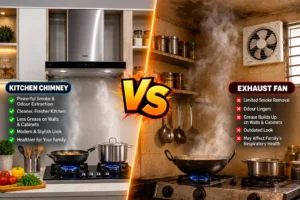
If you live in a flat, you have probably run into this exact problem: you want a chimney that actually clears smoke, but your kitchen has no outer wall to run a duct through, or your building society will not allow drilling. Ducted versus ductless is the single most consequential decision in choosing a chimney for an Indian apartment, more than brand, more than price. Get it wrong and you either end up with a chimney that cannot vent properly, or one that recirculates warm, greasy air back into your kitchen no matter how good the specs looked online.
This guide walks through exactly how each system works, why ducted wins for heavy Indian cooking when it is available to you, when ductless is genuinely your best option rather than a compromise, and the installation details, duct length, bends, apartment rules, that most buying guides skip entirely.
Last updated: September 2026.
[Image Prompt: A highly Attractive, clickbait-style featured image with vibrant abstract gradients, bold lighting effects, and a central subject representing the blog topic, modern cinematic composition, ultra-detailed, high contrast, visually striking, Dimensions 1280 x 854 pixels]
Quick Verdict
- You own your flat and have an external wall within about 10 feet: Go ducted. It performs better and costs less over time.
- You rent, or your society won’t allow drilling: Ductless is your practical answer, choose a high-suction model to compensate for filter resistance.
- Your kitchen is in the interior of the flat, no outer wall nearby: Ductless, since a duct run that long would lose too much suction anyway.
- You might move homes in a few years: Consider a dual-mode chimney, or ductless for portability.
How Ducted Chimneys Work
A ducted chimney pulls smoke, steam, and grease-laden air into the hood, then pushes it through a pipe that exits through an external wall or the roof. The contaminated air leaves the kitchen entirely rather than being cleaned and put back. Most installations use a rigid or semi-rigid duct, 150mm in diameter for standard units, running from the chimney outlet to the nearest external opening.
Because the air genuinely leaves the building, a ducted chimney does not rely on a filter to clean recirculated air the way a ductless one does. Most ducted models still use a baffle filter or a filterless auto-clean system to trap grease before it reaches the motor and duct, but that filter’s job is grease capture, not air purification, the ducting handles that by removing the air completely.
[Image Prompt: A realistic cutaway architectural illustration of a wall mounted kitchen chimney connected to a rigid metal duct running through an exterior wall to the outside, showing airflow direction with subtle motion lines, clean technical diagram style, soft natural lighting, editorial infographic quality, Dimensions 1280 x 854 pixels]
How Ductless (Recirculating) Chimneys Work
A ductless chimney pulls air through the hood the same way, but instead of venting it outside, it passes that air through a multi-stage filtration system, typically a grease filter followed by a carbon or charcoal filter, and releases the cleaned air back into the kitchen. No external wall, no drilling, no duct pipe.
The grease filter catches oil particles the same way a ducted chimney’s filter does. The carbon filter is what absorbs odor molecules, which a simple grease filter cannot do on its own. This is also the part that needs regular attention: carbon filters cannot be washed and reused the way baffle filters can, they need periodic replacement, generally every 3 to 6 months for daily heavy cooking, longer for lighter use.
Because the air stays in the room, a ductless chimney removes smoke and most odor but does not remove heat and humidity from cooking, that stays in your kitchen. It also asks more of the motor, since air has to push through two filter stages instead of one, which is why ductless models generally need a higher rated suction to deliver the same real-world performance as a ducted unit.
[Image Prompt: A realistic cutaway diagram of a ductless kitchen chimney showing air being pulled through a grease filter then a carbon filter and released back into the kitchen through vents at the top, labeled airflow path, clean modern technical illustration, soft studio lighting, Dimensions 1280 x 854 pixels]
Ducted vs Ductless: Side-by-Side
| Factor | Ducted | Ductless |
| Where air goes | Vented outside completely | Filtered and recirculated into the kitchen |
| Odor removal | Excellent, air leaves entirely | Good, but weakens as the carbon filter saturates |
| Heat and humidity | Reduced, since hot steam exits with the air | Stays in the kitchen, air is only cleaned, not cooled |
| Installation | Requires wall drilling and ducting | No drilling, mounts almost anywhere |
| Effective suction | Higher, no secondary filter resistance | Lower for the same rated suction, due to filter resistance |
| Recurring cost | Low, baffle filters are washable | Carbon filter replacement every 3 to 6 months, roughly Rs 800 to 1,200 per set |
| Portability | Fixed once installed, duct hole remains in the wall | Can be unmounted and reinstalled in a new home |
| Best for | Owned flats and houses with external wall access | Rentals, society restrictions, interior kitchens |
[Image Prompt: A clean modern split screen product photograph showing a ducted wall mounted chimney on the left connected to visible ducting and a sleek ductless chimney on the right with no visible ducting, neutral studio background, balanced even lighting, professional comparison photography style, Dimensions 1280 x 854 pixels]
Why Ducted Is Preferred for Indian Cooking
Indian cooking is genuinely harder on ventilation than most cuisines. Tadka, deep frying, and cooking with a lot of oil and whole spices produce more airborne grease and stronger odors than typical Western cooking, and a ducted system handles that load with far less strain. Because the air actually leaves the kitchen, there is no filter saturating over the course of a heavy cooking session the way a carbon filter can. A baffle filter used for daily heavy frying needs regular washing, but it does not lose its ability to work the way a carbon filter chemically saturates and stops absorbing odor.
The heat and steam removal matters more than most people expect too. If you have ever noticed your kitchen feels noticeably hotter and more humid after a long cooking session even with the chimney running, that is very likely a ductless system at work, it filtered the smoke but the heat stayed in the room. A ducted system pulls that hot, humid air outside along with the smoke, which is part of why kitchens with ducted chimneys stay more comfortable during long cooking sessions.
If you are deciding on suction power for heavy Indian cooking specifically, our guide on the use of kitchen chimneys covers how to match suction to your kitchen size and cooking style in more depth.
[Image Prompt: A realistic overhead shot of an Indian home kitchen mid deep frying session with visible steam and light smoke rising toward a wall mounted ducted chimney, warm ambient kitchen lighting, shallow depth of field, editorial food photography style, Dimensions 1280 x 854 pixels]
When Ductless Is Your Only Option
For a large number of Indian apartment dwellers, this is not really a preference question, it is a constraint. A few situations where ductless is genuinely the right call, not a compromise:
- You are renting. Drilling through an external wall is usually not something a landlord will approve, and undoing it when you move out adds cost and hassle.
- Your society’s rules prohibit exterior modifications. Many housing societies and RWAs restrict wall drilling or external vent installation, particularly in high-rises, and this is worth confirming with your society office before you commit to a ducted purchase.
- Your kitchen has no external wall access. Interior kitchens, common in some apartment layouts and island kitchens away from any outer wall, would need a duct run long enough to lose most of its suction advantage anyway.
- You expect to move within a few years. A ductless chimney can be unmounted and taken with you, a ducted installation generally cannot.
In any of these cases, prioritize a ductless model rated at 1,200 m³/hr or higher rather than the 800 to 1,000 m³/hr range that might suffice for a ducted unit, since you need the extra headroom to compensate for the carbon filter’s airflow resistance.
The Duct Length and Bends Rule
This is the detail most buying guides gloss over, and it can quietly undo an otherwise good ducted chimney purchase. Suction loss through ducting is not small: industry estimates put it at roughly 5 to 8 percent per metre of straight duct, and a single 90-degree bend costs as much suction as an extra 2 to 3 metres of straight pipe.
A practical rule that holds up across multiple installer guides: keep the total duct run under 3 to 4 metres (roughly 10 to 12 feet), with no more than 2 bends. A chimney rated at 1,000 m³/hr connected to 4 metres of duct with two bends can realistically deliver only 500 to 700 m³/hr of effective suction at the hood, well below what the box promised.
For apartments specifically, this rule is often the deciding factor. If your kitchen sits far from any external wall, or if reaching one means routing the duct through a false ceiling with multiple turns, the suction loss can be severe enough that a well-installed ductless chimney will genuinely outperform a poorly ducted one in day-to-day use. Before choosing ducted purely because it is “better on paper,” measure the actual distance and count the bends your installation would need.
[Image Prompt: A technical diagram style illustration of a kitchen floor plan showing a chimney duct route with two 90 degree bends leading to an exterior wall, distance markers and airflow arrows, clean blueprint aesthetic, soft blue and white color palette, editorial infographic quality, Dimensions 1280 x 854 pixels]
Heat and Humidity: The Difference Most Guides Skip
Most comparisons stop at smoke and odor, but heat management is where the two systems diverge most noticeably in daily use, especially during long cooking sessions or festive-season cooking in bulk. A ducted chimney removes hot, humid air along with the smoke, which measurably cools the kitchen during and after cooking. A ductless chimney only filters the air, the heat and moisture from boiling, frying, and steaming stays in the room.
If your kitchen already runs warm, has limited natural ventilation, or you live somewhere with hot, humid summers, this is worth weighing seriously alongside odor removal. A ductless chimney doing an excellent job on smoke can still leave you cooking in a noticeably hotter, muggier kitchen than a ducted equivalent would.
Can You Get Both? Dual-Mode Chimneys
A smaller but growing category worth knowing about: dual-mode chimneys that can run either ducted or ductless, depending on whether you install a carbon filter for recirculation or connect ductwork for external venting. Several major brands now offer models built this way.
These are genuinely useful in two specific situations. First, if you are renting now but expect to own a home with external wall access later, a dual-mode chimney lets you run it ductless today and switch to ducted mode after moving, without replacing the whole unit. Second, if you are unsure whether your society will eventually approve ducting, it removes the risk of committing to one system only to find your installation constraints change. The trade-off is a somewhat higher upfront price than a single-mode unit, and it is worth confirming that switching modes is something you or a technician can genuinely do without specialized parts.
[Image Prompt: A realistic product photograph of a modern kitchen chimney unit displayed with two configuration options visible side by side, one showing a duct attachment and one showing a carbon filter cartridge, clean studio lighting, professional appliance photography, Dimensions 1280 x 854 pixels]
Renting vs Owning: How That Changes Your Decision
Answer these three questions to decide in under a minute:
- Do you own the flat, and will you likely stay for 5 or more years? Yes to both, go ducted if wall access exists. No to either, lean ductless or dual-mode.
- Does your kitchen have an external wall within about 10 feet, with a route that needs no more than 2 bends? Yes, ducted will perform close to its rated suction. No, ductless will likely outperform a poorly routed ducted install anyway.
- Has your society or landlord confirmed drilling is allowed? Get this in writing or at least clearly confirmed before buying a ducted unit, not after installation day when the installer shows up.
Two or more answers pointing toward ducted, and you have a genuinely strong case for it. Two or more pointing away, ductless or dual-mode is the practical choice, not a downgrade.
Best Ductless Chimneys for Apartments
For apartment use, prioritize higher suction (1,200 m³/hr or above), a filterless or heat auto-clean grease stage to reduce upkeep, and a compact 60cm width if your cooktop allows it, since apartment kitchens are often tighter than independent house kitchens. A few genuinely well-reviewed categories to shortlist from:
| Model Category | Suction | Notable Feature |
| Kaff ductless 60cm range | ~1,000 to 1,200 m³/hr | Strong motors built specifically to compensate for carbon filter resistance |
| Glen dual-mode 60cm range | Up to 1,600 m³/hr | Switch between ducted and ductless as your situation changes |
| Elica filterless ductless auto-clean | ~1,200 to 1,350 m³/hr | Low-maintenance heat auto-clean grease stage |
| Faber ductless compact range | ~1,000 to 1,200 m³/hr | Wide service network, useful if something needs repair |
| Hindware ductless auto-clean | ~1,000 to 1,200 m³/hr | Budget-friendlier entry point for smaller kitchens |
Prices and exact suction figures shift by model year, confirm the current listing before buying. If you’re comparing specific brands beyond this shortlist, our guide on which chimney brand is best in India breaks down suction, service network, and price across eight major brands.
[Image Prompt: A modern editorial flat lay style arrangement of five compact ductless kitchen chimney units on a clean light grey surface, soft even studio lighting, high resolution commercial product photography, consistent visual style, Dimensions 1280 x 854 pixels]
Safety and Maintenance Notes
For ductless chimneys, the carbon filter is the single most important maintenance item, and the one people forget most often since it sits out of sight. A saturated carbon filter does not fail loudly, odor removal just quietly gets worse over weeks until you notice smells lingering. Set a reminder every 3 to 6 months depending on cooking frequency, rather than waiting for a noticeable decline.
For ducted chimneys, the duct joints deserve a periodic check, grease can accumulate inside the pipe over years and, combined with the flame-adjacent nature of a kitchen, is worth having a technician inspect every couple of years. Regardless of system type, never leave hot oil unattended on the stove, a running chimney reduces smoke and captures grease, it does not prevent a pan fire. Consistent kitchen ventilation is also tied to genuine health outcomes, unfiltered cooking smoke is a documented contributor to indoor air pollution according to the World Health Organization’s research on the subject, which is worth a look if you want the broader context.
Sources & About This Guide
Duct length and bend-loss figures in this guide are cross-checked across multiple installer and manufacturer sources, including guidance consistent with the Bureau of Energy Efficiency India on motor performance standards. Suction and pricing figures reflect the Indian market as of September 2026 and shift with model updates and festive sales.
Conclusion
Ducted is the better-performing system for Indian cooking whenever you can actually install it well, short duct run, few bends, wall access confirmed. Ductless is not a lesser choice when those conditions are not met, it is the correct engineering answer for a rented flat, a restrictive society, or an interior kitchen, and modern ductless models with strong motors and auto-clean grease stages perform genuinely well for the vast majority of everyday Indian cooking. The mistake to avoid is choosing based on which sounds more premium rather than which actually fits your specific apartment.
Frequently Asked Questions
1. Is ductless chimney as good as ducted for Indian cooking?
For heavy daily frying and tadka, a ducted chimney generally performs better since it removes air completely rather than filtering and recirculating it. A high-suction ductless model can handle moderate to fairly heavy cooking well, but it will not quite match a properly installed ducted system on odor removal and heat management.
2. Can I convert a ductless chimney to ducted later?
Only if it’s a dual-mode model designed for both. A standard ductless chimney is built around recirculation and generally cannot be retrofitted with duct venting. If future flexibility matters to you, choose a dual-mode model from the start.
3. How long can a chimney duct pipe be?
Keep it under 3 to 4 metres (roughly 10 to 12 feet) with no more than 2 bends where possible. Every additional metre and every 90-degree bend measurably reduces effective suction, a bend can cost as much suction as 2 to 3 extra metres of straight duct.
4. Do ductless chimneys really work for Indian cooking?
Yes, provided you choose a model with sufficiently high suction (1,200 m³/hr or above) and stay consistent with carbon filter replacement. They handle daily moderate to fairly heavy cooking well; the main limitation is heat staying in the kitchen and gradual odor performance decline as the filter saturates between replacements.
5. Which chimney is better for a rented apartment?
Ductless, in almost all cases. It requires no drilling, no permanent modification your landlord would need to approve, and can be unmounted and taken with you when you move. A dual-mode chimney is worth considering if you expect to own a home with wall access in the future.
6. How often should I replace the carbon filter in a ductless chimney?
Every 3 to 6 months for daily heavy cooking, and up to a year for lighter, occasional use. Unlike a baffle filter, a carbon filter cannot be washed and reused, it needs to be swapped out once it stops absorbing odor effectively.
7. Can apartment societies stop chimney duct installation?
Yes, many housing societies and RWAs restrict exterior wall modifications, including duct vents, particularly in high-rise buildings. Always confirm with your society office or building management before purchasing a ducted chimney, rather than after installation day.
8. Does a ductless chimney make my kitchen hotter?
It can feel that way, since a ductless system filters and recirculates air rather than removing heat and steam from the kitchen. A ducted chimney vents hot, humid cooking air outside, which noticeably cools the kitchen during and after cooking, a difference a ductless system cannot replicate.
9. Is a dual-mode chimney worth the extra cost?
It’s worth it if your living situation might change, moving from a rental to an owned flat, or uncertainty about society approval for ducting. If your installation situation is stable and clear either way, a purpose-built single-mode chimney is usually the more cost-effective choice.
10. What suction power do I need for a ductless chimney in a small apartment kitchen?
Aim for at least 1,200 m³/hr rated suction, higher than you would need for an equivalent ducted unit, since the carbon filter adds airflow resistance that reduces real-world performance below the rated figure.