A beautiful and modern kitchen today is not just about style, it is about hygiene, safety, and comfort. From my experience working around heavy Indian cooking, the Use of Kitchen Chimney has completely changed how clean and breathable a kitchen feels. When people ask me what is the use of kitchen chimney, I explain that it is not just a luxury appliance but a powerful kitchen ventilation system that improves daily life.
Written by Mohammed Saqib · Updated: October 2026.
If you cook Indian food at home even twice a week, you already know the struggle. The tadka hits the pan, oil starts popping, smoke fills the room, and by the time your dal is ready, the entire kitchen smells like a dhaba. The walls near the stove look greasy, and you’re wiping down cabinets more than you’re actually cooking.
I have been there. And after finally installing a kitchen chimney, I honestly wished I had done it five years earlier.
The use of kitchen chimney goes far beyond just pulling smoke out of the room. It is one of the most practical kitchen ventilation decisions you can make for your home. According to the World Health Organization, indoor air pollution from cooking is a major contributor to respiratory problems in households that cook on gas stoves without proper ventilation. And in Indian cooking, where we regularly do deep frying, tadka, and grilling, the need for a proper kitchen smoke remover becomes even more real.
So if you have been wondering what is the use of chimney in kitchen, or whether it is worth buying, this article breaks it all down for you, clearly and honestly.
Last updated: September 2026 — refreshed with the latest suction, noise, and safety guidance for Indian kitchens.
Quick Answer: What Does a Kitchen Chimney Actually Do?
- Removes smoke and fumes at the source, right above the flame
- Traps grease before it settles on tiles, cabinets, and walls
- Removes odors through carbon filters (ductless models) or by exhausting air outside (ducted models)
- Reduces heat and steam buildup in the cooking zone
- Supports cooking ventilation by capturing some smoke, grease, and airborne particles when correctly sized and installed; it does not guarantee removal of gases such as NO2 or CO
What is the Use of Chimney in Kitchen?
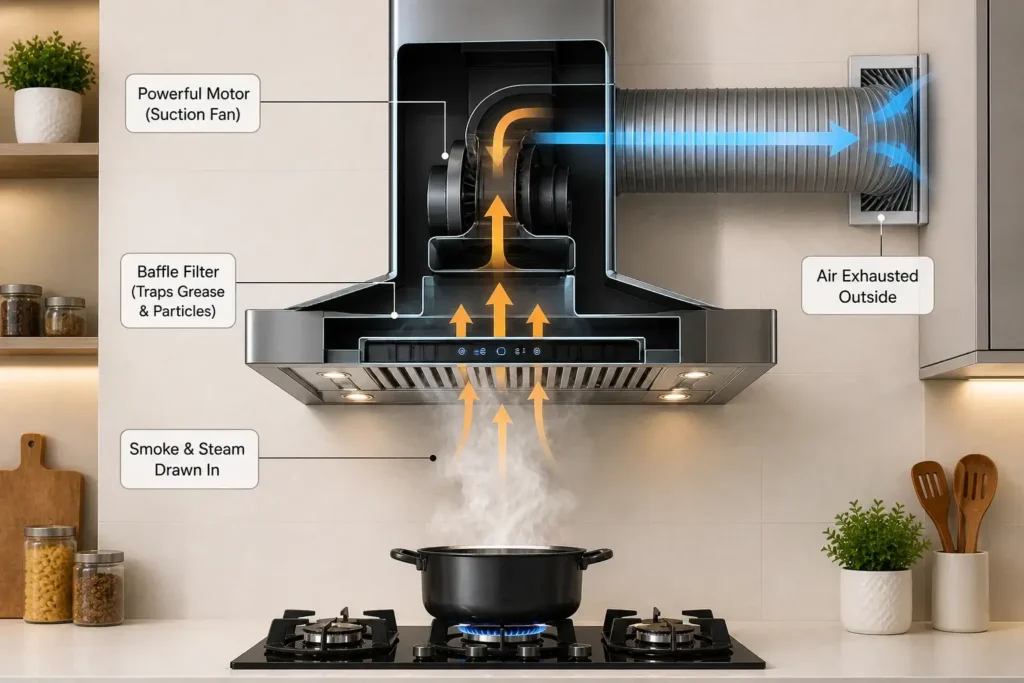
At its core, the use of kitchen chimney is ventilation. But it is not the same as opening a window or switching on a ceiling fan. A kitchen chimney works by drawing in contaminated air from directly above your cooking surface, filtering it, and either sending it outside through a duct or recirculating cleaned air back into the room.
The basic kitchen chimney working principle involves a motor that creates suction. As you cook, smoke, cooking fumes, grease particles, steam, and odors rise naturally with the heat. The chimney hood sits directly above the stove and pulls all of that upward before it spreads around the room.
There are two main operating modes:
Ducted kitchen chimney (exhaust mode): The polluted air is physically expelled outside through a chimney duct pipe. This is the more effective option for heavy Indian cooking since the contaminated air actually leaves your home.
Ductless chimney system (recirculation mode): The air passes through filters (including a carbon filter) that trap grease and absorb odors. The cleaned air then cycles back into the kitchen. This works well in apartments where external ducting is not possible.
The efficiency of any chimney depends on chimney suction power (measured in m3/hr), the quality of filters, and correct placement above the cooktop. For Indian kitchens with heavy frying, most experts suggest a minimum suction capacity of 800 to 1000 m3/hr.
How Kitchen Chimney Removes Smoke and Cooking Fumes
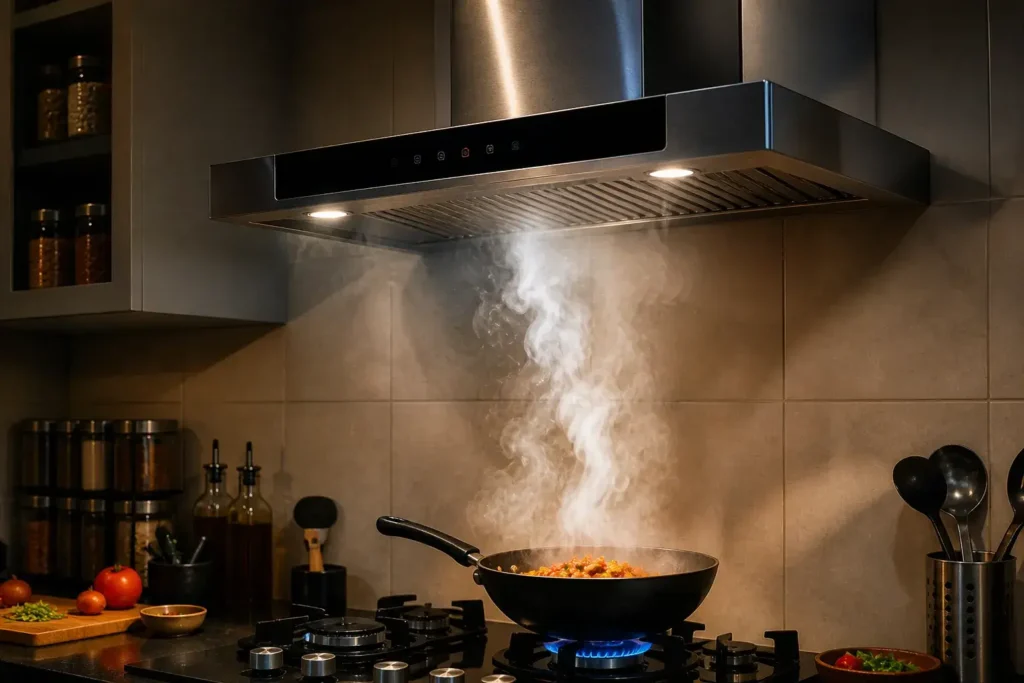
One of the biggest kitchen chimney uses is smoke removal. When you fry or do a tadka, oil droplets become airborne along with smoke. Without a chimney, these particles settle on every nearby surface: walls, tiles, cabinets, even the ceiling.
A kitchen chimney for smoke removal works by catching this smoke at the source before it disperses. The hood creates a suction zone directly above the flame. Smoke gets drawn in, passes through the baffle filter or mesh filter, which traps oil droplets, and then either exits through the duct or goes through a carbon filter for odor removal.
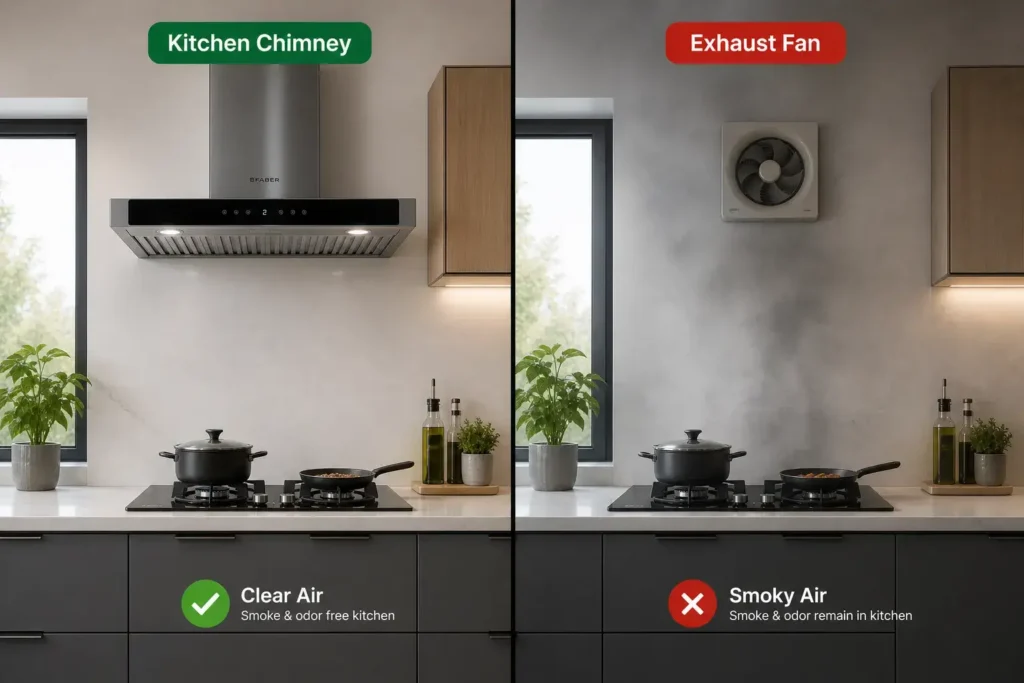
This is exactly why the chimney vs exhaust fan debate almost always favors a chimney. An exhaust fan is placed on a wall and draws air from the general room. By the time smoke reaches it, it has already spread everywhere. A chimney works at the cooking source, which makes it dramatically more effective for kitchen smoke control.
Baffle Filter vs Carbon Filter: What’s the Difference?
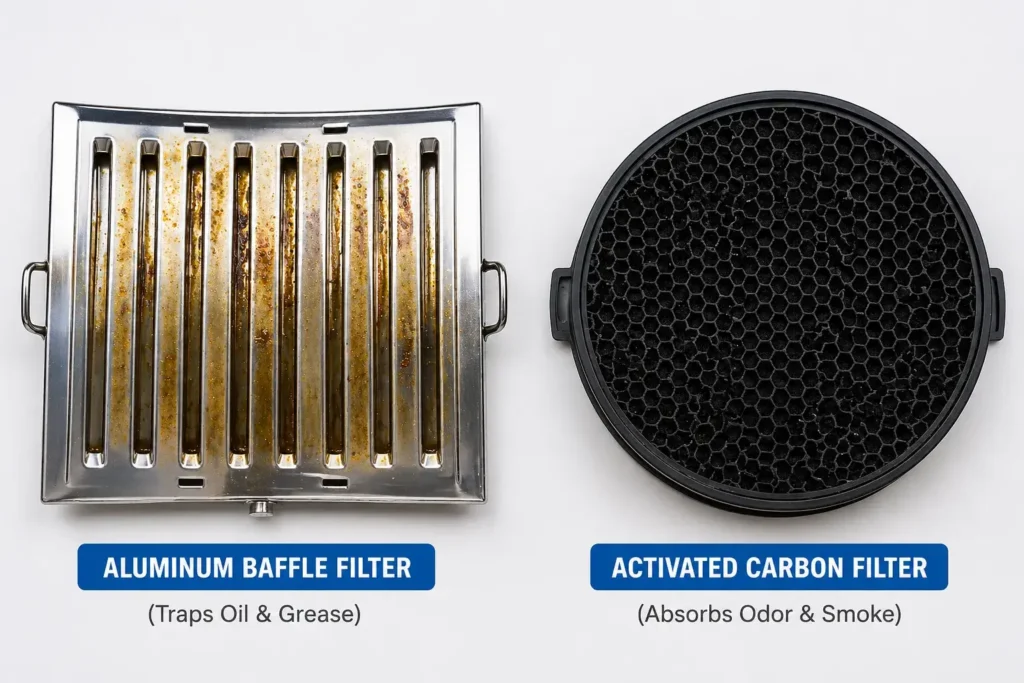
Baffle filter chimney use: Baffle filters are made of curved aluminum panels. Oil droplets hit the curved surfaces, condense, and drip into a collection tray. These are washable, long-lasting, and ideal for heavy cooking. They do not help with odors though.
Carbon filter chimney use: Carbon filters absorb odors and fumes. They are used in ductless models. These need to be replaced every 3 to 6 months depending on how often you cook.
Most good chimneys for Indian kitchens come with baffle filters as the primary grease trap, and an optional carbon filter for odor control in ductless setups.
How to Use a Kitchen Chimney Properly: Step-by-Step
Owning a chimney is one thing, using it correctly is another. A lot of people switch it on only after the smoke has already filled the room, which defeats half the purpose. Here is how to get the most out of it:
- Switch it on before you start cooking, not after. Turning it on 1 to 2 minutes ahead lets suction build up before oil hits the pan.
- Match the fan speed to the cooking method. Use low speed for boiling or light sautéing, medium for regular cooking, and high speed for deep frying, tadka, or grilling.
- Keep the hood directly above the flame. If your cooktop has multiple burners, position pans under the chimney’s suction zone rather than at the far edge of the stove.
- Let it run for 5 to 10 minutes after cooking. Residual smoke, steam, and odor take a few minutes to fully clear, even after the flame is off.
- Check the oil collection tray or cup weekly if you have an auto-clean model, and empty it before it overflows.
- Wipe the baffle filter surface with a damp cloth between full washes if you cook daily, this reduces grease buildup between deep cleans.
Following this routine consistently is what actually determines whether your chimney performs at 90% efficiency or drops to 50% within a year.
Kitchen Chimney Benefits for Health

Here is something that doesn’t get talked about enough. The kitchen chimney for health benefits is one of the strongest reasons to install one, especially if you or anyone in your family cooks frequently.
When you cook on a gas stove, the combustion process releases nitrogen dioxide (NO2) and carbon monoxide (CO) in small amounts. Frying food at high temperatures also releases fine particulate matter and volatile organic compounds. Breathing these repeatedly over years is not harmless.
A correctly sized and installed ducted chimney can capture some cooking smoke, grease, and airborne particles and exhaust them outdoors. It should not be assumed to remove all combustion gases such as carbon monoxide or nitrogen dioxide, and results vary with the appliance, mounting, duct route, and make-up air. Recirculating ductless models filter some grease and odours but do not vent combustion gases, heat, or moisture outdoors. Keep the kitchen ventilated and follow the manufacturer’s installation guidance.
This matters most in:
- Kitchens with poor natural airflow or small windows
- Homes where cooking happens multiple times a day
- Households with older people members, young children, or people with asthma
A chimney can be a practical ventilation upgrade for households that cook frequently, particularly when the model is correctly sized and vents outdoors. Whether it is the right purchase depends on cooking habits, installation options, budget, and the performance of the specific appliance.
Kitchen Chimney Use for Grease and Wall Protection
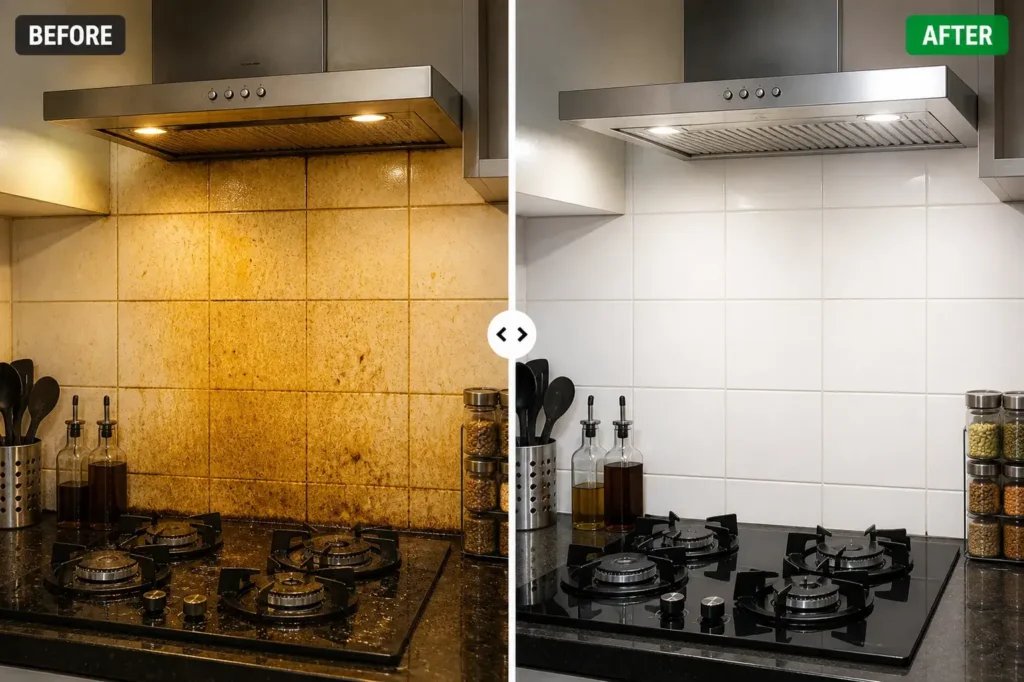
Anyone who has ever scrubbed oil off kitchen tiles knows how frustrating it is. Grease settles silently every time you cook. It builds up on tiles behind the stove, on cabinet fronts, on the exhaust fan cover, even on nearby appliances.
One of the most practical kitchen chimney uses is protecting your kitchen surfaces. Once you install a chimney, the kitchen grease removal happens at the source. Grease particles are trapped by the filters before they get a chance to settle anywhere.
I noticed a clear difference within weeks of installing mine. The tiles behind my stove stopped getting that sticky film. Cabinet surfaces near the stove stayed cleaner for longer. The overall kitchen hygiene improvement was visible and actually reduced cleaning time.
For modular kitchens especially, this matters a lot. High-finish cabinet shutters and painted walls can get permanently stained by oil residue over time. A chimney for modular kitchen actively protects that investment.
How Often Should Chimney Filters Be Cleaned?
- Light cooking (once a day, less frying): Clean filters every 3 to 4 weeks
- Heavy Indian cooking (daily frying, tadka, grilling): Clean filters every 2 weeks
- Auto-clean chimney models: Usually need cleaning every 2 months since the motor automatically drains oil into a collection cup
Baffle filters can be washed with warm water and dish soap. Never use harsh chemicals on them.
Kitchen Chimney Use for Reducing Heat and Steam

This one surprises people sometimes. Yes, a chimney also helps with heat. When you boil water, fry food, or pressure cook, steam and heat rise above the stove. Without ventilation, this moisture lingers in the kitchen. Over time it can affect wooden cabinets, cause paint to peel, and make the room uncomfortably warm.
The chimney heat control function works by pulling hot air and steam upward and out of the kitchen. This keeps the cooking zone cooler and reduces moisture buildup. Especially in closed kitchens with limited windows, this is a real difference you feel while cooking.
The steam also matters for the cook directly. Without a chimney, steam from a boiling pot hits your face when you lean over to stir. With a chimney running, that steam is drawn away. It is a small thing, but it makes cooking noticeably more comfortable.
Types of Kitchen Chimney: Which One Should You Choose?
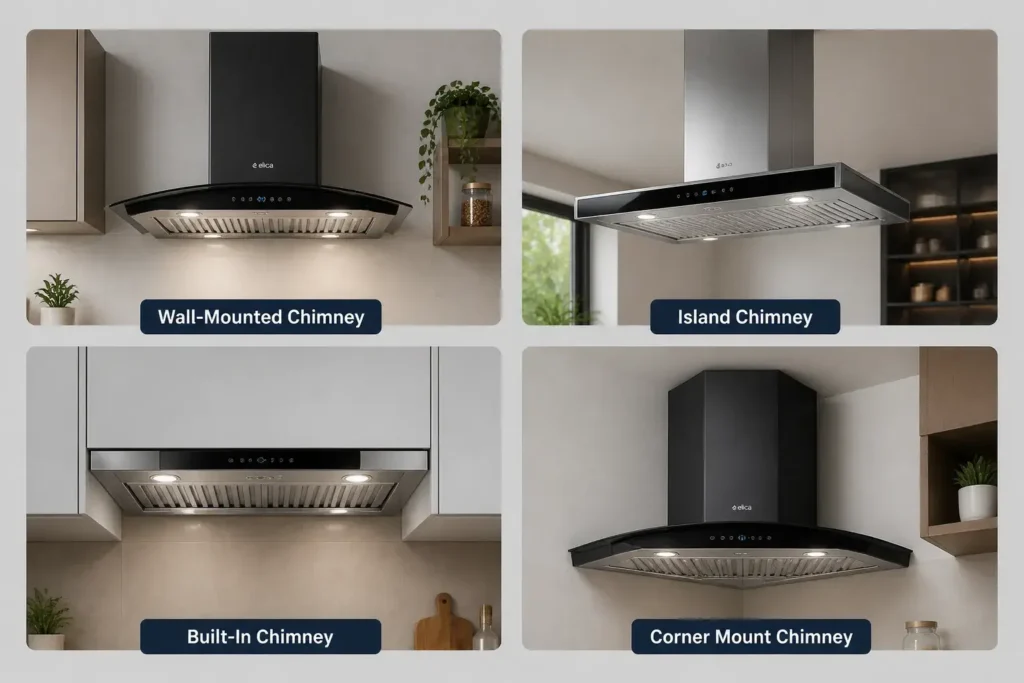
The use of kitchen chimney can vary depending on which type you buy. Here is a quick breakdown of the main types available:
- Wall-Mounted Chimney: The most common type in Indian homes. Fixed to the wall directly above the cooking range, available in 60 cm and 90 cm widths, and suits most standard kitchen layouts. Good suction power and widely available from brands like Elica, Faber, Glen, and Hindware.
- Island Kitchen Chimney: Designed for kitchens where the cooktop is on a kitchen island rather than against a wall. Hangs from the ceiling and is visually striking. Tends to be more expensive but works well in open kitchen layouts.
- Built-in Chimney: Installed within a cabinet above the cooktop. Ideal for compact modular kitchen setups where you want the chimney to blend into the cabinetry.
- Corner Mount Chimney: Installed in a corner when the stove is placed at a kitchen corner. Less common but useful for specific kitchen layouts.
- Auto-Clean Chimney: A feature, not a type. Auto-clean models have a motor that automatically breaks down oil particles and collects them in a cup, meaning less manual maintenance, especially useful for heavy cooks.
Kitchen Chimney vs Exhaust Fan: Key Differences
| Feature | Kitchen Chimney | Exhaust Fan |
| Smoke capture | From the general room air | From general room air |
| Grease trapping | Yes, with baffle/mesh filters | No |
| Odor removal | Yes (especially ductless with carbon filter) | Partial |
| Heat control | Yes | Limited |
| Installation cost | Higher | Lower |
| Effectiveness for Indian cooking | High | Moderate |
The kitchen chimney vs exhaust fan comparison is clear for anyone who does regular Indian cooking. An exhaust fan was the older solution when chimneys were not common. Today, with chimney prices starting around Rs. 5,000 to Rs. 8,000 for entry-level models, the investment is accessible for most households.
Advantages and Disadvantages of Kitchen Chimney
| Advantages | Disadvantages |
| Higher upfront cost than an exhaust fan | Higher upfront cost than exhaust fan |
| Protects tiles, walls, and cabinets from grease | Requires regular chimney filter cleaning |
| Improves kitchen air quality for healthier cooking | Professional installation needed for ducted models |
| Reduces heat and steam in the kitchen | Adds to electricity bill (typically 150-250 watts per use) |
| Reduces cleaning effort on kitchen surfaces | Needs servicing every 6 to 12 months |
| Adds a modern look to the kitchen | Not useful if placed too far from the cooktop |
Is Kitchen Chimney Necessary? Who Actually Needs One?
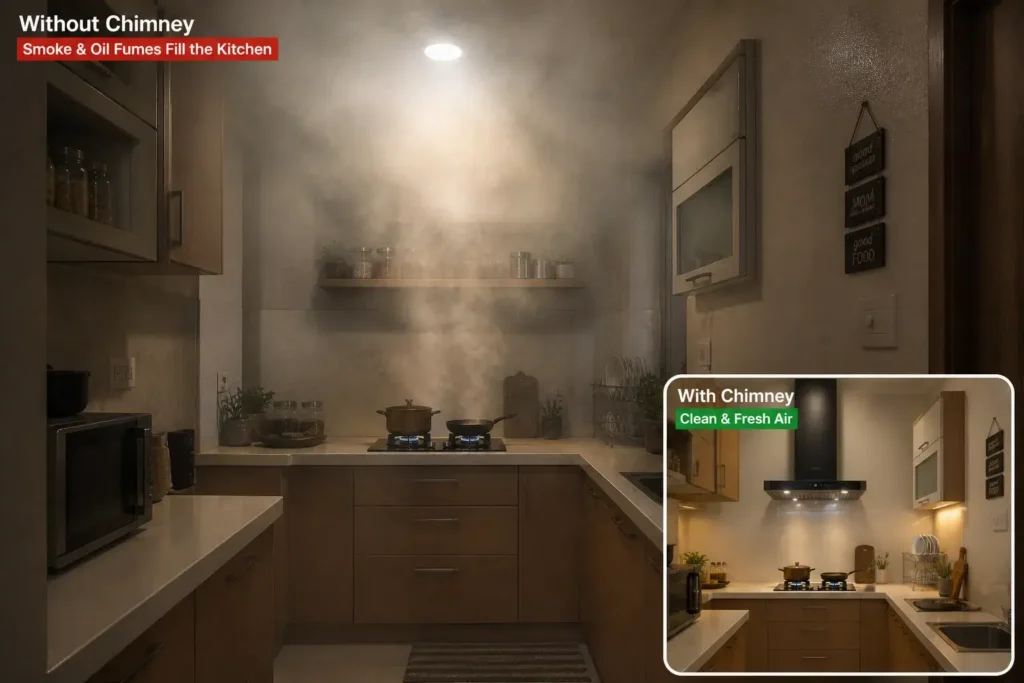
Here is the honest answer: if you cook Indian food regularly, especially anything involving deep frying, tadka, or grilling, then yes, a kitchen chimney is genuinely useful and not just a style statement.
For light cooking like boiling, steaming, or cooking in water-based gravies, the immediate need is lower. But even then, kitchen odor removal and general kitchen ventilation are reasons enough to consider one.
It is particularly necessary in:
- Closed kitchens with no windows or poor airflow
- Compact apartments where cooking smells spread quickly to other rooms
- Homes with health concerns like asthma or respiratory conditions
- Modular kitchens where protecting cabinet and surface finishes matters
For a small kitchen, a 60 cm chimney with 800-1000 m3/hr suction capacity is usually sufficient. For larger kitchens or high-frequency cooking, 90 cm models with 1200+ m3/hr work better.
Kitchen Chimney Installation and Maintenance Tips
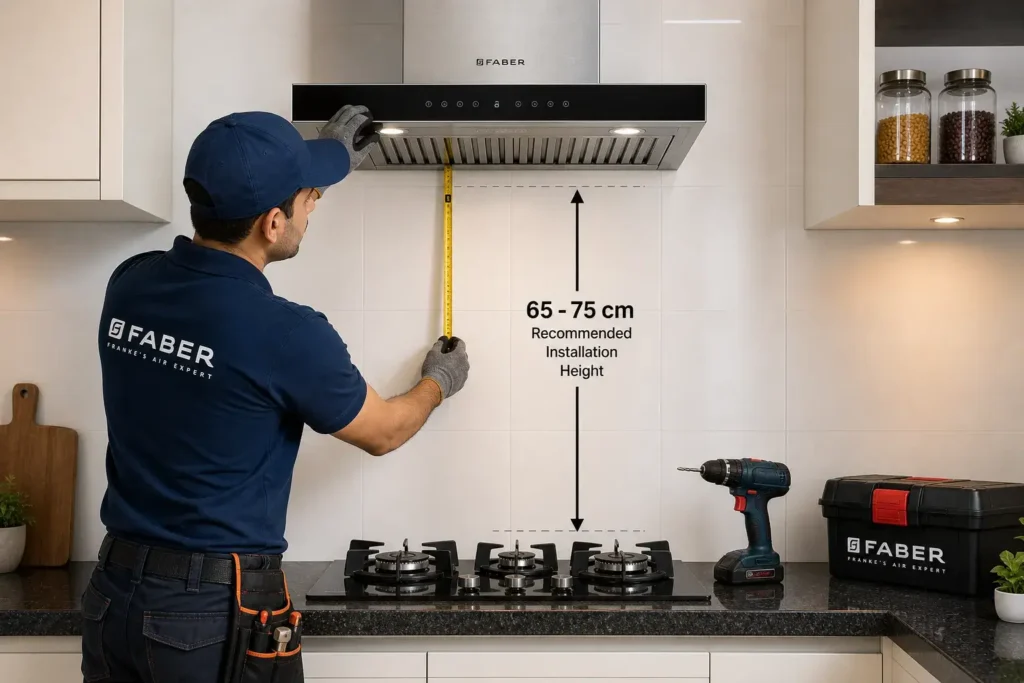
Getting the installation right directly affects performance. A few things to keep in mind:
Correct chimney installation height: The ideal placement is 65 to 75 cm above a gas stove and 55 to 65 cm above an electric hob. Too high and it loses suction efficiency. Too low and it becomes a safety issue.
Duct length matters: Shorter duct runs mean better performance. If your duct run is more than 2 to 3 meters, each additional meter reduces effective suction.
Regular maintenance schedule:
- Clean baffle filters every 2 to 4 weeks, depending on cooking frequency
- Check motor blades every 6 months
- Service the motor annually
- Replace carbon filters (ductless models) every 3 to 6 months
Chimney lifespan: A well-maintained kitchen chimney lasts 8 to 12 years. Look for models with at least a 1-year comprehensive warranty and check for brand service networks in your city.
Kitchen Chimney Noise Levels: What to Expect
Noise is one of the most common complaints people have after buying a chimney, and it is worth checking before you buy rather than after. Chimney noise is rated in decibels (dB), and here is roughly what the range means in practice:
- Below 58 dB: Considered quiet, comparable to normal conversation. Good for daily use.
- 58 to 65 dB: The range most standard chimneys fall into on medium-high speed. Noticeable but tolerable.
- Above 65 dB: Loud enough to disrupt conversation. Usually a sign of an underpowered motor working too hard, poor duct design, or a chimney that is undersized for the kitchen.
Ducted chimneys are generally quieter than ductless ones, since ductless models rely on more internal recirculation. If noise matters to you, look specifically for a BLDC (brushless DC) motor and check the manufacturer’s dB rating at maximum speed, not just the average, since that is when most chimneys are actually loud.
Kitchen Chimney Safety: Reducing Fire Risk
This is a part of chimney ownership that does not get discussed enough. Grease is flammable, and a chimney filter clogged with built-up oil is a genuine fire hazard, not just a cleaning inconvenience.
A few safety habits worth building in:
- Never skip filter cleaning schedules. A grease-caked baffle filter is far more likely to catch fire near an open flame than a clean one.
- Empty the auto-clean oil collection cup regularly. A full tray defeats the safety purpose of the auto-clean feature.
- Keep the installation height correct (65 to 75 cm above a gas stove). Too low, and the hood sits close enough to flames to be risky.
- Never leave hot oil unattended, chimney or not. A running chimney reduces smoke, but it does not prevent a pan fire.
- If a grease fire does start, turn off the flame, cover the pan with a metal lid or baking sheet to cut off oxygen, and never use water on burning oil. Keep a fire extinguisher rated for kitchen (Class K/F) fires within reach if possible.
A well-maintained chimney is a safety feature. A neglected one, ironically, can become part of the risk.
People Also Ask (FAQ)
1. What is the use of kitchen chimney in daily cooking?
The use of kitchen chimney in daily cooking is to pull away smoke, cooking fumes, grease particles, steam, and odors from directly above your stove before they spread around the room. It keeps the kitchen cleaner, protects walls and cabinets from grease buildup, and makes the cooking environment more breathable.
2. What is the use of chimney in kitchen compared to an exhaust fan?
A kitchen chimney captures smoke at the source, right above the stove, and traps grease through filters. An exhaust fan draws general room air and has no grease-trapping mechanism. For Indian cooking involving frying and tadka, a chimney is significantly more effective.
3. Does kitchen chimney improve air quality?
Yes. A kitchen chimney ventilation system removes smoke, cooking fumes, steam, and in ductless models with carbon filters, also neutralizes odors. This directly improves indoor air quality in the kitchen and reduces long-term exposure to combustion gases from gas stoves.
4. Is kitchen chimney necessary for small kitchens?
Especially yes. In a small kitchen with limited windows, smoke and grease have nowhere to go. A kitchen chimney for small kitchen with 60 cm width and 800 m3/hr suction power is enough to manage ventilation and prevent grease buildup on surfaces.
5. How does a ducted kitchen chimney work?
A ducted kitchen chimney draws contaminated air through the hood, passes it through a baffle filter that traps oil particles, and then expels the filtered air outside through a chimney duct pipe. It physically removes polluted air from the home, making it more effective than recirculation models.
6. How often should I clean my kitchen chimney filter?
For regular Indian cooking, clean baffle filters every 2 to 4 weeks by washing them with warm soapy water. If you use a ductless chimney with a carbon filter, replace the carbon filter every 3 to 6 months. Auto-clean models need less frequent manual cleaning, roughly every 2 months.
7. What suction power should I look for in a kitchen chimney?
For light cooking: 600-800 m3/hr is sufficient. For regular Indian cooking with frying and tadka: 900-1000 m3/hr, and for large kitchens or frequent heavy cooking: 1200 m3/hr or more. Always match chimney suction capacity to your actual cooking habits.
8. What are the health benefits of kitchen chimney?
The kitchen chimney for health reduces your exposure to cooking smoke, fine particles from frying, and nitrogen dioxide from gas combustion. Regular inhalation of these can irritate the respiratory system over time. A proper chimney ventilation system keeps the kitchen air cleaner during and after cooking.
9. What is the correct height to install a kitchen chimney?
The standard chimney installation height is 65 to 75 cm above a gas stove. For electric hobs, 55 to 65 cm is recommended. Installing at the correct height ensures maximum chimney suction efficiency without being a safety risk.
10. Can a kitchen chimney be used in a rented apartment?
Yes, but you may need to go with a ductless chimney system if drilling through walls for ducting is not permitted. Ductless models recirculate filtered air back into the kitchen. They work well for light to moderate cooking and require carbon filter replacement every few months.
11. How loud is a kitchen chimney?
Most quality kitchen chimneys operate between 45 and 65 dB depending on fan speed. Anything below 58 dB is considered quiet. Ducted models with BLDC motors are typically quieter than ductless ones, especially at high suction settings.
12. Is a dirty kitchen chimney a fire hazard?
Yes. Grease is flammable, and a filter clogged with built-up oil sits directly above an open flame. Regular filter cleaning and emptying the oil collection tray are not just maintenance tasks, they are basic fire-safety steps for anyone using a chimney.
Sources & Further Reading
This guide draws on hands-on experience running a kitchen chimney daily, along with public health and industry guidance, including the World Health Organization’s research on household air pollution and manufacturer technical guidance on chimney ventilation and filtration. Product specifications (suction capacity, dB ratings, filter types) are cross-checked against current listings from major Indian chimney brands rather than assumed.
Conclusion

The use of kitchen chimney is not just about appearances or modern home design. It is a practical solution to a real problem that every Indian kitchen faces: smoke, grease, odors, heat, and indoor air quality.
From protecting your tiles and cabinets from sticky oil deposits to giving you cleaner air while cooking, the kitchen chimney benefits are concrete and long-lasting. Whether you cook lightly or go all-in with daily tadka and frying sessions, a well-chosen chimney makes the experience more comfortable and your kitchen easier to maintain.
If you have been putting off the decision, consider your cooking frequency, kitchen size, and whether you want a ducted kitchen chimney or a ductless chimney system. Match the chimney suction power to your needs, and you will not regret it.
Have questions about which chimney to pick for your kitchen setup? Drop them in the comments and share your experience if you already have one installed. What difference has it made for you?